













Have you ever wondered how experienced traders always make the right decisions in the face of complex fluctuations in the financial market? Their secret may lie in using an extremely powerful market reading tool, the Ichimoku Cloud.
What is the Ichimoku Cloud?

Invented by Japanese journalist Goichi Hosoda in the 1930s, Ichimoku Cloud (also known as Ichimoku Kinko Hyo) has long been considered a “treasure map” for investors. Ichimoku Cloud provides a comprehensive view of the market, including:
- Trend: Ichimoku Cloud helps assess whether the market is going up or down, thereby making appropriate trading decisions.
- Support and resistance levels: The lines and clouds in Ichimoku Cloud are strong psychological barriers for investors, helping to identify price zones where prices are likely to stop and bounce back.
- Momentum: Ichimoku Cloud helps measure the strength of a trend, thereby helping investors capture highly profitable trading opportunities.
- Trading Signals: Crossovers and breakouts of lines in Ichimoku Cloud provide clear trading signals, helping investors make accurate buying and selling decisions.
See now:
- Guide Step By Step How To Become A Successful Trader
- The 5 Best Momentum Indicators to Analyze Trend Strength
- Top 7 Best Volatility Indicators in the Market Updated 2024
Highlights of Ichimoku Cloud

- Comprehensive: Ichimoku Cloud combines various technical elements, providing a comprehensive picture of the market.
- Easy to use: Although it may seem complicated, Ichimoku Cloud is very easy to use and can be applied to all types of markets, from stocks to forex.
- Effective: Over the years of use, Ichimoku Cloud has proven to be effective in predicting trends and finding trading opportunities.
Meaning of Ichimoku indicator
- Ichimoku is an extremely useful tool for investors who want to:
- Understand market trends: Thanks to Ichimoku, you can easily recognize whether the market is going up or down.
- Determine buying and selling points: Ichimoku provides clear signals on when to buy or sell.
- Minimize risk: When combining Ichimoku with other tools, you can make safer investment decisions.
Components of the Cloud
Ichimoku Cloud consists of 5 main components, each line in Ichimoku Cloud has its own meaning:
- Tenkan-sen: Conversion line, indicating short-term changes in trend.
- Kijun-sen: Base line, showing medium-term trend. When the conversion line and the base line intersect, it can be a sign that the market is able to change.
- Chikou Span: Lagging line, helping to confirm the current price trend.
- Senkou Span A and B: These two lines form the “cloud”, the color and position of the cloud indicate potential support and resistance levels in the future.

The Formulas for the Ichimoku Cloud
You can think of Ichimoku Cloud as a “weather forecaster” of market trends. Each line on this map provides important information, calculated based on the highs, lows, and closes of a number of previous trading periods:
Tenkan-sen (Conversion Line):
- Formula: (9-period High + 9-period Low) / 2
Kijun-sen (Base Line):
- Formula: (26-period High + 26-period Low) / 2
Senkou Span A:
- Formula: (Tenkan-sen + Kijun-sen) / 2
Senkou Span B:
- Formula: (52-period High + 52-period Low) / 2
Chikou Span (Lagging Line):
- Formula: The current closing price plotted 26 periods back.
Explanation of the symbols
- 9-period High: The highest price over the last 9 trading periods.
- 9-period low: The lowest price in the last 9 trading periods.
- 26-period high: The highest price in the last 26 trading periods.
- 26-period low: The lowest price in the last 26 trading periods.
- 52-period high: The highest price in the last 52 trading periods.
- 52-period low: The lowest price in the last 52 trading periods.
Simple Ichimoku Cloud Analysis
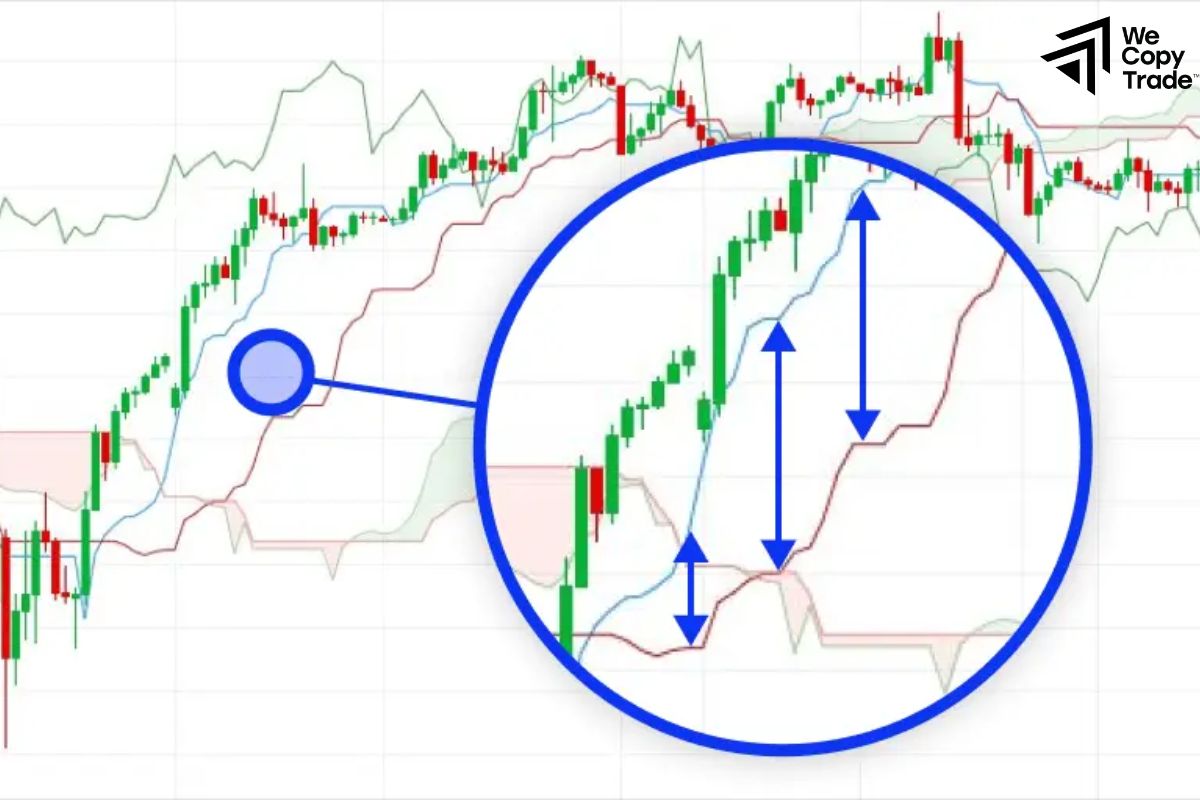
As mentioned in the previous section, the two Senkou Span A and B lines are the main elements that create the cloud. Through color, the Ichimoku cloud helps forecast the weather for the stock market.
Green shows the possibility of the market rising. On the contrary, red shows the possibility of the market falling. In addition, we also rely on the position of the price relative to the cloud to determine the price trend. If the price is above the cloud, the market is in an uptrend. On the contrary, if the price is below the cloud, the market is in a downtrend.
In addition, some traders use the Chikou span to identify possible trend reversals by observing its intersection.
Ichimoku Cloud Signals
In addition to predicting the price trend of the market based on comparing the position of the price and the cloud, they also give us signals about the possibility of the market rebounding when the price touches the support point.
The conversion line and the baseline are the two most important lines in Ichimoku Cloud. When these two lines intersect, it is a signal that the market trend is changing. When the conversion line crosses above the baseline, and the price is also going up above both of these lines, we can be more confident about the uptrend. On the contrary, when the conversion line crosses below the baseline, it is a warning signal that the market may be turning to a downtrend.
Ichimoku not only helps us determine the trend but also helps us decide when to exit a trade. When the trend lines are increasing in a certain direction, it is a signal that we can hold our position. But if the trend lines change direction, we need to consider exiting to protect profits or minimize losses.
How to draw the Ichimoku cloud
To create a complete Ichimoku Cloud, we need to understand each of the lines that make it up. The first and most important lines are Tenkan-sen (conversion line) and Kijun-sen (base line).
Tenkan-sen represents the average price of the last 9 periods (short-term trend). Kijun-sen reflects the average price of 26 periods (long-term trend).
The Ichimoku Cloud is formed by two lines: Senkou Span A and Senkou Span B.
- Senkou Span A: Is the moving average of Tenkan-sen and Kijun-sen, representing the medium-term trend.
- Senkou Span B: Is the MA of the highest and lowest highs over the past 52 periods, showing the longer-term trend.
Chikou Span is the current closing price plotted 26 periods back. This line helps confirm the trend and warns of potential changes.
The Difference Between the Ichimoku Cloud and Moving Averages
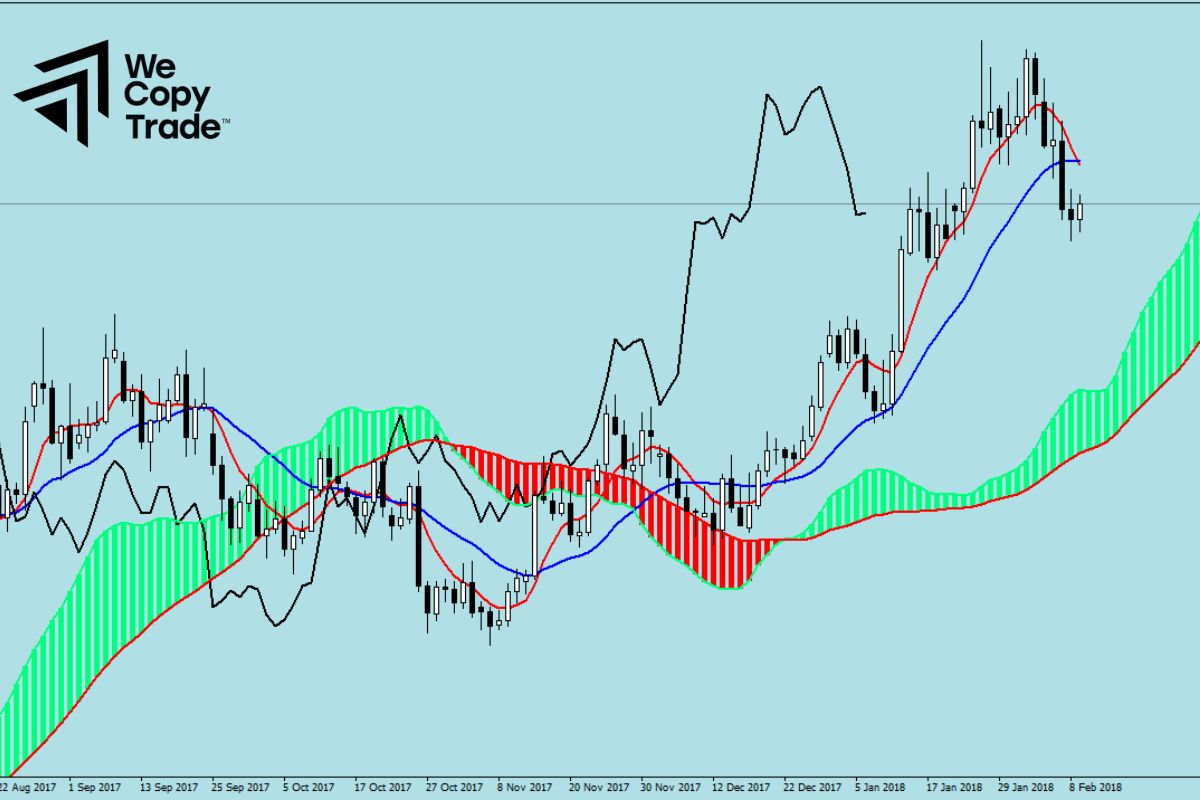
Both the Ichimoku Cloud and moving averages are great aids in technical analysis , but they work in different ways.
- The moving average focuses on the closing price of a given period. It gives us an overview of the average price trend over the past.
- The Ichimoku Cloud takes a more comprehensive approach. It not only looks at the closing price but also takes into account the highs and lows over a given period. This helps the Ichimoku Cloud provide a more complete picture of price action and identify potential support and resistance areas.
Conclusion
In Conclusion, after this article I believe you have a firm grasp of how Ichimoku Cloud works and confidence in successfully applying it to your technical analysis.
See more: