












Have you ever heard of the pairs trade ? It is considered one of the smart and promising investment strategies. However, this strategy requires you to have a certain knowledge base. Don’t miss the following article, I will help you systematize the knowledge you need to know about this term right away. Let’s go!
What Is Pairs Trade?
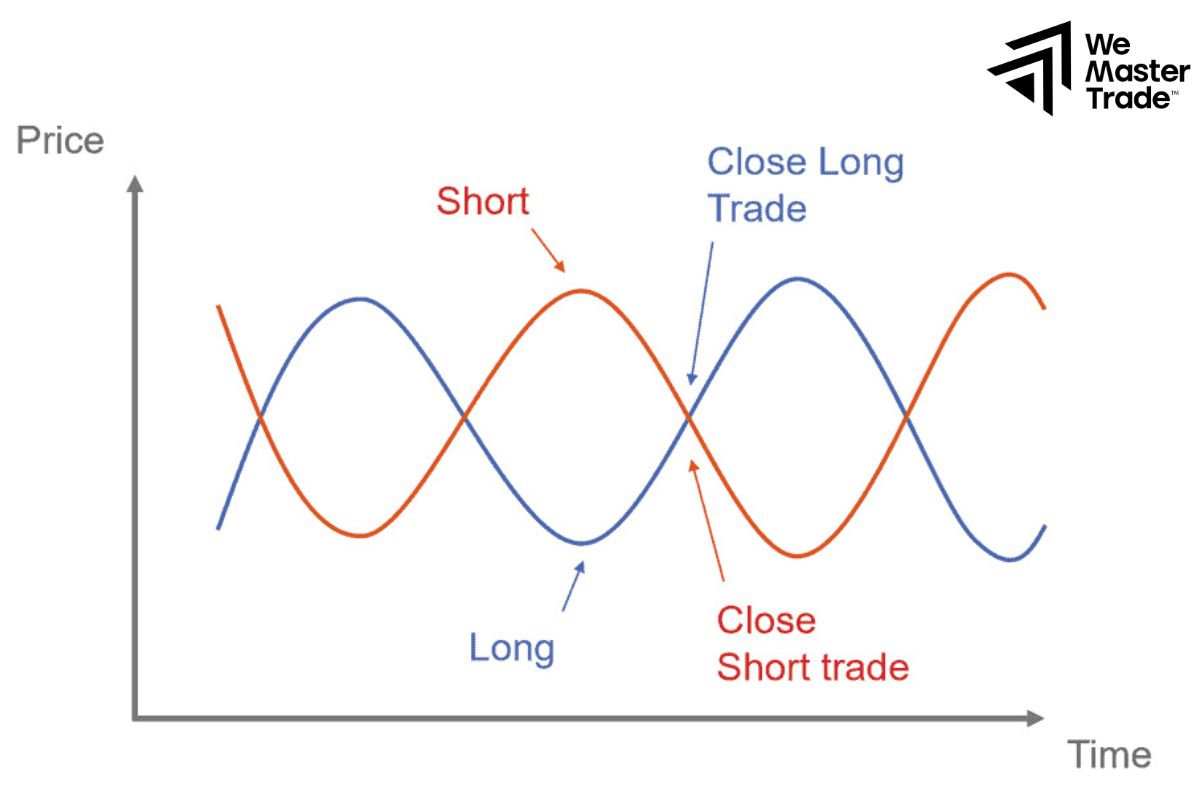
Pairs trade is a complex but attractive investment strategy. Instead of focusing on just one stock, investors will compare and trade two stocks that are closely related to each other. These two stocks often move together at a certain rate. When the price of one of the two stocks suddenly changes compared to the other, investors will take advantage of this opportunity to make a profit.

Suppose you notice that two car manufacturers A and B always have stock prices that go hand in hand. If one day, the stock price of company A increases more than that of company B, you can:
- Buy stock B: Because you predict that the price of stock B will increase to catch up with the price of company A.
- Short sell stock A: You will sell stock A that you do not own in the hope of buying it back later at a cheaper price when the price decreases.
See now:
- Grasp Top Sentiment Indicators For Your Best Trading
- List of Top Reliable Safe Haven For Beginning Traders
- Distinguish Debt vs. Deficit To Make Best Trading Decision
- Apply The Yield Curve Effectively for Successful Trading
Advantages and Disadvantages of Pairs Trade
Pairs trade is a promising investment strategy but also has many potential risks. Here are the opportunities and challenges that this strategy brings, you can refer to learn and gain more experience for yourself:
Advantages
When you buy one stock and short another stock in a pair, you are betting on the price difference between the two stocks, not on the overall market direction. This helps reduce risk when the market is volatile.

When the prices of the two stocks in the pair start to diverge, you have the opportunity to profit by buying the undervalued stock and shorting the overvalued stock.
You don’t have to guess whether the market will go up or down, just focus on the relationship between the two stocks.
Disadvantages
Although pairs trade is an attractive and promising strategy, it is not a perfect strategy. Like any other form of investment, it comes with certain risks and limitations.
- The success of pairs trade depends largely on the relationship between the two assets. If this relationship changes, your strategy may no longer be effective. Unfortunately, the relationship between assets can change unexpectedly due to many factors such as policy changes, unexpected events or the emergence of new products.

- Pairs trade is based on historical data analysis. However, the past does not always repeat the future. This means that even though you have found a pair that has a strong relationship in the past, it does not mean that it will continue to be close in the future.
- To trade pairs effectively, you need to have a thorough knowledge of the market, technical analysis and statistics. Additionally, you also need to spend a lot of time researching and monitoring your trading pairs.
How to identify pairs trades
To identify pairs trade, investors will compare and trade on two stocks that are closely related to each other. Specifically, Traders will create a ratio by dividing the price of one stock by the price of the other stock. This ratio will tell us how the two stocks are moving relative to each other.
Bollinger Bands are a technical tool that helps us determine when the price is high or low compared to the average.
- Identify the pair: In pairs trade, choosing the right pair to trade is considered the most important stepping stone to the success of your investment strategy. First, choose two stocks that are closely related to each other, for example two companies in the same industry, two products that are substitutes for each other.
- If the correlation coefficient is close to 1: It means that the two stocks move almost the same. For example, when stock A increases, stock B also increases.
- If the correlation coefficient is close to -1: It means that the two stocks move in opposite directions. When stock A increases, stock B tends to decrease.
- If the correlation coefficient is close to 0: It means that the two stocks have no clear relationship with each other.
Typically, traders will look for two stocks with a correlation coefficient of 0.8 or higher. This means that the two stocks move very closely together. Typically, investors will focus on pairs of stocks that are in the same industry, the same product, or have a close business relationship.
- Calculate the ratio: Calculate the price ratio between two stocks.
- Chart: Plot this ratio and add Bollinger bands to the chart.
- Identify trading signals:
When the ratio touches the upper band: It can be a signal to sell high-priced stocks and buy low-priced stocks.
When the ratio touches the lower band: It can be a signal to buy high-priced stocks and sell low-priced stocks.
Pairs Trade Strategy Example
Gold and Silver Pairs Trade Example:
Suppose you decide to invest in gold and silver in a special way: you buy gold and sell silver at the same time. This is called a pairs trade. Your profit will depend on how the prices of gold and silver change relative to each other.

Let’s consider the following scenarios:
- Gold and silver both rise or fall by the same percentage: If both rise by 10%, the profit from buying gold will be “cancelled” by the loss from selling silver. Similarly, if both fall by 10%, the loss from buying gold will be offset by the profit from selling silver. In other words, you will neither make nor lose money.
- Gold and silver rise or fall at different percentages:
- Gold rises more than silver: If gold rises by 10% and silver only rises by 8%, you will make a profit. Because the profit from buying gold will be greater than the loss from selling silver.
- Gold goes up less than silver: Conversely, if gold goes up 8% and silver goes up 10%, you will lose money. Because the profit from buying gold is not enough to offset the loss from selling silver.
- Both down: if gold goes down less than silver, you will make a profit, but if gold goes down more than silver, you will lose money.
- Both up: Similarly, if both gold and silver go up, you can still make a profit if gold goes up more than silver.
Conclusion
In conclusion, pairs trade is an attractive and promising investment strategy, but it also requires a lot of skills, experience and cannot avoid potential risks in the face of unexpected market fluctuations. To maximize the effectiveness of this strategy, please research and prepare carefully for your strategy. Good luck!
See more: