













Market structure is essential to understanding how businesses compete and operate in their industry. Whether you are a business owner, an investor, or simply curious about how markets work, understanding market structures will help you make smarter decisions and strategies. So, let’s update now to better understand the types of structures in the market through this article!
What is Market Structure?
Market structure describes how a market is organized based on the level of competition and the interactions between firms. It influences how businesses set prices, compete with each other, and respond to consumer demands.
Besides, by examining the market structure, we can understand how different factors, such as the number of competitors and the degree of product differentiation, affect overall market dynamics. This understanding helps businesses strategize more effectively and makes it easier to predict market trends and consumer behavior.
See now:
- The most effective way to master a live account in stocks
- What is a Demo Account? How to Choose an Account in Forex
- Instructions how to use the Economic Calendar updated daily
- What is a Central Bank? Its role in the economy 2024
4 types of Market Structure and examples?
Market structures can be classified into different types, each with unique characteristics and examples. Here’s an overview:
Monopoly Market structures
- A market structure where a single company dominates the entire market, with no close substitutes for its product or service. This firm has significant control over prices and market conditions.
- Example: Utility companies such as water or electricity providers in some regions, where one company serves the entire area due to high infrastructure costs and regulatory barriers.
Oligopoly Market structures
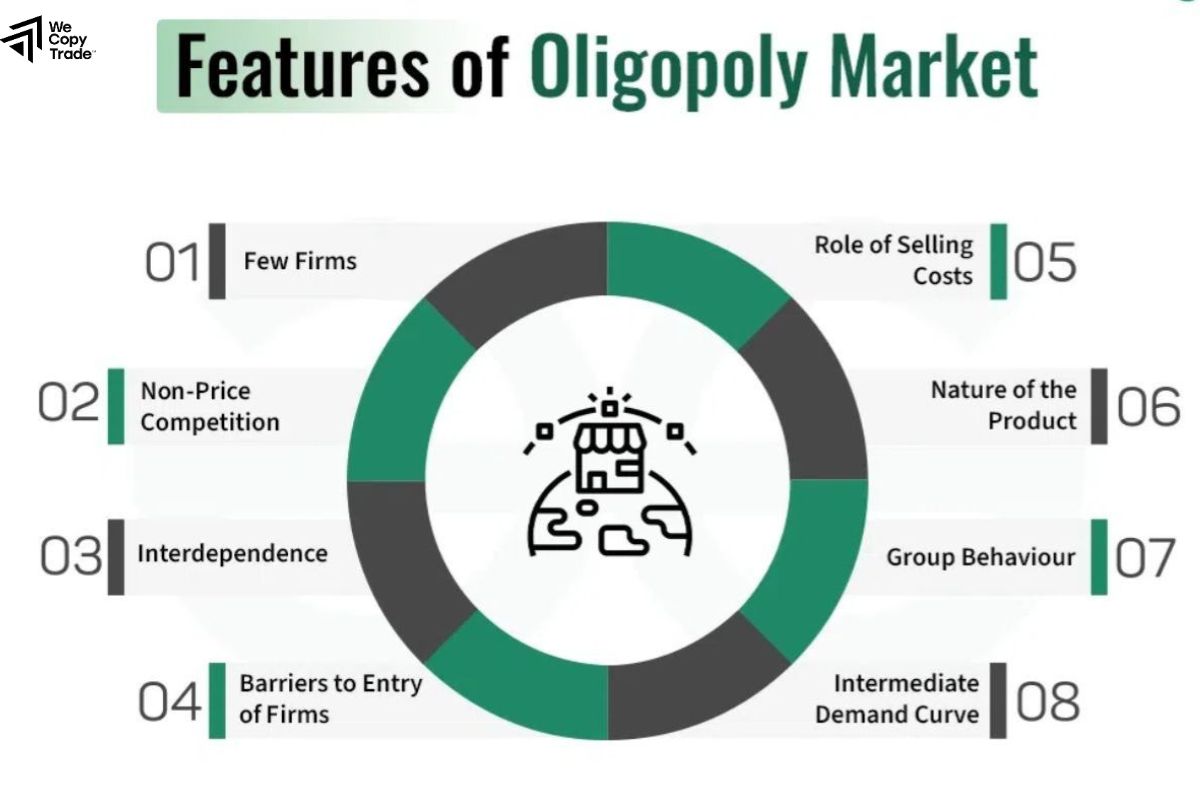
- A market structure characterized by a small number of large firms that have significant control over market prices and can influence each other’s decisions. Firms in an oligopoly often engage in competitive strategies and may collude to control prices.
- Example: The telecommunications industry, where a few major companies dominate the market, such as Verizon, AT&T, and T-Mobile in the United States.
Perfect Competition
- A theoretical market structure where many firms sell identical products, and no single firm can influence the market price. There are no barriers to entry or exit, and consumers have perfect information about prices and products.
- Example: Agricultural markets where many farmers sell identical crops, such as wheat or corn, and no single farmer can affect the market price.
Monopolistic Competition
- A market structure where many firms sell products that are similar but not identical. Each firm has some degree of pricing power due to product differentiation, and there are relatively low barriers to entry.
- Example: The restaurant industry, where many establishments offer similar types of food but with variations in cuisine, ambiance, and service, giving each restaurant a unique appeal to different customer segments.
Comparative Analysis of Market Structures

Here is the expanded comparison table of Market Structure:
| Characteristic | Monopoly | Oligopoly | Perfect Competition | Monopolistic Competition |
| Number of Firms | Only one firm dominates the entire market. | A few large firms dominate the market. | Many firms operate independently with no influence on each other. | Many firms offer similar but differentiated products. |
| Product Differentiation | The product or service is unique, with no close substitutes available. | Products may be homogeneous or differentiated depending on the industry. | Products are homogeneous and identical across all suppliers. | Products are differentiated through branding or features. |
| Barriers to Entry | High barriers to entry, such as high startup costs or strict regulations. | Moderate to high barriers, including economies of scale and strong brand loyalty. | Low or no barriers to entry, allowing easy entry and exit. | Relatively low barriers, but firms need to invest in product differentiation and market presence. |
| Pricing Power | The firm has significant control over pricing and can set prices to maximize profits. | Firms have some pricing power, influenced by the actions of other firms. Prices may be stable or subject to competitive pressures. | Firms are price takers, accepting the market price as given without influencing it. | Firms have some control over prices due to product differentiation, but competition limits this power. |
| Market Information | Limited market information due to the presence of only one provider. | Information may be somewhat transparent but can be strategically managed by firms. | Complete transparency with full information available to both consumers and firms. | Market information is reasonably accessible, but variations in product attributes can affect consumer knowledge. |
How to draw market structure
Drawing market structure typically involves creating visual representations to illustrate the key features and dynamics of each type. Here’s a guide on how to draw and represent different market structures:
For Monopoly
Diagram
- Demand Curve (D): Downward sloping.
- Marginal Revenue (MR): Below D.
- Marginal Cost (MC): Upward sloping, intersects MR.
Price & Quantity: Set where MC intersects MR.
For Oligopoly
Diagram:
- Kinked Demand Curve: Steep above the kink (inelastic) and flatter below (elastic).
- Marginal Revenue (MR): Discontinuous at the kink.
Price & Output: Reflects different elasticities around the kink.
For Perfect Competition
Diagram:
- Demand Curve (D) or Average Revenue (AR): Horizontal.
- Marginal Cost (MC): Upward sloping, intersects AR.
Price & Quantity: Determine where MC intersects AR.
For Monopolistic Competition
Diagram:
- Demand Curve (D): Downward sloping.
- Marginal Revenue (MR): Below D.
- Marginal Cost (MC): Upward sloping, intersects MR.
Price & Quantity: Determine where MC intersects MR.
Conclusion
In conclusion, understanding market structure helps you better navigate your industry. Whether you’re dealing with a monopoly, oligopoly, perfect competition, or monopolistic competition, each structure impacts how businesses compete, set prices, and enter the market. So, understand these differences so you can make smarter decisions, stay competitive, and find success in your market.