












In the world of forex, there are two concepts that always go together: liquidity and volatility. Forex market liquidity is the factor that determines the ability to execute orders quickly at a stable price. Meanwhile, volatility reflects the level of price fluctuations over time.
This article will give you a clear, easy-to-understand view of forex market liquidity, and analyze the factors that affect it and its importance to daily trading activities.
What is forex market liquidity?
Liquidity in finance is simply understood as the ability to buy and sell an asset without significantly changing its price. When it comes to forex market liquidity, we are talking about the ability to convert currency pairs into cash or into other currencies easily, quickly and with little spread.

The forex market is considered the most liquid market in the world, with a daily trading volume of over $7 trillion. This is because:
- Forex operates 24 hours a day, 5 days a week, allowing global traders to participate continuously.
- A wide range of participants include central banks, financial institutions, hedge funds and individual traders.
- The huge trading volume, especially concentrated in major currency pairs such as EUR/USD, GBP/USD or USD/JPY.
As a result, the forex market rarely falls into a state of “no buyers or sellers”.
See now:
- Prop Firm Trading Techniques: From Basic to Advanced
- Qualifying for a Prop Firm: All the Skills You Need
- What is Exchange Rate? A Comprehensive Guide for Traders
Why is liquidity important in forex?
Liquidity is not only a measure of market activity, but also directly affects trading costs and the trader’s experience.
- Lower bid-ask spreads: When liquidity is high, the spread between the bid and ask prices is usually very small. This saves traders money when entering and exiting trades.
- Fast order execution: With high trading volume, buy or sell orders are almost immediately executed at the desired price.
- More stable price fluctuations: Markets with high liquidity often avoid large fluctuations caused by a large order. Prices will be less likely to “jump” unexpectedly.
- Limit slippage: In a highly liquid market, the possibility of orders being filled at a less favorable price is minimized.
Conversely, when liquidity is low, spreads can widen, prices fluctuate strongly, and traders face more risks.
The Relationship Between Liquidity and Volatility

Liquidity and volatility are two sides of the same coin.
- When liquidity is high: Prices tend to move within a narrower range because many buy and sell orders are balanced.
- When liquidity is low: Prices are easily affected by a few large orders, leading to strong and unpredictable fluctuations.
For example, during the European and US trading sessions, forex market liquidity is usually the highest due to the large participation from financial centers. Conversely, on weekends or major holidays, liquidity is lower and price movements can become erratic.
Factors affecting forex market liquidity
Trading hours of financial centers
Forex operates continuously but liquidity levels vary by time frame. When London and New York are operating at the same time, trading volume increases sharply, bringing abundant liquidity.
Currency pair type
Major pairs such as EUR/USD, GBP/USD, USD/JPY usually have the highest liquidity.
Cross pairs or exotic pairs have lower liquidity, leading to larger spreads and higher volatility.
Economic and political events
Important news such as interest rate announcements, employment reports, or geopolitical events can cause sudden changes in liquidity. Prices often fluctuate sharply before and after news releases, even beyond normal liquidity levels.
Involvement of large institutions
Trading activities from central banks, hedge funds, and global financial institutions significantly affect liquidity flows. Large volume orders can temporarily boost or reduce liquidity.
How to recognize forex market liquidity?
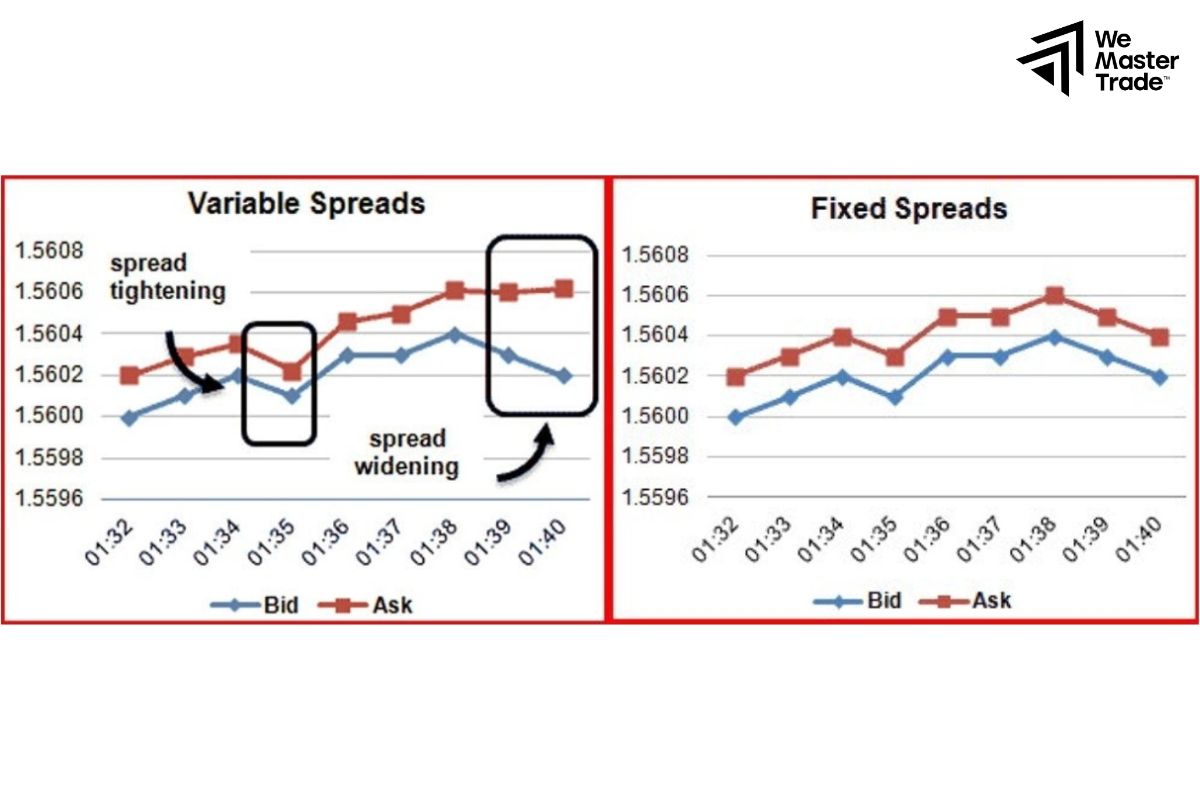
To assess forex market liquidity, traders can rely on some of the following basic signs:
- Monitor the spread (buy-sell price difference):
The smaller the spread, the more buyers and sellers there are in the market, which means high liquidity. On the contrary, when the spread widens, it shows low liquidity and transaction costs may increase. - Observe the trading volume:
On many platforms, you can monitor the volume of orders executed. The larger the volume, the more active the market, indicating strong liquidity. - Consider the time of day:
Liquidity varies by time frame. Typically, the period when major sessions such as London and New York open together is when liquidity is strongest, while weekends or Asian sessions are often less active. - Combined with economic news:
Major events such as interest rate announcements, employment reports, or important political-economic news can cause liquidity to fluctuate strongly in the short term. When there is big news, volume and volatility often increase.
Conclusion
In short, forex market liquidity is one of the most important factors that determine the stability and efficiency of trading. Understanding the relationship between liquidity and volatility, as well as the factors that affect liquidity, will help traders have a more comprehensive view of the forex market.
See also: