











US election financial markets rarely wait for the final vote count before reacting. Traders usually reprice policy expectations, sector winners, and volatility well before election night, especially when the result could shift taxes, regulation, fiscal spending, or rate expectations.
That does not mean the market follows one fixed script. Inflation, earnings, central bank policy, and existing positioning still matter. For a trader, the better question is not just who wins, but how to prepare for a fast change in conditions.
This guide is educational only. It does not provide personal financial advice or guarantee trading results, challenge outcomes, funded status, rewards, or payouts.
Why US elections move financial markets
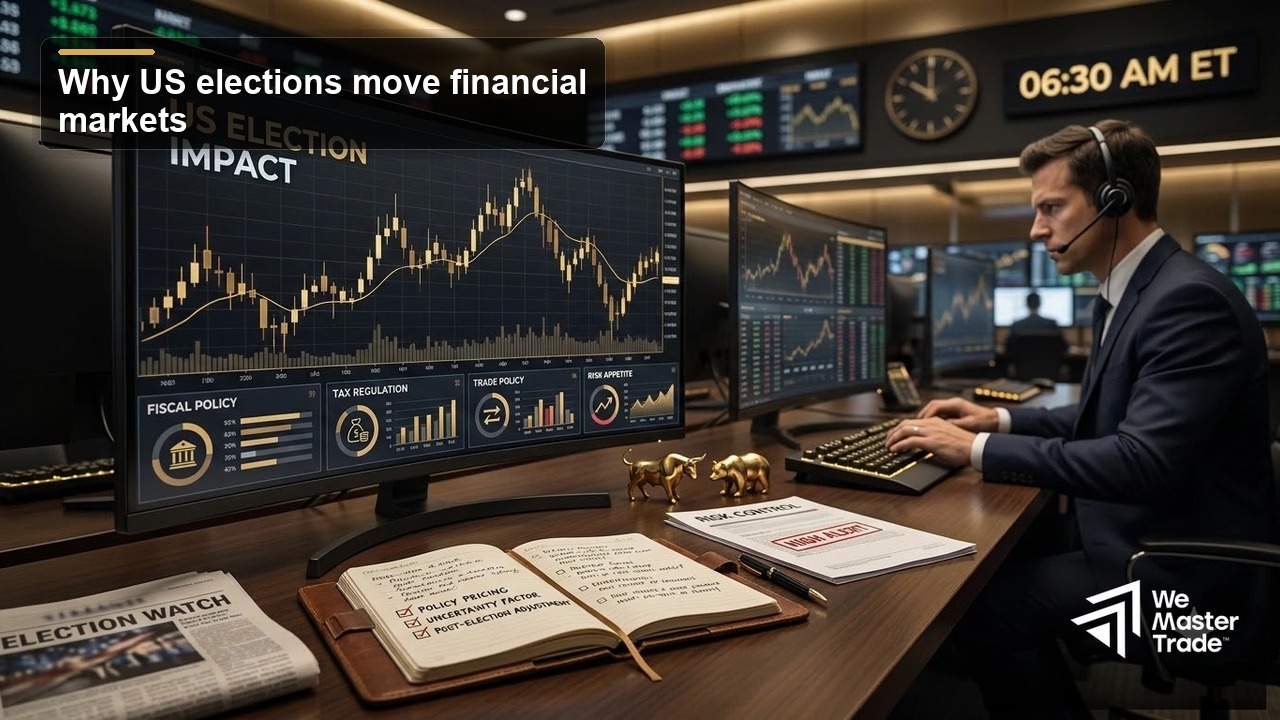
Elections matter because investors try to price policy before it actually arrives. That usually means more attention on fiscal policy, tax ideas, regulation, trade policy, and risk appetite.
The market also reacts to uncertainty itself. Even when investors are not sure which candidate will win, they may still adjust positions because the range of possible outcomes is wider than usual.
Central bank expectations can amplify that move. When election headlines meet rate uncertainty, the reaction can become more erratic, which is why the article on Central Banks and Financial Markets is a useful companion.
What usually reacts first
| Market | Typical reaction | What traders should watch |
|---|---|---|
| US equities and indices | Fast volatility, sector rotation, gap risk | Financials, defense, energy, healthcare, tech, and broad index support or rejection |
| USD and major FX pairs | Choppy repricing around policy and rate expectations | Yield differentials, safe-haven flows, and risk sentiment |
| Treasury yields | Repricing as traders think through fiscal and inflation effects | The term structure, bond demand, and rate guidance |
| Gold and defensive assets | Possible risk-off flows when uncertainty rises | Real yields, volatility, and whether traders seek protection |
If you are focusing on index moves, the article on Trading US Indices Around News Events is the more practical next read.
What history suggests, and what it does not
Historical studies often show that election periods can bring higher short-term volatility, but they do not produce a simple one-direction result. Sometimes markets bounce on relief after clarity appears. Sometimes they stay choppy because policy details are still unclear.
That is the main trap for traders: turning a historical pattern into a guaranteed forecast. Past performance can explain context, but it cannot tell you the exact trade for the next election.
Live conditions can also feel very different from a clean historical chart. If you want to think about that gap between theory and execution, read Real Market Trading.
A trader’s checklist for election week
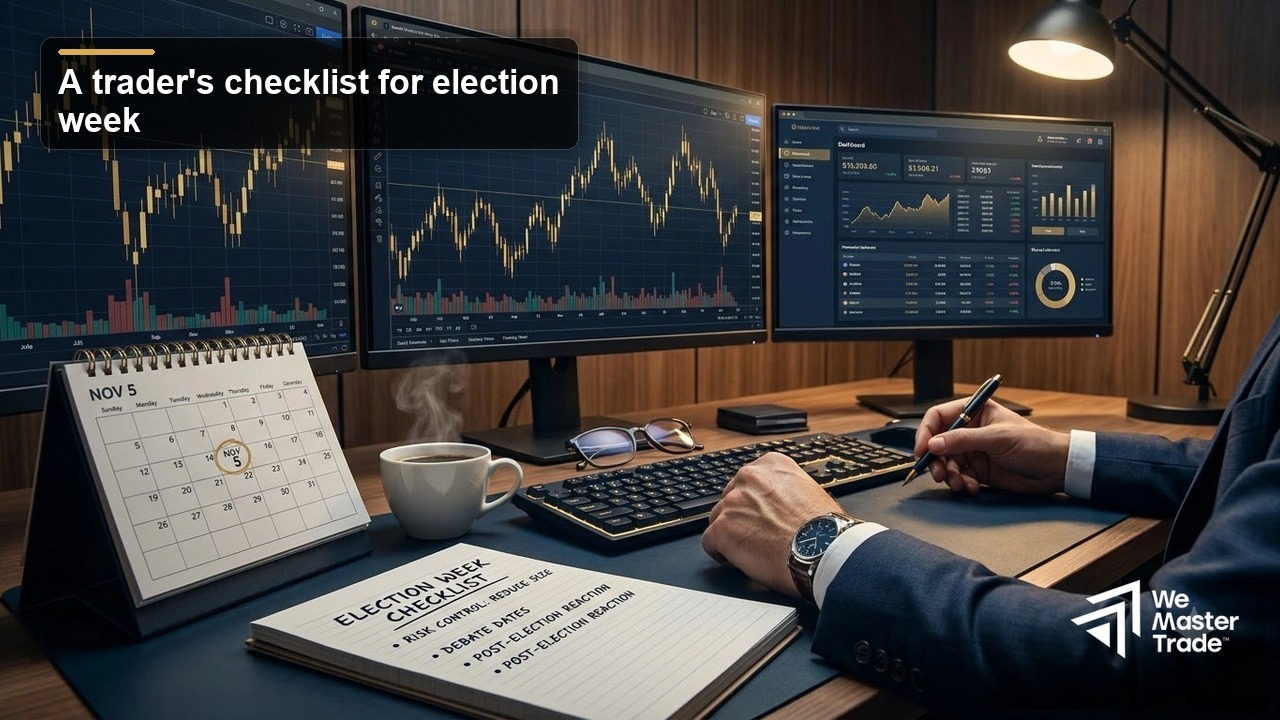
Before election week starts, make the plan before the noise starts.
- Mark the calendar for debates, polls, voting day, and post-election commentary.
- Decide in advance whether you will trade the event or wait for the reaction.
- Reduce size if the setup depends on a clean, orderly market.
- Check overnight holding risk, spread expansion, and news rules.
- Write down your invalidation level before the trade starts.
- Stop after the plan is complete; do not add size because headlines feel urgent.
When the market gets noisy
The worst election-week mistake is not being wrong. It is being oversized and unmanaged when the move becomes messy.
If your process is still loose, build the event plan into How to Build a Trading Strategy before you try to trade the headline itself.
If you trade through a prop firm
In a prop firm account, election week is not only a macro event. It is also a rules event.
Drawdown limits, consistency requirements, and news exposure can turn a small mistake into a large problem. That is why Risk Taking in Trading matters here: the issue is not whether the market moves, but whether your risk stays controlled while it does.
FAQ
Do US elections always move markets?
No. Elections can raise uncertainty and volatility, but the size and direction of the move depend on what the market already priced in, how close the race is, and what policy changes investors expect.
Which markets react most during election periods?
US indices, sector ETFs, Treasury yields, and major FX pairs often react first. Gold and other defensive assets can also see more interest when traders want protection.
Should traders avoid election day?
Not automatically. Some traders prefer to stay flat and wait for clarity, while others trade only if the setup is already defined. The right answer depends on your risk plan and your ability to handle spreads, slippage, and volatility.
Do central banks matter more than elections?
Often, yes. Markets can reprice around election headlines, but central bank expectations still shape rates, yields, and valuation. That is why election analysis should never ignore monetary policy.
Turn election headlines into a process
Election headlines are not a strategy. A written plan, a fixed risk limit, and a clear view of what you will do before the event matter more than predicting the result.
If you want a rule-based environment to practice around market events, start from the WeMasterTrade and compare the Trading Challenge or Instant Evaluation only after your risk plan is clear.