











The US trading session is the most powerful window in the forex market. It moves billions of dollars in volume daily, triggers the biggest price swings, and for prop firm traders — it can make or break your funded account in a single morning.
Whether you’re a scalper chasing quick pips or a swing trader waiting for confirmation, understanding how the New York session works gives you a real edge over traders who just follow generic timing advice.

What Is the US Trading Session?
The US trading session — also called the New York session — is one of three major forex trading windows alongside London and Tokyo. It runs when North American financial centers are open and US economic data hits the market.
US Session Hours (EST, GMT, and Key Timezones)
| Timezone | Open | Close |
|---|---|---|
| EST (New York) | 8:00 AM | 5:00 PM |
| GMT (London) | 1:00 PM | 10:00 PM |
| SGT (Singapore) | 9:00 PM | 6:00 AM |
| ICT (Bangkok) | 8:00 PM | 5:00 AM |
Note: Hours shift by one hour during US Daylight Saving Time (March–November).
Which Markets Are Active During the US Session?
The New York session doesn’t just cover forex. Multiple asset classes go live simultaneously:
- Forex — highest liquidity on USD pairs
- US Equities — NYSE and NASDAQ open at 9:30 AM EST
- Commodities — Gold (XAU/USD) and Oil see heavy movement
- US Bonds — Treasury yields influence USD direction in real time
This convergence of markets is why the US session generates more volatility than Tokyo — and why it demands more discipline from traders.
The London–New York Overlap: The Golden Window
If there’s one time block every forex trader should know, it’s the London–New York overlap: 8:00 AM – 12:00 PM EST.
During this window, two of the world’s largest financial centers are active at the same time. European institutional traders are closing positions while US institutions are opening new ones. The result: maximum liquidity, tighter spreads, and the largest pip movements of the day.
Why 8AM–12PM EST Is the Best Time to Trade
- Over 50% of total daily forex volume occurs during this overlap
- Spreads on major pairs drop to their lowest levels
- Price moves are more decisive — breakouts are more likely to follow through
- Economic releases from both the US and Europe often land in this window
For most active traders, this 4-hour block is worth more than the rest of the session combined.
Best Currency Pairs During the Overlap
Not all pairs perform equally during the US session. Focus on pairs with direct USD exposure:
| Pair | Why It Moves |
|---|---|
| EUR/USD | Highest volume pair globally |
| GBP/USD | Strong London + NY overlap activity |
| USD/JPY | Major risk sentiment pair |
| USD/CAD | Correlated with US oil prices |
| XAU/USD | Gold reacts sharply to US data |
| USD/CHF | Safe haven flows during US news |
For a deeper breakdown of when each pair is most active, read our guide on Forex Trading Hours and Golden Time Periods.
US Session Volatility & Price Behavior
Volatility in the US session isn’t random. It follows predictable patterns tied to the calendar and market structure.
Tuesday, Wednesday, Thursday — Why These Days Matter
Research consistently shows that Tuesday, Wednesday, and Thursday produce the largest intraday moves during the US session. Here’s why:
- Monday — markets are feeling out direction after the weekend gap
- Tuesday–Thursday — institutional order flow is at full strength, most US economic releases are scheduled
- Friday — traders reduce exposure before the weekend, volume drops after the US open
If you’re selective about when you trade the US session, mid-week is your target window.
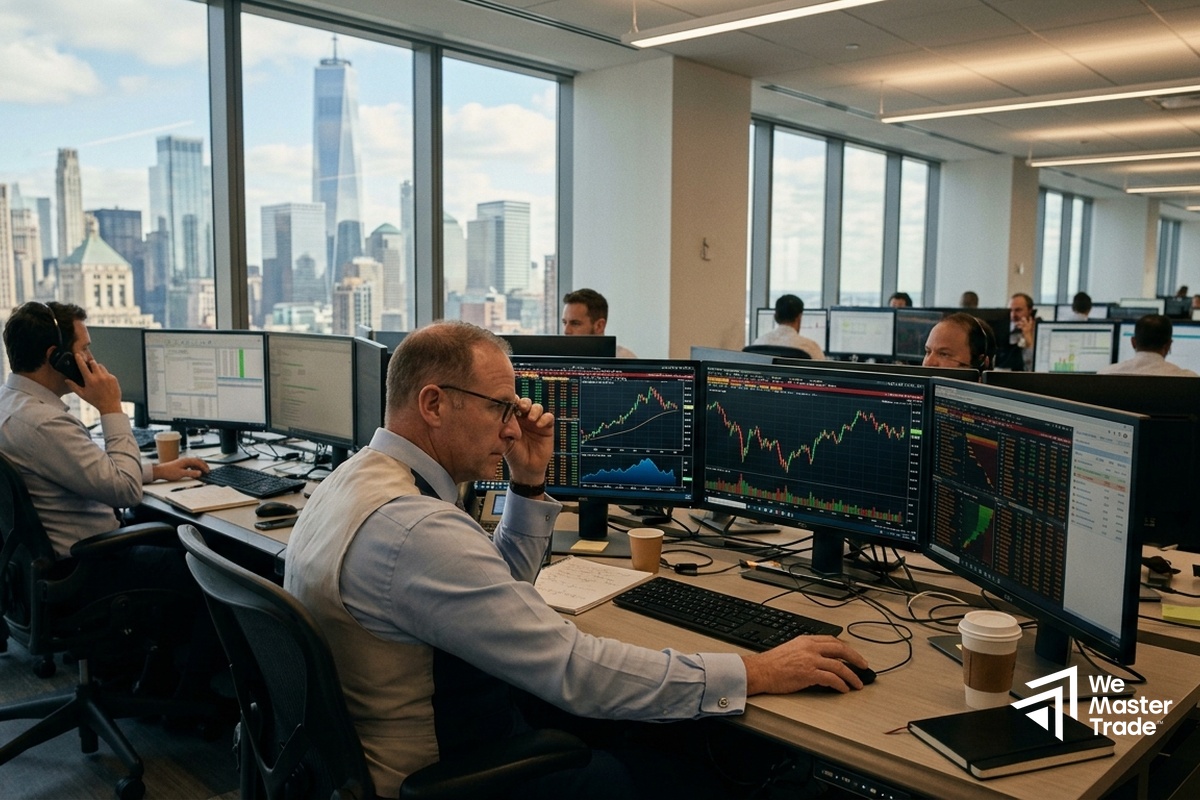
High-Impact News Events (NFP, CPI, FOMC)
The US session hosts the market’s most volatile scheduled events. These releases can move major pairs 50–150 pips within minutes:
- NFP (Non-Farm Payroll) — first Friday of every month, 8:30 AM EST
- CPI (Consumer Price Index) — monthly inflation data, 8:30 AM EST
- FOMC Rate Decision — 8 times per year, 2:00 PM EST
- Retail Sales, GDP, Jobless Claims — weekly/monthly, mostly 8:30 AM EST
Understanding how to trade around news is a skill in itself. See our full breakdown in Forex News Trading Strategy.
US Session Strategy for Prop Firm Traders
This is where most guides stop — and where WeMasterTrade starts. Trading the US session with a funded account is fundamentally different from trading your own capital.
How Volatility Spikes Affect Your Drawdown Limit
Prop firms enforce strict drawdown rules — typically 5% daily max and 10% total. During high-volatility US session events, a single trade can consume a large portion of your daily limit in minutes.
Key rules to protect your account:
- Reduce position size by 30–50% during the first 30 minutes of the NY open
- Never enter a trade 5 minutes before a high-impact news release
- If you hit 50% of your daily drawdown before noon — stop trading for the day
- Use wider stops during the overlap to avoid stop hunts on thin liquidity wicks
For a complete framework, read MT5 Risk Management and apply these principles to your funded account rules.
Should You Trade News Events on a Funded Account?
This depends entirely on your prop firm’s rules. Some firms explicitly prohibit holding trades through major news. Others allow it but the risk is yours.
General guidance:
- Evaluation phase — avoid news trading. Protecting the challenge is the priority.
- Funded phase — selective news trading is acceptable if your risk per trade is under 0.5%
- Instant funding accounts — same rules apply; a single blown news trade can end your account
If your prop firm doesn’t restrict news trading, treat high-impact events as optional setups — not guaranteed opportunities.
Best Session Window for Scalpers vs Swing Traders
| Style | Best Window | Why |
|---|---|---|
| Scalper | 8:00–10:00 AM EST | Maximum volatility, tight spreads |
| Day Trader | 8:00 AM–12:00 PM EST | Full London-NY overlap |
| Swing Trader | 2:00–4:00 PM EST | Afternoon trend continuation after FOMC/data |
| News Trader | 8:30 AM EST ±15 min | Around major US releases |
Learn more about how the Prop Trading model works and how session timing fits into your overall strategy.
US Session vs Other Sessions — Quick Comparison
| US Session | London Session | Tokyo Session | |
|---|---|---|---|
| Hours (EST) | 8AM–5PM | 3AM–12PM | 7PM–4AM |
| Volume | Very High | Highest | Low–Medium |
| Volatility | Very High | High | Low |
| Best Pairs | USD majors | EUR, GBP pairs | JPY, AUD pairs |
| News Events | Heavy (US data) | Moderate (EU data) | Light |
| Prop Firm Risk | High | High | Lower |
Tips to Maximize Performance During the US Session
- Build a pre-session routine — check the economic calendar 30 minutes before 8 AM EST every day
- Mark key levels the night before — support, resistance, and previous day high/low
- Trade the first hour with smaller size — the opening 30–60 minutes can be erratic as orders fill
- Use the overlap window for entries, afternoon for management — most big moves complete by 12PM EST
- Log every US session trade — note the time, spread, and whether a news event was nearby. Patterns emerge fast.
- Respect your daily drawdown hard stop — no session is worth a failed funded account
The US trading session rewards preparation and punishes impulsive decisions. Treat it as the highest-stakes window of your trading day — because for your prop firm account, it is.