












Candlestick-based trading remains one of the most widely used forms of technical analysis across forex, equities, indices, and cryptocurrency markets. According to data published by the Bank for International Settlements, global foreign exchange turnover exceeded 7.5 trillion dollars per day in its latest survey, highlighting the scale of markets where traders rely on chart-based decision making. Within that framework, reversal patterns continue to attract attention because they help identify potential turning points before broader trend changes become obvious.
This guide explains the Morning Star Pattern Strategy in practical terms. You will learn how the morning star pattern forms, why it signals a potential bullish reversal, how to identify high-quality setups, and how experienced traders use confirmation tools such as volume analysis, RSI, market structure, and risk management techniques to improve trade selection.

What Is the Morning Star Pattern and Why Does It Signal a Bullish Reversal?
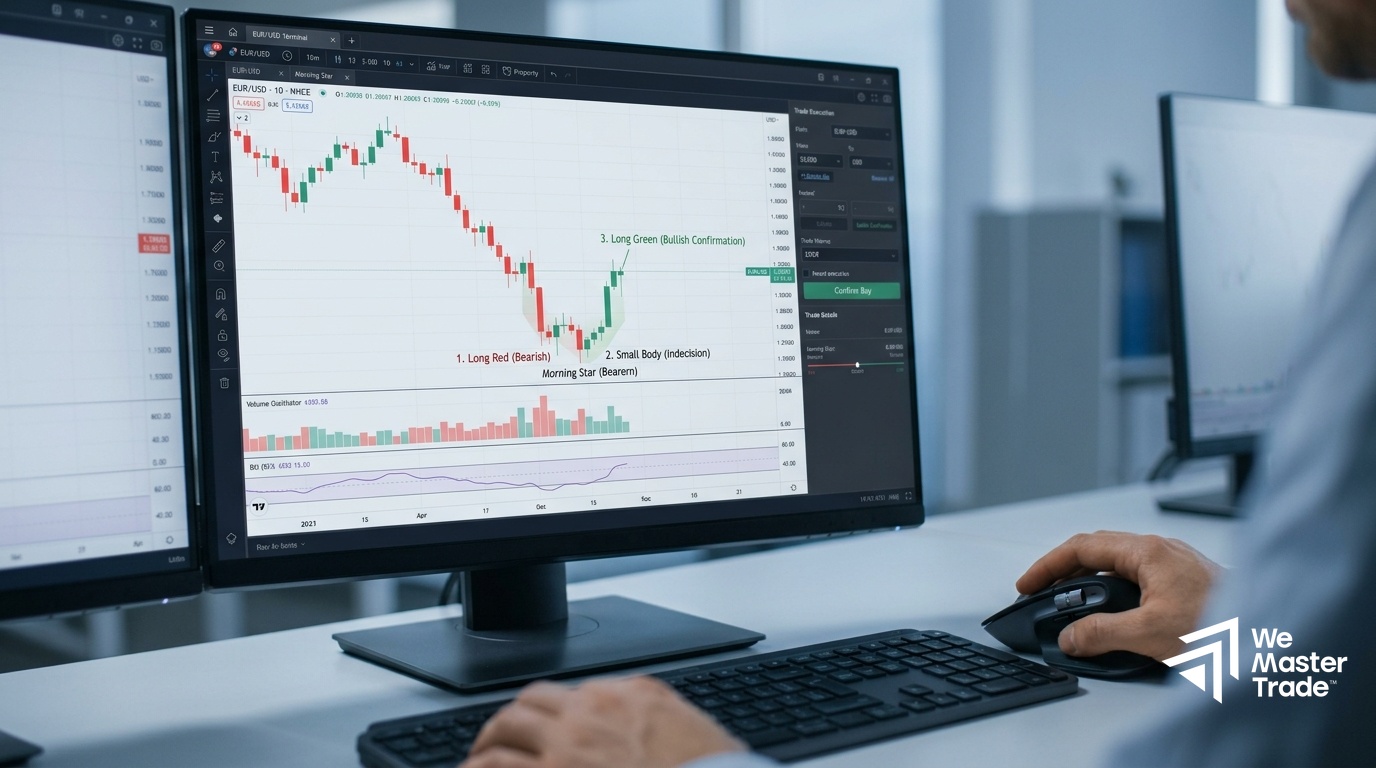
The morning star pattern is a three-candle bullish reversal pattern that typically appears after a sustained downtrend. The structure consists of a large bearish candle, followed by a small-bodied candle that reflects indecision, and then a strong bullish candle that closes deep into the first candle’s range. This sequence signals that selling pressure may be weakening while buyers begin to regain control.
The pattern emerged from Japanese candlestick analysis, a charting methodology developed centuries ago by rice merchants seeking to understand crowd psychology. Modern traders continue to use these principles because price action often reflects shifts in market sentiment before fundamental data catches up.
A key reason the morning star candlestick pattern works is the psychological transition it represents. The first candle confirms bearish momentum. The second candle shows hesitation as sellers lose conviction. The third candle demonstrates renewed buying interest and often marks the beginning of a trend reversal.
Traders evaluating bullish candlestick patterns rarely rely on the pattern alone. Location matters. A morning star setup that forms near a major support level or demand zone generally carries more weight than one appearing in the middle of a consolidation range.
Many participants trading through a modern proprietary trading platform combine candlestick confirmation with broader market context rather than treating any single pattern as an automatic entry signal.
Why Traders Pay Attention to Morning Star Formations
The morning star pattern appears across multiple asset classes and timeframes. Forex traders use it to identify potential reversals in currency pairs. Equity traders monitor it around earnings-related pullbacks. Cryptocurrency traders often look for the formation during periods of extreme volatility.
Several academic studies examining technical analysis have found that certain candlestick formations can provide statistically meaningful information when combined with trend and support-resistance analysis. The pattern is not predictive by itself, but it helps traders recognize changing market conditions.

How to Identify a Valid Morning Star Pattern on a Price Chart
Not every three-candle formation qualifies as a high-quality morning star setup. Traders who consistently apply objective criteria generally avoid many false signals that occur during random market fluctuations.
The first requirement is an established downtrend. Without prior bearish momentum, the pattern loses much of its significance. A reversal pattern requires something to reverse. If price has been moving sideways, the formation may simply represent short-term noise rather than a meaningful shift in sentiment.
The second element is the middle candle. This candle often appears as a doji, spinning top, or another small-bodied candlestick. Its purpose is not necessarily to reverse the trend immediately but to indicate that sellers are beginning to lose momentum. The smaller the candle relative to the first bearish candle, the more evident the market’s hesitation becomes.
The third candle provides the actual confirmation. A strong bullish candle closing above the midpoint of the first candle significantly improves reliability. Many traders prefer to see the third candle close near its high, indicating continued buying pressure into the session close.
Key Characteristics of a Strong Morning Star Setup
| Characteristic | Why It Matters |
| Existing downtrend | Confirms reversal context |
| Small middle candle | Signals market indecision |
| Strong bullish third candle | Demonstrates buyer control |
| Support zone location | Increases probability |
| Rising volume | Strengthens conviction |
| Higher timeframe alignment | Reduces noise |
Volume analysis adds another layer of confirmation. Markets that show increasing participation during the third candle often indicate stronger institutional involvement. Rising volume alongside bullish price action frequently improves the quality of the bullish reversal signal.
Support and resistance trading principles also play an important role. When a morning star pattern forms near a historical support area that has already produced multiple reversals, the setup gains additional credibility.
Common Identification Mistakes
Many traders label any three-candle reversal as a morning star pattern. That approach creates unnecessary losses. One of the most common errors is ignoring the broader trend. Another is entering before the third candle confirms the reversal.
A valid morning star entry strategy requires patience. Waiting for confirmation often means entering slightly later, but it can significantly reduce exposure to false breakouts and premature trend reversal trading attempts.

Morning Star Trading Strategy: Entry, Stop-Loss and Take-Profit Rules
A successful morning star trading strategy depends on execution rather than pattern recognition alone. Entry timing, stop placement, position sizing, and profit objectives ultimately determine whether a trader can convert a bullish reversal pattern into a profitable trade.
One common entry method involves buying immediately after the third candle closes. This approach prioritizes confirmation and reduces the risk of entering before the reversal is validated. Conservative traders often wait for a break above the high of the third candle before initiating a position.
More aggressive participants sometimes enter during the formation of the third candle if volume and momentum indicators show strong bullish participation. While this can improve reward potential, it also increases exposure to failed reversals.
Stop-Loss Placement
The most widely used morning star stop loss method places protection below the lowest point of the pattern. This level represents the point at which the bullish thesis becomes invalid.
Risk management remains essential regardless of pattern quality. Professional traders commonly risk between 0.5 percent and 2 percent of account equity on a single trade depending on strategy design and volatility conditions.
Take-Profit Approaches
Profit targets vary according to market conditions and timeframe. Three commonly used methods include:
| Method | Description |
| Resistance Target | Exit near previous resistance |
| Fixed Risk-Reward | Aim for two-to-one or three-to-one ratio |
| Trend Following | Hold until trend structure breaks |
A strong risk reward ratio allows traders to remain profitable even when win rates remain below 50 percent. Many institutional strategies prioritize asymmetric returns rather than maximizing trade frequency.
Traders seeking additional capital to apply disciplined setups often explore an instant funded account model that provides immediate market access without traditional evaluation stages, allowing them to focus on execution and risk management rather than challenge requirements.
Example Morning Star Trade Workflow
- Identify a clear downtrend.
- Locate a morning star pattern near support.
- Confirm bullish momentum through the third candle.
- Verify volume confirmation.
- Enter after confirmation.
- Place stop loss below pattern low.
- Target a minimum two-to-one reward-to-risk ratio.
Using RSI, Volume and Market Structure for Stronger Confirmation
The morning star pattern strategy becomes more effective when combined with independent confirmation signals. Experienced traders rarely rely on candlestick formations in isolation because markets generate false signals under all conditions.
Relative Strength Index, commonly known as RSI, is one of the most frequently used confirmation tools. RSI readings below 30 often indicate oversold conditions, although oversold does not automatically mean price will reverse. A morning star pattern appearing alongside bullish RSI divergence creates a stronger technical argument for reversal.
MACD confirmation provides another useful perspective. When MACD begins turning upward while price forms a morning star pattern, traders gain additional evidence that bearish momentum may be fading.
Volume analysis contributes further validation. Increased trading volume during the third bullish candle suggests stronger participation from buyers. This often distinguishes meaningful reversals from temporary price fluctuations.
Market structure analysis is equally important. Traders monitor higher highs and higher lows after the pattern forms. A break of structure frequently confirms that a broader trend change may be underway.
Many traders combine RSI, MACD, moving averages, and specialized cTrader indicators to create a more comprehensive technical analysis strategy rather than relying on a single indicator.
Multi-Timeframe Analysis
Multi timeframe analysis helps traders align short-term entries with broader market trends. For example, a morning star pattern appearing on a four-hour chart while the daily chart remains bullish generally offers stronger context than a setup that contradicts higher-timeframe momentum.
The approach reduces noise and helps traders focus on higher-probability opportunities. Research published by various trading education providers suggests that combining higher and lower timeframe analysis can improve consistency by filtering out weaker setups.

Morning Star vs Bullish Engulfing: Which Reversal Pattern Is More Reliable?
The morning star pattern and bullish engulfing pattern are among the most recognized bullish reversal patterns in technical analysis. Both seek to identify shifts in market sentiment, yet they communicate that shift in different ways.
A bullish engulfing pattern forms with two candles. The second bullish candle completely engulfs the body of the preceding bearish candle, signaling aggressive buying pressure. The morning star pattern uses three candles and often develops over a longer period, allowing traders to observe the transition from selling dominance to buyer control more clearly.
The choice between the two patterns often depends on trading style. Short-term traders may favor bullish engulfing formations because they generate signals more frequently. Swing traders frequently prefer the morning star candlestick pattern because the additional candle provides extra confirmation.
Comparison of the Two Patterns
| Factor | Morning Star Pattern | Bullish Engulfing Pattern |
| Number of Candles | Three | Two |
| Confirmation Strength | Higher due to additional candle | Moderate |
| Signal Frequency | Lower | Higher |
| Typical Risk | Often smaller when near support | Varies by volatility |
| Best Use Case | Trend reversal trading | Momentum reversals |
| Market Psychology | Gradual shift in sentiment | Sudden shift in sentiment |
Neither pattern guarantees success. Reliability increases when either formation appears near significant support levels, aligns with market structure, and receives confirmation from volume or momentum indicators.
Market conditions also influence effectiveness. During highly volatile periods, both patterns can generate false bullish reversal signals. Traders who combine candlestick analysis with support and resistance trading generally achieve more consistent results than those relying on patterns alone.
Common Morning Star Trading Mistakes and Risk Management Best Practices
The largest losses associated with the morning star pattern strategy rarely occur because traders misunderstand the pattern itself. They usually stem from poor execution, excessive risk, or ignoring market context.
One common mistake is trading every morning star setup regardless of location. A pattern forming in the middle of a range carries less significance than one appearing near a long-established support zone. Market structure matters as much as candlestick formation.
Another frequent error involves entering too early. Traders often anticipate confirmation rather than waiting for it. The third candle exists for a reason. It validates that buyers have regained control. Entering before confirmation increases exposure to failed reversals.
Five Mistakes That Reduce Performance
| Mistake | Potential Consequence |
| Ignoring trend context | Low-probability entries |
| Entering before confirmation | Increased false signals |
| No stop-loss placement | Large drawdowns |
| Oversized positions | Excessive account risk |
| Ignoring volume confirmation | Weak trade quality |
Risk management remains the foundation of sustainable trading. Even high-probability setups fail. Professional traders focus on preserving capital first and generating returns second.
Position sizing plays a critical role. Many experienced traders limit exposure on individual trades to a small percentage of total account equity. This prevents a series of losing trades from causing significant damage.
Building a Sustainable Trading Plan
A complete morning star trading strategy should include:
- Entry criteria
- Confirmation requirements
- Stop-loss rules
- Profit-taking methodology
- Position sizing framework
- Performance review process
Trading journals provide another advantage. Recording every morning star setup helps traders identify patterns in their decision-making and refine execution over time.
Successful reversal trading strategy development often comes from hundreds of documented trades rather than a handful of winning examples shared on social media.
Key Questions About the Morning Star Pattern Answered
Q: What is a Morning Star pattern?
A Morning Star is a three-candle bullish reversal pattern that appears after a downtrend and signals a potential transition from selling pressure to buying pressure. It consists of a bearish candle, a small indecision candle, and a strong bullish confirmation candle.
Q: How reliable is the Morning Star pattern?
The pattern becomes more reliable when it forms near support levels, aligns with broader market structure, and receives RSI confirmation, MACD confirmation, or volume confirmation. No candlestick formation guarantees future price direction.
Q: Where should traders enter a Morning Star trade?
Many traders enter after the third candle closes or after price breaks above the high of the formation. This approach prioritizes confirmation and reduces exposure to premature entries.
Q: What stop-loss level is commonly used?
The most common morning star stop loss placement is below the lowest point of the three-candle structure. This level represents the invalidation point for the bullish setup.
Q: Does the Morning Star pattern work in forex markets?
Yes. The forex morning star pattern is widely used by currency traders, stock traders, commodity traders, and cryptocurrency participants. Its effectiveness depends on market context rather than asset class.
Traders researching international markets should also understand regional regulations and issues related to forex trading legality before applying any trading strategy.
Q: Which indicators work best with Morning Star setups?
RSI, MACD, moving averages, volume analysis, Fibonacci retracement levels, and support-resistance zones are commonly used to strengthen candlestick confirmation.
Q: Can the Morning Star pattern fail?
Yes. False signals occur in all markets. Strong bearish momentum, low liquidity, major news events, and weak confirmation can all contribute to failed setups.
Q: What timeframe works best for Morning Star trading?
The daily and four-hour charts often provide stronger signals because they reduce market noise. However, the pattern can appear on virtually any timeframe.
The WeMasterTrade Advantage: Applying Proven Trading Setups With Immediate Capital Access
Identifying a high-quality morning star setup is only one part of successful trading. The larger challenge is applying disciplined risk management while maintaining sufficient capital to take advantage of opportunities when they appear. Many traders develop strong technical analysis skills yet struggle to scale their strategies because of capital limitations.
WeMasterTrade approaches this challenge through its Angel Funding model. Rather than requiring traders to complete lengthy evaluation phases, the company provides access to funded trading accounts immediately. This structure allows qualified traders to focus on execution, market analysis, and consistency rather than repeatedly attempting challenge-based assessments.
A distinctive aspect of the model is the dedicated Risk Management team. The team identifies high-probability opportunities and can copy qualifying trader positions at ratios of up to one-to-four alongside the trader’s own positions. This creates an alignment of interests because the firm’s profitability is connected directly to trader performance.
For traders using a technical analysis strategy built around candlestick formations, market structure analysis, and disciplined risk controls, access to immediate funding can remove one of the most significant barriers to growth. Traders who want immediate capital access without months of evaluation may find WeMasterTrade’s structure worth examining as part of their broader trading development plan.