












Forex liquidity providers are institutions or market participants that continuously make currencies available to buy and sell. By streaming bid and ask prices and accepting transactions, they help brokers and trading venues match orders with less delay and smaller price disruption.
For a trader, the liquidity provider is usually behind the scenes. Its effect appears through spreads, available depth, execution speed, slippage, rejected orders, and how those conditions change during news, rollovers, and holidays.
What is a Forex liquidity provider?
A liquidity provider (LP) supplies executable prices and market depth. In institutional foreign exchange, major banks, non-bank market makers, electronic trading firms, prime brokers, and other large financial institutions may provide liquidity to venues or counterparties.
The Forex market is decentralized. There is no single exchange or universal order book containing every currency transaction. Instead, liquidity is distributed across banks, electronic communication networks, multi-dealer platforms, brokers, and bilateral relationships.
That structure means the price and depth available to one broker may differ from another. Each firm can connect to different providers, use different aggregation technology, apply its own risk model, and add markups or commissions.
Why does the Forex market need liquidity providers?
Liquidity providers perform several related functions:
- Stream bid and ask quotes for currency pairs.
- Offer quantities available at different price levels.
- Accept the other side of transactions within their limits.
- Help reduce the price impact of ordinary order flow.
- Support continuous price discovery across trading sessions.
- Allow brokers and venues to manage or transfer exposure.
Without sufficient liquidity, a relatively small order could move price sharply. Traders would face wider spreads, more slippage, and greater difficulty entering or exiting positions.
Who provides liquidity in Forex?
Tier-one banks
Large international banks are central participants in the wholesale FX market. They quote prices to institutional clients and other banks, facilitate corporate flows, and manage substantial currency books.
“Tier one” is commonly used in the industry, but there is no single public certification that labels every provider. The relevant issue for a broker is the quality, stability, and terms of its actual relationships.
Non-bank market makers
Electronic market-making firms can stream competitive prices and manage risk using technology, statistical models, and connections across venues. They have become important sources of liquidity in many currency pairs.
Prime brokers and prime-of-prime firms
Direct relationships with major banks can require substantial capital, credit, and operational infrastructure. A prime-of-prime firm may provide smaller brokers access to aggregated institutional liquidity through an intermediary relationship.
This access is not identical to dealing directly with every underlying bank. Credit terms, technology, pricing, and risk controls still pass through the intermediary.
Electronic venues and ECNs
Electronic communication networks and trading venues bring together quotes from multiple participants. They can support price competition and order matching, but execution depends on venue rules, participants, and available depth.
Retail brokers
A retail broker may route risk externally, internalize some client flow, or use a hybrid model. Labels such as STP, ECN, A-book, and B-book are often simplified in marketing. Actual execution quality depends on routing, aggregation, risk controls, and how orders are handled in specific conditions.
How brokers and liquidity providers work together
A simplified order path can look like this:
- Liquidity providers stream quotes and available quantities.
- A bridge or aggregator receives multiple price feeds.
- The broker constructs the prices displayed on its platform, including any markup.
- A client sends an order.
- The broker matches, internalizes, or routes that order according to its execution model.
- The fill is returned to the trading platform.
This process occurs electronically and can take a fraction of a second under normal conditions. Yet every step introduces variables: network latency, stale quotes, aggregation rules, last-look practices, order size, available depth, and broker risk management.
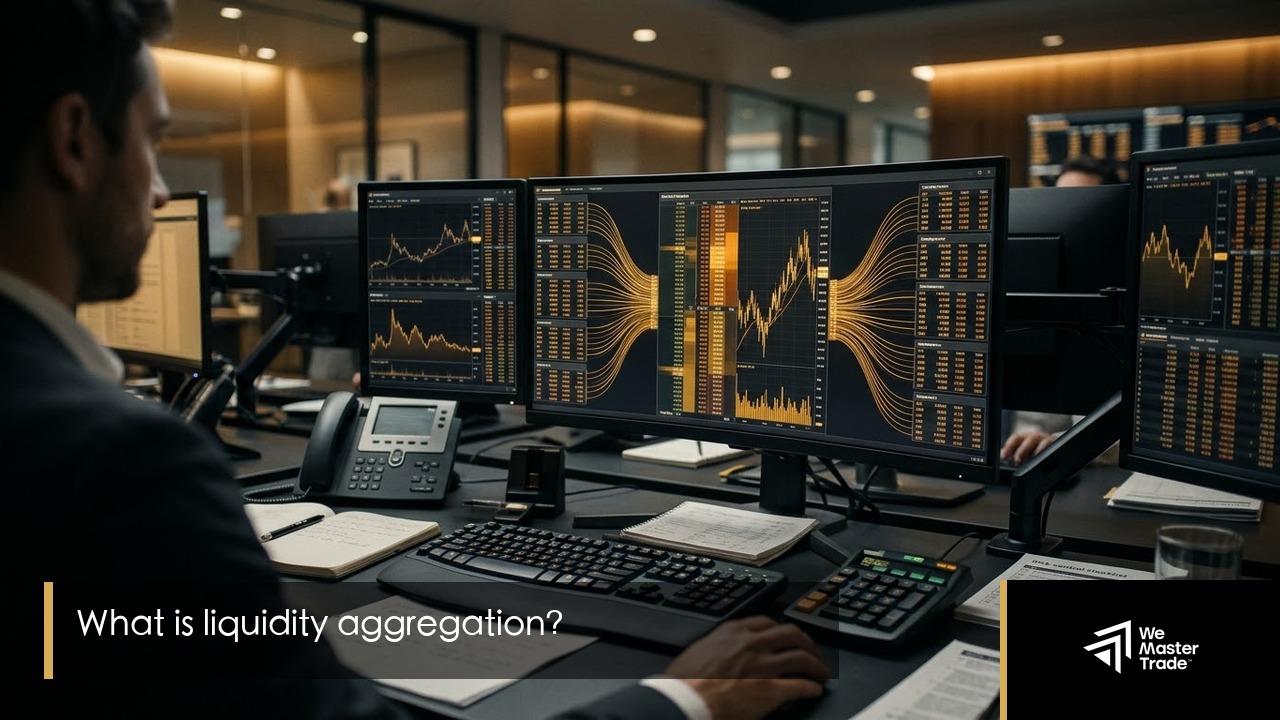
What is liquidity aggregation?
Liquidity aggregation combines quotes from several providers into one price stream and depth pool. An aggregator can select the best available bid and ask and route orders across providers according to defined rules.
For example, one provider may offer the best price for a small quantity while another offers more depth at a slightly worse price. A large order may be filled across several levels, producing a volume-weighted average price rather than the top quote shown on screen.
Aggregation can improve resilience and pricing, but it does not guarantee perfect execution. If all providers reduce depth during the same event, the combined pool will also become thinner.
How liquidity affects retail traders
Spreads
The spread is the difference between the bid and ask. Deep competition generally supports tighter spreads. Spreads can widen when liquidity falls, volatility jumps, or providers protect themselves from uncertainty.
Displayed spread is only one cost. Commission, slippage, financing, and the probability of rejection or requote can also matter.
Slippage
Slippage is the difference between the expected price and the executed price. It can be negative or positive. Large orders, fast markets, thin depth, and latency increase the chance that the quoted price is no longer available when the order reaches the market.
Market depth
Top-of-book price shows the best bid and ask, not how much can be traded there. A market can display a tight spread but have little depth. Larger orders may consume several levels and receive a worse average fill.
Execution speed
Liquidity is not the only factor affecting speed. The platform, broker server, bridge, aggregator, provider, trader connection, and geographic distance all contribute. Faster execution does not guarantee a better price if depth is poor.
Price stability
Deeper markets can absorb ordinary flow with less price movement. In thin conditions, a smaller imbalance may cause a rapid jump. This is one reason execution behaves differently across major, minor, and exotic currency pairs.
When does Forex liquidity change?
Trading-session overlaps
Liquidity is often stronger when major financial centers overlap, particularly for currency pairs linked to those regions. Conditions can be thinner late in the US session or before the next major center becomes active.
Economic news and central-bank events
Before a major announcement, providers may widen prices or reduce size because the next tradable price is uncertain. Immediately after release, order flow can overwhelm available depth and increase slippage.
The article on central banks and financial markets explains why policy decisions can rapidly change rates, currencies, and risk sentiment.
Daily rollover
Around the transition between trading days, liquidity can briefly fall and spreads may widen. Strategies that rely on tight stops or short holding periods should account for this recurring change.
Holidays
Fewer participating institutions can mean lower depth even while platforms remain open. Review holiday trading market conditions before assuming a normal spread or fill pattern.
Market stress
During unexpected political, financial, or geopolitical events, providers may withdraw quotes, reduce size, or reprice quickly. A market described as highly liquid under normal conditions can behave very differently under stress.
Major, minor and exotic pairs
| Pair type | Typical liquidity characteristics | Trading implication |
|---|---|---|
| Major pairs | Broad participation and generally deeper liquidity | Often tighter spreads in normal conditions |
| Minor/cross pairs | Less direct activity than majors | Spreads and depth can vary more by session |
| Exotic pairs | Fewer providers and lower depth | Wider spreads, larger slippage and stronger event risk |
A currency pair contains a base and quote currency, and its liquidity depends on demand for both sides. The base currency versus quote currency guide explains how to read that relationship.
Liquidity provider vs market maker vs broker
These terms overlap but are not identical.
- Liquidity provider: supplies executable prices and quantity to a venue or counterparty.
- Market maker: continuously quotes both sides and may hold or hedge inventory risk.
- Broker: gives clients market access and handles orders under its execution model.
- Aggregator: combines prices and depth from multiple sources.
- Prime broker: provides credit, settlement, and access relationships for institutional participants.
One firm can perform more than one role. Traders should avoid assuming a business model from a label alone.
How liquidity providers make money
Liquidity providers may earn the bid-ask spread, receive venue incentives, charge access or service fees, and manage inventory across related markets. Their result depends on quote quality, order flow, hedging costs, adverse selection, technology, and risk management.
They also face risk. A provider quoting during fast movement may trade against better-informed flow or be unable to hedge at the expected price. Widening the spread or reducing quantity is one way to manage that uncertainty.
What traders can evaluate without seeing the provider list
Retail traders often cannot independently verify every upstream liquidity relationship. They can still measure observable execution:
- Average spread by instrument and session.
- Spread distribution around news and rollover.
- Positive and negative slippage.
- Fill time and rejection rate.
- Difference between small and larger order fills.
- Stability during volatile periods.
- Whether stop and limit execution matches documented policy.
Record these observations over a meaningful sample. One poor fill may be an outlier; a repeated pattern by session or event is more informative.
Liquidity and prop firm trading
Many prop programs use simulated environments, and their instruments, prices, and execution rules may differ from a personal broker account. Traders should read how symbols, commissions, spreads, slippage, prohibited practices, and drawdown are defined for the specific program.
WeMasterTrade provides information about available simulated symbols and supported trading platforms. Those pages should be reviewed together with the current account conditions before selecting a strategy or instrument.
Do not assume that the name of an instrument guarantees identical liquidity or execution across all platforms. Test the environment and account for its rules in risk calculations.
Common misconceptions about Forex liquidity providers
“More providers always mean better execution”
Provider count alone says little about price quality, depth, uptime, credit, or routing. Several weak or duplicate feeds may add less value than a smaller set of stable relationships.
“A tight spread means deep liquidity”
A tight top-of-book quote can be available for very little size. Depth and realized fill matter.
“Slippage proves manipulation”
Slippage can arise naturally when prices move or available quantity is consumed. Persistent asymmetric execution deserves investigation, but one slipped order is not proof of misconduct.
“Major pairs are always liquid”
They are generally more liquid than exotic pairs, but depth can still fall around holidays, rollover, unexpected news, or market stress.
“An ECN label guarantees direct interbank access”
Marketing labels vary. Read the execution policy, legal disclosures, pricing model, and observable results rather than relying on one term.
Frequently asked questions
Who are the biggest Forex liquidity providers?
Large global banks and non-bank electronic market makers are important participants, but rankings and relationships change. A retail trader rarely needs a static “top provider” list as much as reliable execution data from the platform being used.
Do liquidity providers trade against clients?
An LP may take the opposite side of a transaction as part of market making and then hold, offset, or hedge that exposure. This is not automatically improper; execution quality and conflict-management practices are what matter.
Why do spreads widen during news?
Future prices become uncertain, order flow accelerates, and providers may reduce quoted size to control risk. Less depth and faster repricing lead to wider spreads and more slippage.
Can a broker use several liquidity providers?
Yes. Brokers can aggregate multiple feeds and route orders according to price, size, latency, credit, or other rules.
Is Forex liquidity the same all day?
No. It changes with trading sessions, pair composition, news, holidays, rollover, and market stress.
Liquidity is visible through execution
Forex liquidity providers help the market function, but traders experience their effect indirectly. The practical evidence is the spread paid, the depth available, the speed and quality of fills, and how reliably those conditions hold when markets become difficult.
Rather than choosing a strategy based on ideal spreads, collect execution data in the sessions and events you actually trade. Build slippage and liquidity changes into position sizing, stop placement, and expectations.
> Forex and leveraged trading involve substantial risk. Liquidity can change without warning, and orders may execute at prices different from those requested. This material is educational and not personal financial advice.