












The foreign exchange market is the global place for currency trading with a daily transaction volume reaching trillions of dollars. While it is no stranger to the financial world, understanding and engaging in forex learning in a structured way remains a major challenge for many beginners. This article provides a comprehensive overview of the Forex market, how it works, who participates, the factors influencing exchange rates, and the essential foundation before stepping into this field.
See more:
- Useful Prop Firm Success Tips For Traders
- Prop Firm Investment Tips to Maximize Trading Opportunities
- Prop Firm Investor Experience & Valuable Lessons
What is Forex?

Forex (short for Foreign Exchange) is a decentralized financial market where currencies are exchanged in pairs, for example: EUR/USD or USD/JPY. The value of each currency pair constantly changes based on supply and demand, interest rates, economic–political conditions, and market sentiment.
Unlike stock markets with a specific trading center, the Forex market operates across continents, 24 hours a day (except weekends), divided into 4 main sessions: Sydney, Tokyo, London, and New York. In forex learning, the first thing to understand is that this continuity is both an opportunity and a risk.
Who participates in the Forex market?
Forex learning also means understanding the key participants in the market. They can be divided into 4 main groups:
-
Central banks and governments: Regulate exchange rates to control inflation and boost trade.
-
Large financial institutions: Commercial banks and hedge funds trade with millions of USD.
-
International corporations: Conduct foreign currency transactions for international payments.
-
Individual traders: A smaller share but rapidly growing thanks to online trading platforms.
Advantages and challenges of joining the Forex market
Advantages
-
Extremely high liquidity: Large volumes traded with ease.
-
24/5 activity: Fits multiple time zones and personal schedules.
-
Low cost: Many platforms offer competitive spreads and no commission.
-
Flexibility: Start with small capital through micro or demo accounts.
Challenges
-
Strong volatility: Exchange rates change every minute, creating big risks.
-
Broad knowledge required: From macroeconomics to technical analysis.
-
Psychological pressure: Forex can be mentally exhausting due to nonstop activity.
Why pursue structured forex learning?
Approaching the Forex market without knowledge is highly risky. Forex learning helps participants:
-
Clearly understand how the market operates, avoiding manipulation.
-
Grasp key terms such as pip, lot, spread, leverage.
-
Recognize technical and fundamental analysis strategies.
-
Learn risk management and build a personal trading plan.
Forex learning is not only about absorbing knowledge but also about training discipline and sharpening responsiveness to market fluctuations.
Main forms of Forex trading
Three main forms of Forex trading:
Spot trading
The most common form, where currency buying and selling happens immediately at market prices.
Forward and futures contracts
Allow participants to “lock in” exchange rates for future trades—mainly used for hedging rather than speculation.
Contract for Difference (CFD) trading
Popular among individual traders, CFDs don’t require owning real assets but trade based on price changes.
Some important terms in forex learning
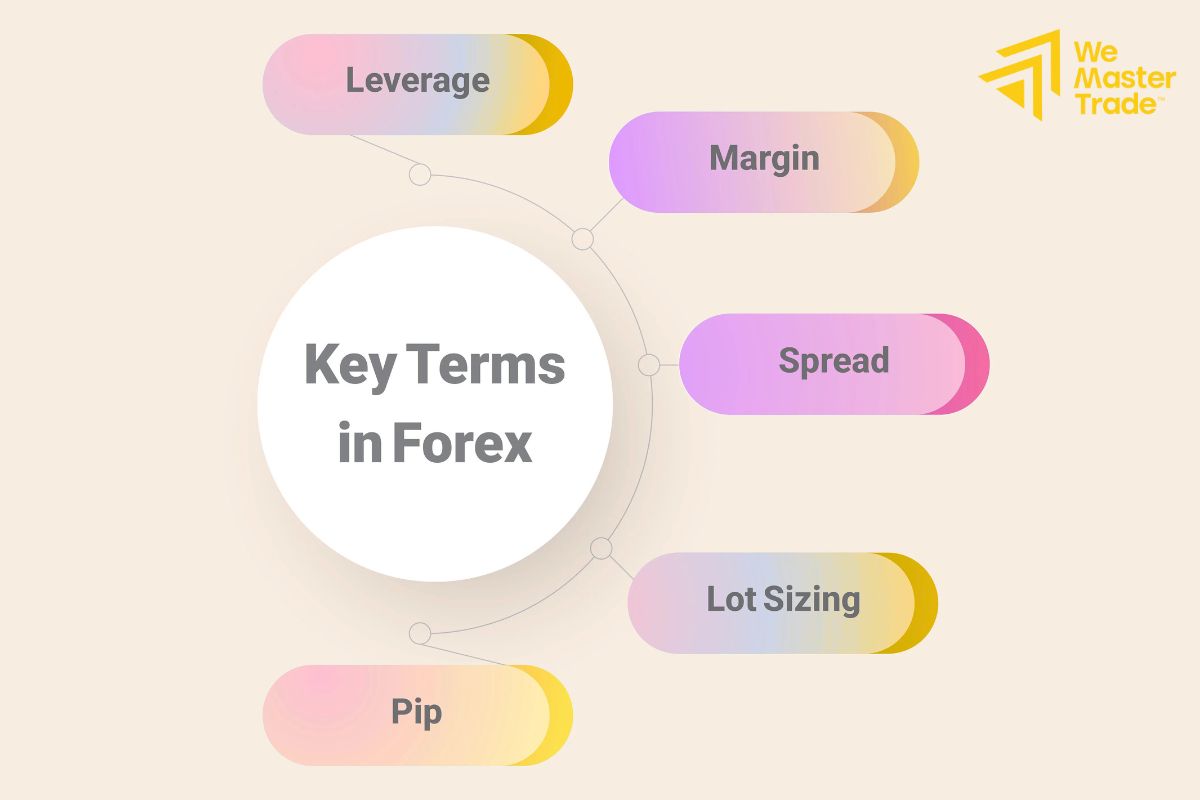
When starting forex learning, you should get familiar with these basics:
-
Pip: The smallest unit of change in a currency pair.
-
Lot: Standard trading volume (1 lot = 100,000 units of the base currency).
-
Leverage: Lets you trade larger volumes than your actual capital. A double-edged sword—it can increase profits but also magnify risks.
-
Spread: The difference between the bid and ask price—an implicit transaction cost traders must note.
Popular trading strategies
During forex learning, exposure to trading strategies not only clarifies market behavior but also provides a framework to analyze price movements systematically. Below are three widely used methods, each with its unique features, conditions, and contexts:
Trend Following Strategy
This strategy focuses on identifying and following the main market trend—the dominant price direction over a certain period. Traders use tools such as:
-
Moving Averages (MA)
-
ADX (Average Directional Index)
-
Market structure: higher highs/lows (uptrend) or lower highs/lows (downtrend)
The goal of trend following is not to predict reversal points, but to identify the current trend and stick with it until signs of weakening appear. The strength of this strategy lies in its stability when the market moves in a clear direction. However, during sideways phases, the strategy may generate false signals and needs adjustment or combination with other filters..
Breakout Strategy

A breakout happens when price surpasses a defined support or resistance level, often with a surge in volume or volatility. Recognizing breakouts requires careful observation of accumulation zones and patterns like:
-
Triangles
-
Pennants
-
Consolidation ranges
The breakout strategy is widely applied during the opening of European or US sessions – times when the market is likely to move strongly. However, not every breakout is valid. Many cases are “false breakouts” – where price surpasses a level but quickly reverses afterward. Therefore, combining confirmation factors such as volume, session timing, or candlestick behavior is crucial to minimize errors.
Reversal Strategy
This method seeks signs of the end of a current trend and the start of a new, opposite one. Suitable for traders skilled at assessing trend exhaustion.
Common tools include:
-
RSI and Stochastic indicators for overbought/oversold zones
-
Reversal candlestick patterns (pin bar, engulfing, morning star…)
-
Confluence of static and dynamic support/resistance levels
The reversal strategy often requires high accuracy in determining entry timing, since going against the trend always carries higher risk. Distinguishing between a technical correction and a true reversal is a skill that must be practiced during serious forex learning.
Conclusion
In short, Forex is one of the most dynamic and appealing financial markets worldwide. However, along with potential comes significant risk. Structured forex learning, clear strategies, and strong psychology are the prerequisites for any trader aiming to enter this market seriously and safely.
See more: