












A fair value gap is a price imbalance created when strong buying or selling pushes the market so quickly that very little trading occurs between prices. The move leaves an unfinished area on the chart, and markets often return to that area later.
Many traders first ask what is a fair value gap in trading, because the behaviour appears repeatedly across different markets. Once you begin noticing it, you realise price rarely moves in a straight line without later revisiting certain levels.
Context matters. An FVG is not a signal by itself. It becomes useful only when combined with structure, trend direction, liquidity, and session timing. This guide explains a repeatable fair value gap trading strategy you can actually follow, not just recognise visually.
To understand why the market behaves this way, it helps to learn how markets move liquidity before the real move.
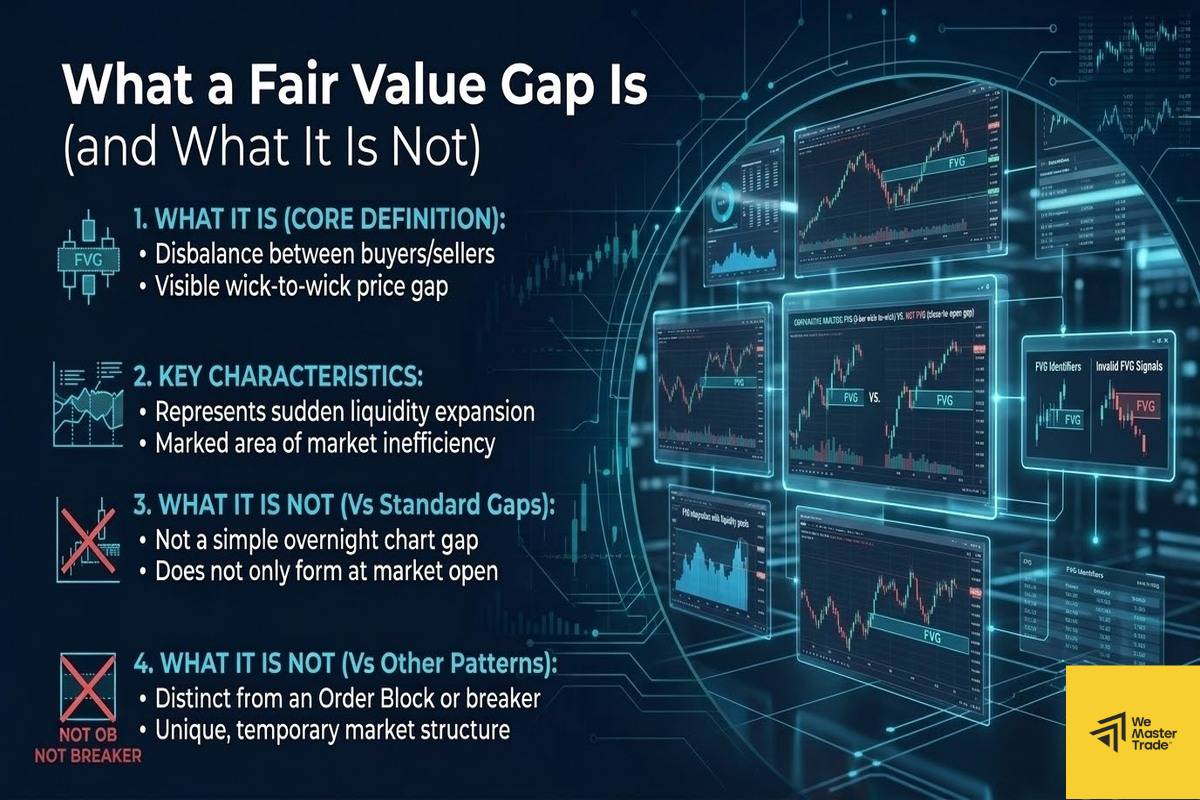
What a Fair Value Gap Is (and What It Is Not)
If you have ever watched price surge away from a level and then return to it hours later, you have already seen a fair value gap in trading.
An FVG forms through a simple three-candle sequence:
- The first candle closes normally
- The second candle moves strongly in one direction
- The third candle opens away from the first
The middle candle moves so quickly that trading barely occurs across a small price range. That thin area becomes the fair value gap.
This is different from a normal market gap that happens when markets close, such as a weekend gap in equities. A traditional gap appears because trading paused. A fair value gap appears because trading happened too aggressively.
Why Price Returns to FVGs
Markets constantly search for balance. When price moves too quickly, some orders never get filled. Later, price often comes back to that level so those transactions can occur. Traders call this mitigation.
Rather than imagining the market correcting itself, think of it as the market finishing a conversation it started earlier.
You will notice this behaviour frequently in forex trading environments where liquidity drives price, because currency markets trade continuously across global sessions.
Key Terminology
Bullish FVG
An imbalance created during strong upward movement.
Bearish FVG
An imbalance created during strong downward movement.
Mitigation
Price returning to the imbalance area.
Displacement
A decisive move away from a level with urgency.
Inducement
A move that encourages traders to enter before reversing.
Premium / Discount
Relative pricing within a range. Above midpoint is premium, below is discount.
How FVGs Form
Fair value gaps usually appear during moments of high participation. Session opens, economic releases, and institutional order flow commonly produce them.
The important idea is displacement. Not every move creates a tradable imbalance. A valid FVG usually follows a strong move away from structure, where you can visually sense urgency.
You can recognise displacement when:
- one candle is noticeably larger than surrounding candles
- price does not overlap much
- direction is clear
When to Ignore FVGs
Not every gap deserves attention.
You should stand aside when:
- price is moving sideways without direction
- candles overlap heavily
- volatility is extremely low
- a spike occurs with no follow-through
Many traders lose money by forcing patterns into messy markets.
Spotting an FVG Correctly
Before considering a trade, run through a simple checklist:
- a clean three-candle imbalance exists
- the impulse candle is larger than nearby candles
- the zone can be marked clearly
- nearby highs or lows provide liquidity targets
If one of these is missing, the setup weakens.
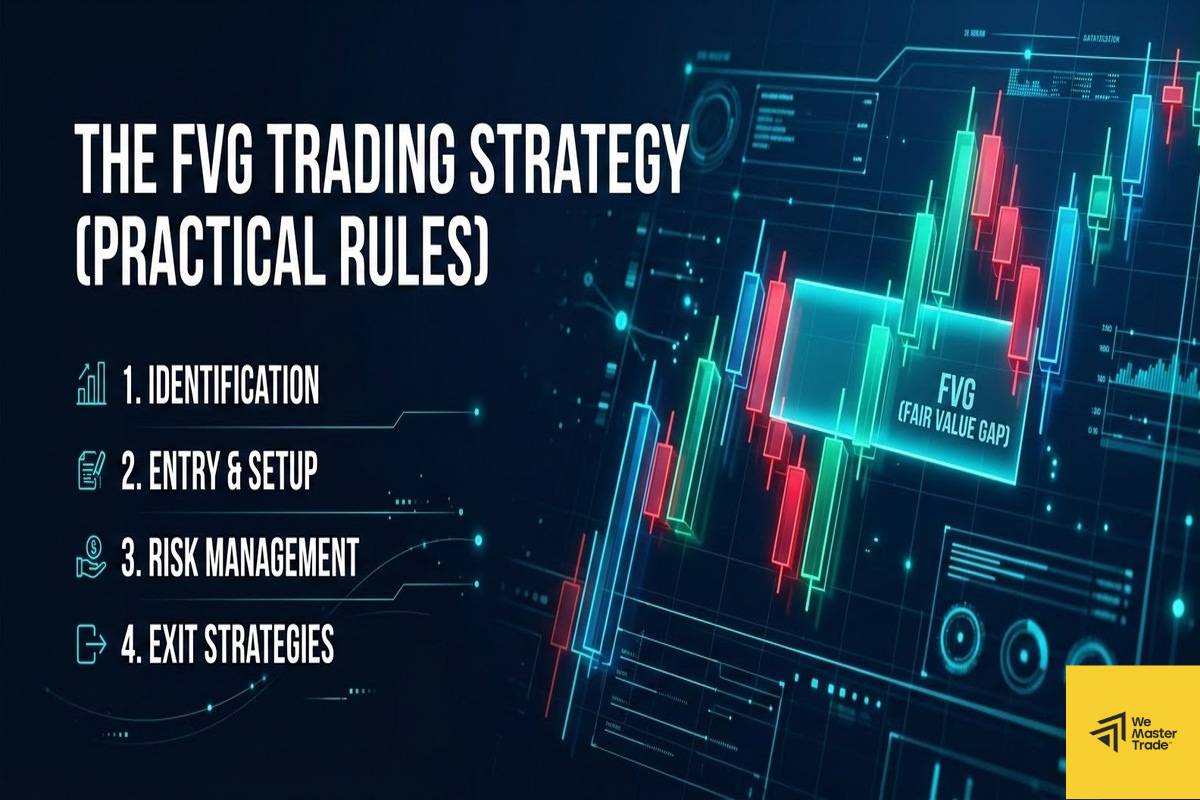
The FVG Trading Strategy (Practical Rules)
A reliable fair value gap trading strategy starts with context, not entry. Most failed trades happen because traders see a gap and react immediately. The edge comes from preparation first, execution second.
Step 1: Determine Directional Bias
Begin on a higher timeframe chart.
Look for the overall market story:
- Is price making higher highs and higher lows?
- Has structure recently broken upward or downward?
- Is price near a major support or resistance level?
Your job here is not to predict every move. Your job is to decide which direction you want to trade. Once bias is clear, you ignore gaps against that direction and focus only on aligned setups.
Step 2: Mark the Dealing Range
Now move to your execution timeframe and identify the recent swing range.
Mark:
- recent highs and lows
- equal highs or equal lows
- obvious liquidity areas
This gives the gap meaning. A fair value gap inside random movement has little value. A fair value gap positioned between liquidity and direction has purpose.
Step 3: Wait for the FVG to Form
Patience matters here. Do not anticipate the gap.
Allow a clear displacement move to occur first. You should see urgency in price, not slow overlapping candles. When the impulse candle leaves a clean imbalance, mark the zone from the first candle’s high/low to the third candle’s opposite side.
Now the setup exists, but the trade still has not appeared yet.
Step 4: Wait for Mitigation
Price often returns to the fair value gap before continuing.
This is the key moment. Instead of chasing the breakout, you are waiting for the market to revisit the imbalance. This is where many traders enter too early.
You want to see price enter the zone and react, not slice straight through it.
Step 5: Choose an Entry Model
Conservative Entry
Wait for rejection inside the gap or a small shift in market structure before entering. This approach reduces false entries and is often easier psychologically.
Aggressive Entry
Place a limit order at the edge of the gap with a strict invalidation level. This provides better pricing but requires confidence in your bias.
Step 6: Invalidation Rules
A trade idea must have a clear point where it is wrong.
Price invalidation:
If price cleanly trades through the entire fair value gap, the imbalance has been filled and the setup is no longer valid.
Time invalidation:
If price touches the gap but shows no reaction after several candles, the market has likely moved on.
Accepting invalidation is part of the strategy. It protects consistency.
Step 7: Stops and Targets
Stops can be placed:
- just beyond the fair value gap
- beyond the nearest swing high or swing low
Targets should always relate to liquidity rather than arbitrary ratios. Look for:
- equal highs or equal lows
- previous swing points
- session highs or lows
You are not forcing a 2:1 reward. You are following where price naturally wants to travel.
Step 8: Trade Management
Two simple management styles work well.
Scaling Method
Take partial profit at the first liquidity level, then trail stops behind new structure or newly formed imbalances.
Fixed Target Method
Close the entire trade at a mapped liquidity objective.
Avoid trailing late in a session, just before major news, or near higher timeframe levels where reversals commonly occur.
Many traders practise this discipline first inside structured trading challenges designed to build consistency.
Example Walkthroughs
Bullish continuation
Price trends upward. A strong impulse creates a bullish FVG. During a pullback, price revisits the gap and then continues toward prior highs.
Bearish reversal
Price sweeps highs. A bearish FVG forms during rejection. Price returns to the imbalance and drops toward previous lows.
These are realistic FVG examples traders repeatedly observe across markets.
FVG Quality Grading
| Quality | Characteristics |
| High | Strong displacement, aligned with trend, clear liquidity target |
| Medium | Smaller impulse, weaker confirmation |
| Avoid | Choppy conditions, overlapping candles, unclear direction |
Common Mistakes
Many problems come from impatience:
- marking any gap as a fair value gap
- trading without directional bias
- entering before mitigation
- placing stops too tightly
- ignoring session timing
Often the market shows the move first and the opportunity later.
Frequently Asked Questions
What is a fair value gap in trading?
It is a price imbalance created when aggressive buying or selling leaves little trading activity between candles.
Do FVGs work across markets?
Yes. Forex, indices, and crypto all display this behaviour, although volatility differs.
How late is too late?
If many candles pass without reaction, the level usually weakens.
Should I trade the whole gap or the midpoint?
Some traders prefer the midpoint, others the edge. It depends on risk tolerance.
Can FVGs work in ranges?
They tend to perform better within trends.
Best confirmation?
A structural shift or a clear rejection candle.
Do sessions matter?
Yes. London and New York sessions often provide the strongest reactions.
Bringing It Together
The core lesson of the fair value gap trading strategy is simple. You are not trading the candle that caused the move. You are trading the return to imbalance after it.
An FVG is not a guarantee. It is a framework for understanding behaviour. When combined with structure, liquidity, and patience, it becomes a practical way to read price instead of reacting emotionally.
This material is educational in nature. Trading involves risk and outcomes vary between traders.