











If you watch price long enough, the market starts to feel less random. You begin to notice that strong moves rarely start from nowhere. Instead, they tend to form after a period of quiet consolidation, followed by a sudden move that catches traders off guard.
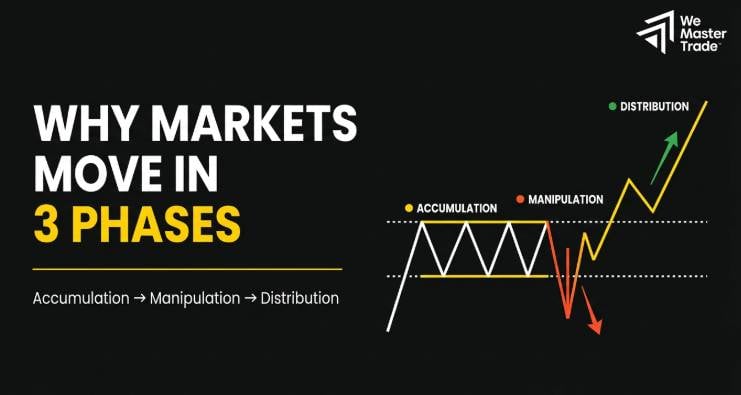
This behaviour is commonly described as accumulation manipulation distribution.
The idea is simple in principle. Price often moves through three stages. First, it trades sideways while positions build. Then it makes a false move that encourages traders to enter the wrong direction. Finally, it travels in the true direction of the market.
In trading discussions this is often called AMD forex.
You may recognise similarities with the Wyckoff market cycle or the ICT “Power of 3” concept. They describe related behaviour but approach it differently. Wyckoff focuses on broader structural phases and volume logic, while ICT frameworks emphasise liquidity and stop placement. The AMD model simplifies the same behaviour into a practical observation. Markets frequently form a range, sweep liquidity, and then move away from it.
In short, the market often moves after the trap, not during it.
What AMD Is and Why It Appears in Price
Markets move because orders must be matched. Large participants cannot simply buy or sell at once without causing dramatic price movement. They need liquidity, and liquidity is created where many traders place orders.
In practice, this means liquidity tends to sit in predictable areas. Stops commonly gather above recent highs, below recent lows, and around equal highs and lows formed during consolidation. When price reaches those levels, many orders trigger at the same time.
This is where manipulation in forex becomes visible.
Price appears to break out of a range, traders enter the move expecting continuation, and then the market reverses. What looks like a breakout is often just the market accessing liquidity before moving in the opposite direction. The false move is not always intentional manipulation. It is often simply how large orders interact with available liquidity.
Understanding this behaviour changes how you interpret price. Instead of reacting to movement, you begin to anticipate why the movement occurs, which is an important step when learning what prop trading is and how professional evaluation models work.
Phase 1: Accumulation
Accumulation in trading is the calmest part of the cycle. Price moves sideways and neither buyers nor sellers take clear control. Many traders interpret this as indecision or a lack of opportunity, but it is usually preparation.
You will often see:
- a clear range high and range low
- repeated reactions at the same levels
- overlapping candles
- decreasing volatility
This phase matters because it defines where traders are positioning themselves. Breakout traders start placing orders around the range edges. Stop losses begin collecting just outside the boundaries.
When marking your chart, identify the range highs and lows, note any equal highs or equal lows, and observe how price behaves around the midpoint. Clean accumulation typically looks balanced. Price moves back and forth without committing to direction.
Ironically, the phase where nothing appears to happen is often where the most important information exists.
Phase 2: Manipulation
The manipulation phase is where the market becomes emotional.
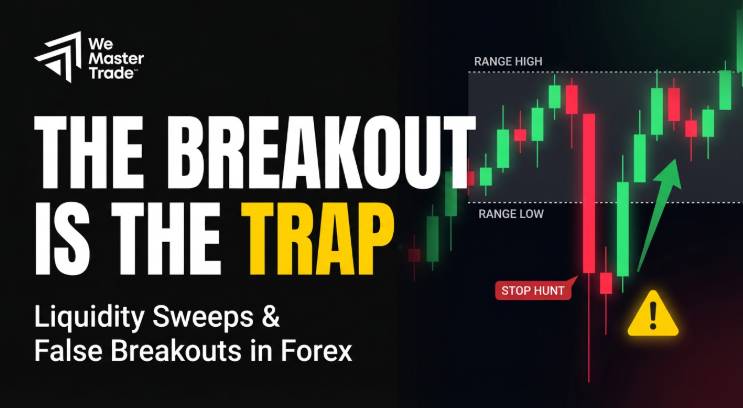
Price suddenly breaks above or below the range. The move is fast and convincing. Traders enter quickly because they believe a trend has started. Within moments, price returns back inside the range.
This is the classic liquidity sweep.
The characteristics are consistent. You often see a sharp wick, a fast impulse beyond the range, and then a rejection. Stop losses trigger on one side of the market, providing the liquidity needed for the next move.
This is what traders refer to when discussing manipulation in forex. After the fact it appears obvious, but in real time it feels convincing. The challenge is learning patience. A sustained breakout usually holds outside the range. A manipulation move fails to remain there.
When price cannot maintain acceptance beyond the range, the market is telling you something important. The breakout was not the opportunity. It was the signal.
Phase 3: Distribution
The real opportunity often appears during the distribution phase.
After liquidity is taken, price begins to move toward the opposite side of the range. The market now travels with less resistance because many traders are positioned incorrectly and must exit.
This is where the accumulation distribution idea becomes practical. The market accumulates orders, manipulates participants into entering early, and then distributes price in the true direction.
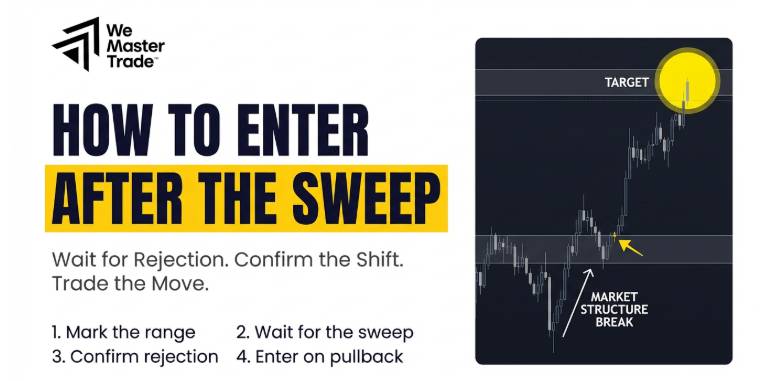
The entry logic becomes clearer at this point. Instead of entering the breakout, you wait for the rejection, then look for a structural shift on a lower timeframe. A pullback after that shift often provides the entry.
Targets typically sit at opposing liquidity, such as previous highs or lows. Stops usually sit beyond the sweep wick. Because risk is defined and targets are logical, the risk-to-reward relationship improves naturally.
Quick Reference Guide
| Phase | Typical Behaviour | What to Look For | What to Avoid |
| Accumulation | Sideways range | Equal highs/lows, stable volatility | Trading inside the range |
| Manipulation | False breakout | Sweep wick and fast rejection | Chasing the breakout |
| Distribution | Directional trend | Structure shift and pullback entry | Entering too late |
How to Trade AMD Step by Step
- Identify higher timeframe bias
- Mark the accumulation range
- Wait for a liquidity sweep
- Confirm rejection and structural shift
- Enter on pullback, not the breakout
- Place stops beyond the sweep
- Target opposing liquidity
The model does not predict. It prepares. You wait for conditions instead of forcing trades.
Many traders practise this model inside structured evaluation environments before risking capital. A common approach is using trading challenges designed to assess discipline and consistency.
Example Walkthroughs
Consider a bullish scenario. Price consolidates during the Asian session. When London opens, the market pushes below the range lows, triggering sell stops. Shortly after, price rejects the move and returns to the range. During the New York session, the market continues upward toward the range highs. This sequence appears frequently in forex trading in Australia, where traders observe how different global sessions interact with liquidity.
The signal was not the drop. The signal was the rejection.
In a bearish scenario, price consolidates beneath resistance. A breakout above the range encourages buyers to enter. Price then returns below resistance and forms lower highs before dropping toward prior lows.
If you use volume indicators, remember that forex volume is decentralised and varies by broker. Many traders rely on price action instead, since the behaviour itself often reveals the pattern.
Common Mistakes
Most errors occur because traders act too early.
They chase the manipulation candle. They try to apply AMD in trending markets where no range exists. They ignore trading sessions and attempt to trade through high-impact news. They move stops emotionally after entry.
A key filter is simple. If you cannot clearly draw the range, there is likely no accumulation phase. Without accumulation, the AMD sequence does not exist.
Risk and Psychology
The manipulation phase creates urgency. Fast movement triggers fear of missing out, and traders enter before confirmation. When the market reverses, frustration often leads to revenge trading.
Structured risk rules help. Fixed position sizing, a defined daily loss limit, and a commitment not to re-enter impulsively protect consistency.
The goal is not to trade often. The goal is to trade well-timed opportunities.
Frequently Asked Questions
Which timeframe works best for spotting AMD?
Higher timeframes identify accumulation more reliably, while lower timeframes provide precise entries.
How do I confirm manipulation is real?
Price must fail to hold outside the range and quickly return inside with rejection.
Where should stops go?
Beyond the sweep wick or outside the range structure.
Can AMD work in forex without volume?
Yes. Price action alone often reveals liquidity behaviour clearly.
How do sessions affect setups?
London often creates manipulation, and New York often produces distribution moves.
How do I distinguish consolidation from accumulation?
Accumulation shows defined highs and lows with repeated reactions, not random sideways movement.
When is AMD unreliable?
During choppy conditions, low liquidity, or major news events.
Should I trade the manipulation phase?
Generally no. The higher probability trade appears during distribution after confirmation.
Bringing It Together
Experienced traders sometimes prefer immediate evaluation rather than phased assessment, which is why some choose instant funding programs based on trading performance.
The most important lesson of accumulation manipulation distribution is simple.
The breakout is usually not the trade. The move after it is.
AMD is a framework for understanding behaviour, not a guarantee. Markets will not follow it every time, but recognising the pattern helps traders avoid reacting emotionally to sudden movement and instead wait for clearer conditions.
This material is educational in nature. Trading involves risk and outcomes vary between individuals.