










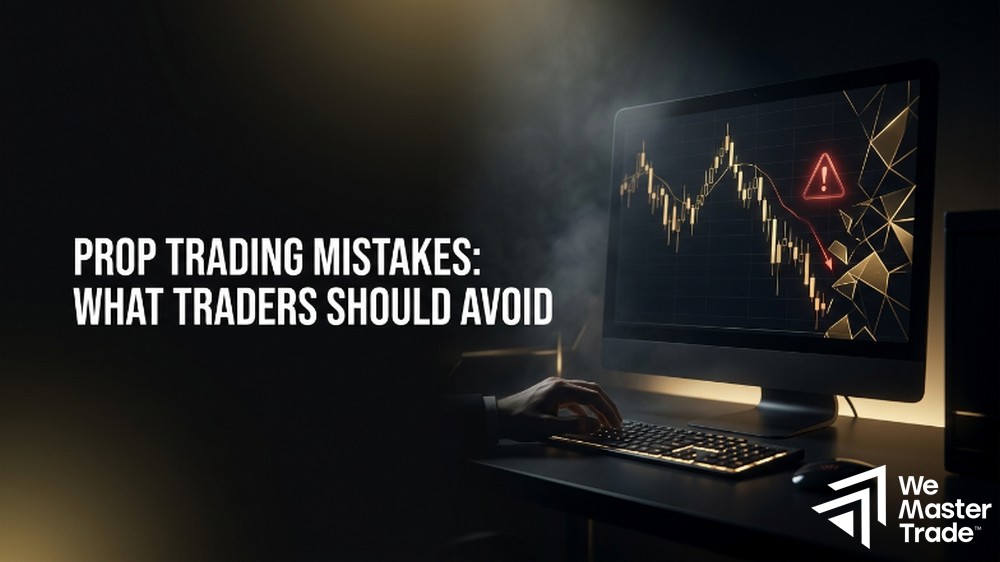
Prop trading mistakes usually do not come from one bad market call. More often, they come from poor risk control, unclear rules, emotional decisions or a strategy that does not fit the evaluation environment.

That is why avoiding mistakes matters. It does not guarantee that a trader will pass a challenge or achieve a payout, but it can reduce avoidable errors and make the process more disciplined.
Why prop trading mistakes can be costly
Prop trading is different from casual practice because rules matter as much as trade direction. A trader can be right about the market and still fail if the position size is too large, the daily loss limit is breached or a news rule is ignored.
This creates a different kind of pressure. Instead of only asking “Is this setup good?” a prop trader must ask:
- Does this trade fit the drawdown limit?
- Does it respect the daily loss rule?
- Is the market condition suitable for my strategy?
- Am I trading because there is a setup, or because I want to recover?
The best traders are not mistake-free. They are better at preventing one mistake from becoming a chain of mistakes.
Common prop trading mistakes and safer responses
| Mistake | Why it hurts | Safer response |
|---|---|---|
| Trading without a plan | Decisions become emotional and inconsistent | Define setup, entry, exit and risk before trading |
| Ignoring risk management | One trade can damage the account | Set risk per trade and daily stop limits |
| Overtrading | More trades can mean more mistakes and costs | Trade only setups that match the plan |
| Using too much leverage | Small moves can create large losses | Size positions around drawdown rules |
| Skipping the journal | Problems stay hidden | Track trades, emotions and rule breaks |
| Chasing the perfect strategy | The trader keeps switching before learning | Test one method long enough to gather data |
| Trading after a big win | Confidence can turn into oversizing | Keep risk fixed after winning streaks |
| Revenge trading after a loss | Losses can compound quickly | Step away after rule breaches or emotional trades |
The safer response is rarely exciting. It is usually basic: reduce size, follow the plan, stop trading when conditions are poor and review decisions with data.
Mistakes before starting a prop firm challenge
One common mistake is starting a challenge before understanding the rules. Traders may focus on the profit target and overlook the daily loss limit, max drawdown, news restrictions, minimum trading days or consistency requirements.

Another mistake is using a strategy that worked in a loose demo environment but does not fit the challenge. For example, a high-volatility strategy may create strong gains in some periods, but it may also create drawdown swings that are too large for the rules.
Before starting, a trader should test the strategy under similar constraints. That means using the same risk per trade, the same instruments, the same trading hours and the same stop rules. If the strategy cannot survive those conditions in practice, the challenge may expose the problem quickly.
Unrealistic targets are also dangerous. A trader who believes they must pass quickly may overtrade or oversize. The better goal is controlled execution. Speed is not useful if it breaks the rules.
Mistakes during a challenge
During a challenge, the most dangerous mistakes often appear after emotional events.
After a loss, some traders try to recover immediately. This can lead to revenge trading, larger positions and weaker setups. After a win, some traders feel more confident and increase size too quickly. Both reactions create risk because the next trade is no longer based on the plan.

News events can create another trap. Major releases may produce fast movement, wider spreads and sudden reversals. Even if the trader has a directional bias, execution can become difficult. If the firm’s rules restrict news trading, ignoring that rule can be more damaging than the trade result itself.
Trading without data is another quiet mistake. Without a journal, the trader may not know whether the problem is entry quality, exit discipline, position sizing, time of day or emotional behavior. A review process makes improvement more concrete.
FAQ
What is the biggest mistake in prop trading?
The biggest mistake is often ignoring risk rules. A trader can recover from a normal loss, but a rule breach can end the evaluation.
How do I know if I am ready for a prop firm challenge?
You may be more prepared if you understand the rules, have tested your strategy under similar limits and can follow risk controls during losing streaks.
Should I practice on a demo account first?
Yes, demo practice can be useful if it follows realistic rules. Practice should include position sizing, drawdown limits and journaling, not only entries.
Is overtrading worse in prop trading?
Overtrading can be especially harmful in prop trading because repeated small mistakes may add up to daily loss or drawdown breaches.
Can avoiding mistakes guarantee passing a prop firm challenge?
No. Avoiding mistakes can improve preparation, but it does not guarantee a result. Markets remain uncertain, and each trader’s strategy and discipline are different.
Trade rules first, profit targets second
The strongest prop trading mindset is rule-first. Profit targets matter, but they should not push the trader into decisions that violate the account structure.
For WeMasterTrade readers, the practical takeaway is simple: know the rules, trade smaller than your emotions want, keep records and review behavior honestly. In prop trading, discipline is not decoration. It is part of the strategy.