












Paper trading practice is one of the most useful ways to learn trading mechanics without putting real money at risk. It allows traders to test entries, exits, risk rules, platform features, and emotional routines in a simulated environment. Used well, it can shorten the learning curve. Used casually, it can create false confidence.
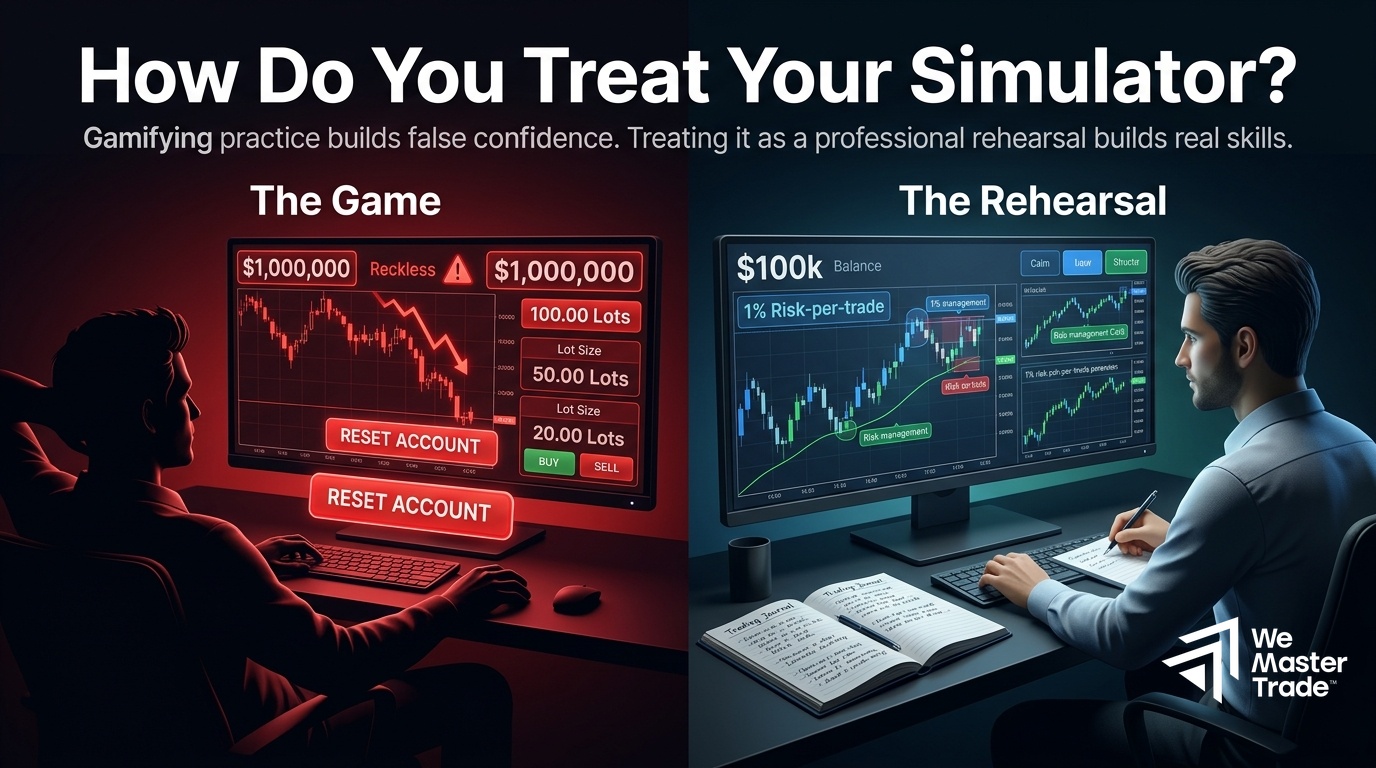
The difference is structure. A trader who treats paper trading like a game may take oversized positions, ignore costs, and reset the account after every mistake. A trader who treats paper trading like professional rehearsal can build habits that transfer more effectively to live or funded trading conditions.
WeMasterTrade focuses on education-first trader development, and paper trading fits naturally with that mission. Traders can combine simulated practice with resources from WeMasterTrade Academy and ongoing educational articles on the WeMasterTrade Blog.
What Is Paper Trading Practice?
Paper trading means practicing trades without using real money. Historically, traders wrote hypothetical trades on paper. Today, most traders use demo accounts, simulators, or platform replay tools.
According to Investopedia, a paper trade is simulated trading that helps investors practice buying and selling securities without real capital. Many brokers and platforms now offer demo environments where users can place orders, monitor charts, and track hypothetical performance.
In a trading education context, paper trading practice can help with:
- Learning order types such as market, limit, stop, and stop-limit.
- Testing a strategy across different market conditions.
- Practicing position sizing.
- Building a pre-trade and post-trade routine.
- Reducing platform mistakes before trading live.
- Understanding how spreads, slippage, and volatility affect execution.
For traders interested in prop firm pathways, paper trading also helps build the discipline required for challenge rules, drawdown limits, and consistent execution. The article Researching the Prop Firm Market explains why traders should understand rules and risk before choosing a funded trading model.
Why Paper Trading Is Useful
Paper trading is valuable because it separates learning from financial pressure. New traders often lose money not only because their strategy is weak, but because they do not yet understand execution, order placement, position sizing, or emotional decision-making.
It builds platform fluency
Before a trader can focus on market structure, they need to know the platform. Paper trading lets them practice placing orders, modifying stops, closing partial positions, setting alerts, and reviewing charts.
This matters because small operational mistakes can become expensive in live markets. Clicking the wrong lot size or closing the wrong position may be avoidable with enough practice.
It supports strategy testing
A paper account can help answer practical questions:
- Does the setup appear often enough to trade?
- Does the stop placement make sense?
- Are targets realistic?
- Does the trade idea work better in trend or range conditions?
- How often does news disrupt the setup?
These answers are not final proof of profitability. They are early evidence that helps a trader decide whether a strategy deserves deeper testing.
It creates a safer learning environment
Day trading and leveraged trading involve significant risks. The SEC warns that day traders may experience severe losses and that trading on borrowed money can increase loss potential. Investor.gov also highlights the complexity and speculative nature of intraday trading, especially when leverage is involved.
Paper trading cannot remove market risk once a trader goes live, but it can help traders avoid learning basic mechanics with real capital.
The Limitations Traders Must Understand
Paper trading is helpful, but it is not the same as live trading. The biggest mistake is assuming simulated results will translate directly into real outcomes.
No real emotional pressure
When there is no real money at stake, it is easier to follow the plan. A trader may hold winners calmly in a demo account but exit too early in live markets. They may accept a simulated loss but panic when real capital is involved.
Execution may be too clean
Some demo environments may not fully reflect slippage, partial fills, spread widening, liquidity gaps, or fast-market conditions. This is especially important for scalpers and news traders, where execution quality can make a large difference.
Reset culture can weaken accountability
If a trader resets the demo account every time performance declines, the practice becomes less useful. The point is not to protect the ego. The point is to collect honest feedback.
Oversized positions create fake confidence
Many simulators provide large virtual balances. If a beginner trades unrealistic size, the results may teach the wrong lessons. A paper account should match the trader’s expected live or funded account rules as closely as possible.
How to Set Up a Realistic Practice Routine
Paper trading becomes more powerful when it mirrors real trading constraints.
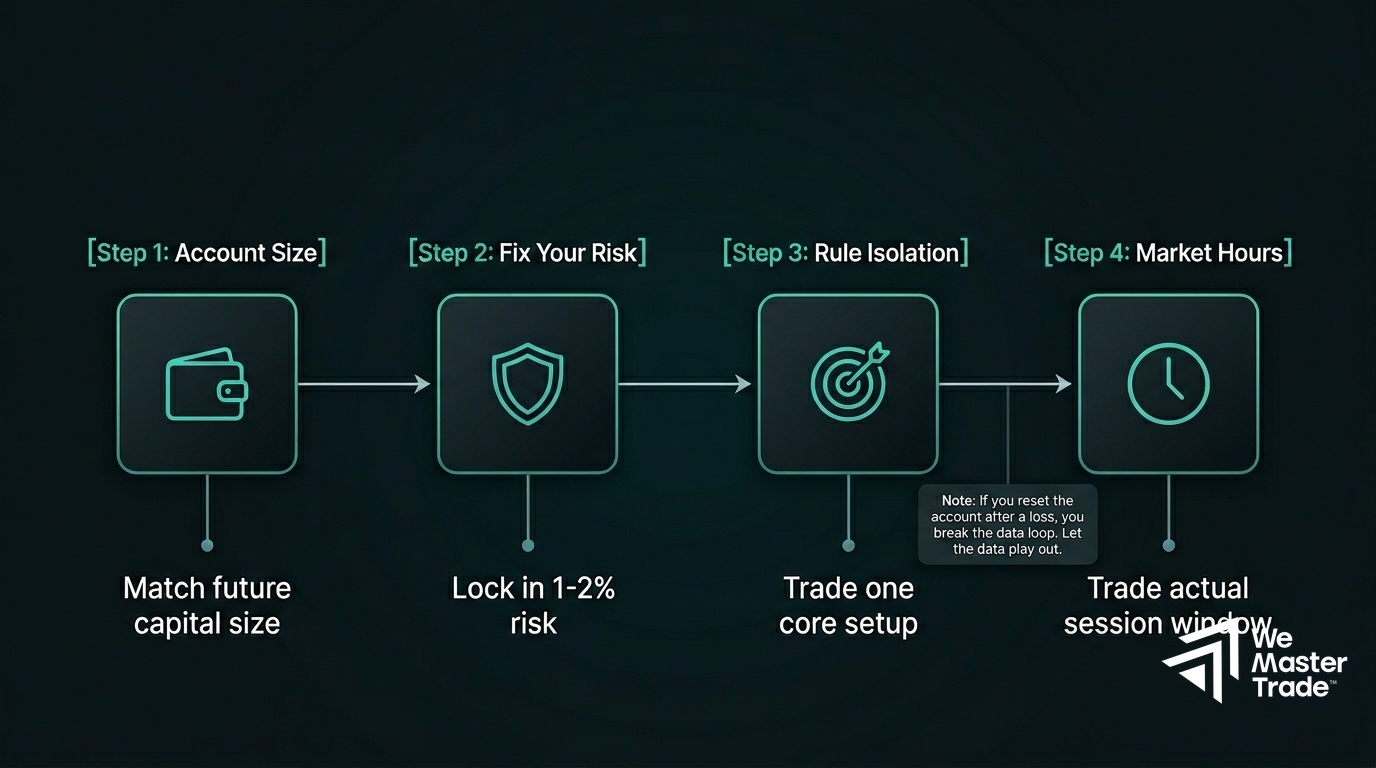
1. Define the practice account size
Set the virtual balance to a realistic amount. If the platform gives $100,000 but your intended live risk is based on a smaller account, adjust position size accordingly.
2. Set a risk-per-trade rule
Many traders risk a small fixed percentage per trade during practice. The exact number depends on the trader’s plan, market, and account rules, but the important point is consistency. Do not change risk size because you feel confident or frustrated.
3. Choose one strategy
Paper trading multiple strategies at once makes review difficult. Start with one core setup, such as trend pullbacks, range reversals, breakout retests, or gap continuation.
4. Define session hours
Trade only during the hours you would realistically trade live. This helps you understand whether the routine fits your schedule, energy, and local timezone.
5. Track costs and slippage assumptions
Even if the simulator does not model costs perfectly, you can record estimated spread, commission, and slippage. This helps prevent unrealistic expectations.
6. Review weekly
A weekly review should answer:
- Did I follow the setup rules?
- Which mistakes repeated?
- Which market conditions were difficult?
- Was the risk consistent?
- Did I stop trading when the plan said to stop?
Structured traders can pair this practice with education from WeMasterTrade Academy and later explore relevant account pathways through WeMasterTrade Instant Funding if appropriate for their goals.
Paper Trading Journal Template
A simple journal can include:
- Date and session.
- Market and timeframe.
- Strategy name.
- Entry reason.
- Stop-loss location.
- Target logic.
- Position size.
- Screenshot before entry.
- Screenshot after exit.
- Result in R-multiple.
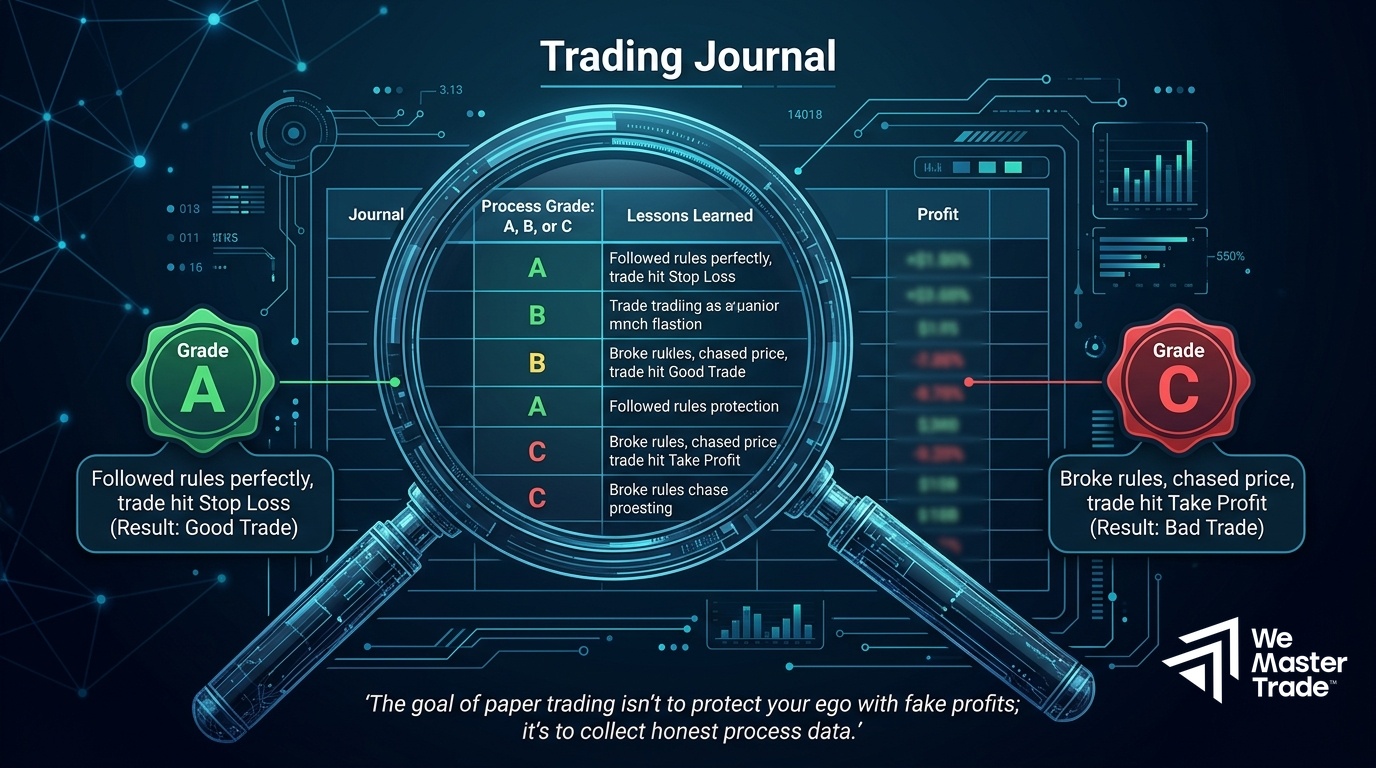
- Process grade: A, B, or C.
- Lesson learned.
The most important field is not profit or loss. It is process grade. A trader needs to know whether results came from plan execution or randomness.
When to Move From Paper Trading to Live Conditions
A trader may consider moving beyond paper trading when they can show consistency in process, not just in simulated profit.
Signs of readiness may include:
- At least 30 to 50 documented trades in one strategy.
- Consistent use of stop-loss and position sizing.
- No repeated platform mistakes.
- Clear rules for when not to trade.
- Stable performance across different market conditions.
- A written plan for reducing size if live emotions become difficult.
The transition should be gradual. Some traders begin with very small live size to experience real emotional pressure while limiting risk. Others use structured evaluation environments. In all cases, trading involves risk, and simulated results should not be treated as a promise of future outcomes.
FAQ
Is paper trading good for beginners?
Yes. It is especially useful for learning platform mechanics, order types, and basic strategy execution before using real capital.
How long should I paper trade?
There is no fixed timeline. A better standard is evidence: enough documented trades to show that you can follow one strategy consistently.
Can paper trading make me profitable?
Paper trading can help build skills, but it does not guarantee live profitability. Real markets include emotional pressure, execution differences, costs, and changing conditions.
Should experienced traders use paper trading?
Yes. Experienced traders often use simulation to test new ideas, adapt to new markets, or rebuild confidence after a difficult period.
Conclusion
Paper trading practice is not a shortcut. It is rehearsal. When used with realistic rules, honest journaling, and clear review, it can help traders develop platform confidence and disciplined execution before entering live or funded trading conditions.
The best paper trading routine treats every simulated trade as data. The goal is not to prove you are right. The goal is to learn what your process can and cannot handle.