












Most traders believe doing more leads to earning more. More trades, more indicators, more screen time — surely that adds up to more profit? It doesn’t. In fact, the opposite is almost always true. The less is more trading philosophy is one of the most consistently supported ideas across professional trading floors, funded trader programs, and elite price action communities. Yet it’s also one of the hardest principles for new traders to genuinely accept and apply. This guide from WeMasterTrade breaks down exactly what it means, why it works, and how you can build it into your trading system starting today.
Why More Trades Usually Means More Losses
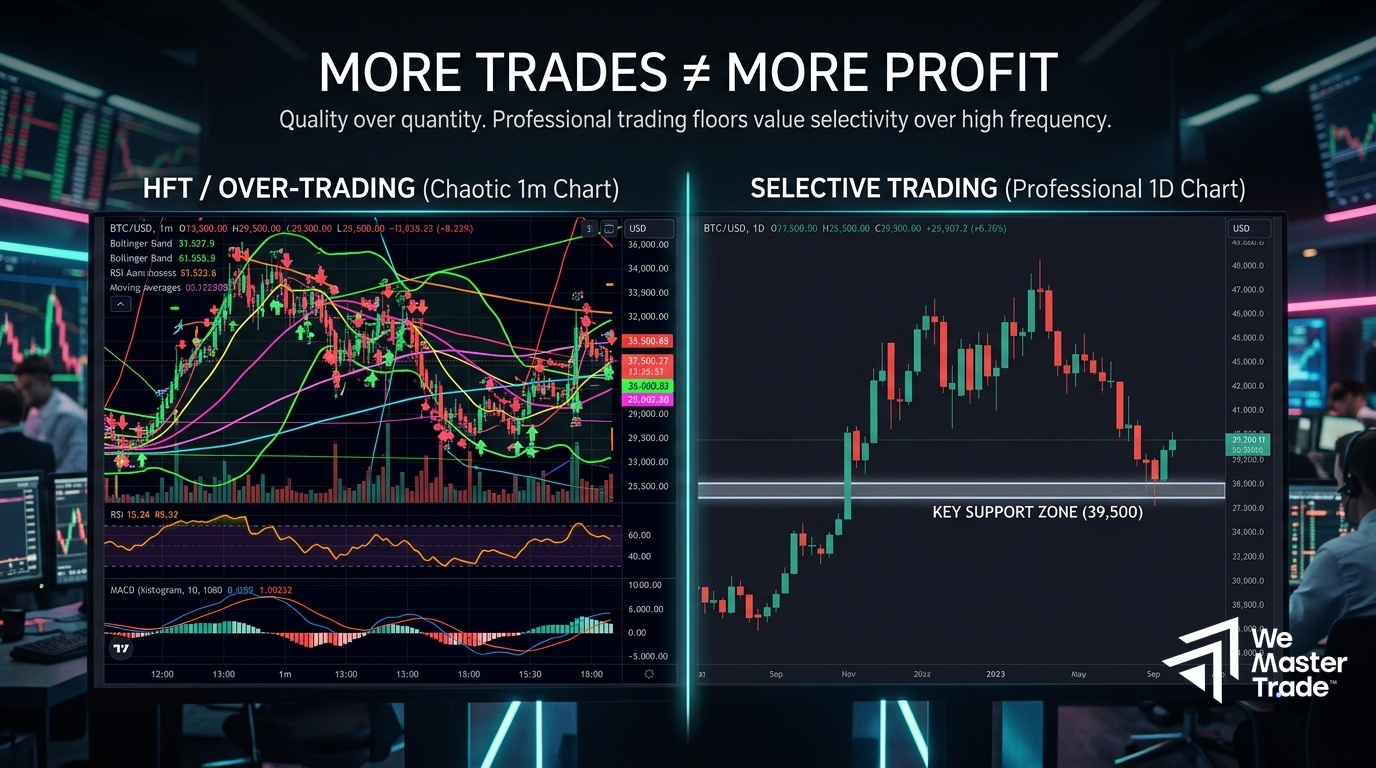
Overtrading is the single most common account killer — not bad strategies, not market conditions, not bad luck.
When you’re in the market constantly, you’re not looking for quality setups. You’re filling time. You’re reacting to noise. And every unnecessary position you open carries transaction costs, emotional wear, and drawdown risk that chips away at your edge.
The Math of Overtrading
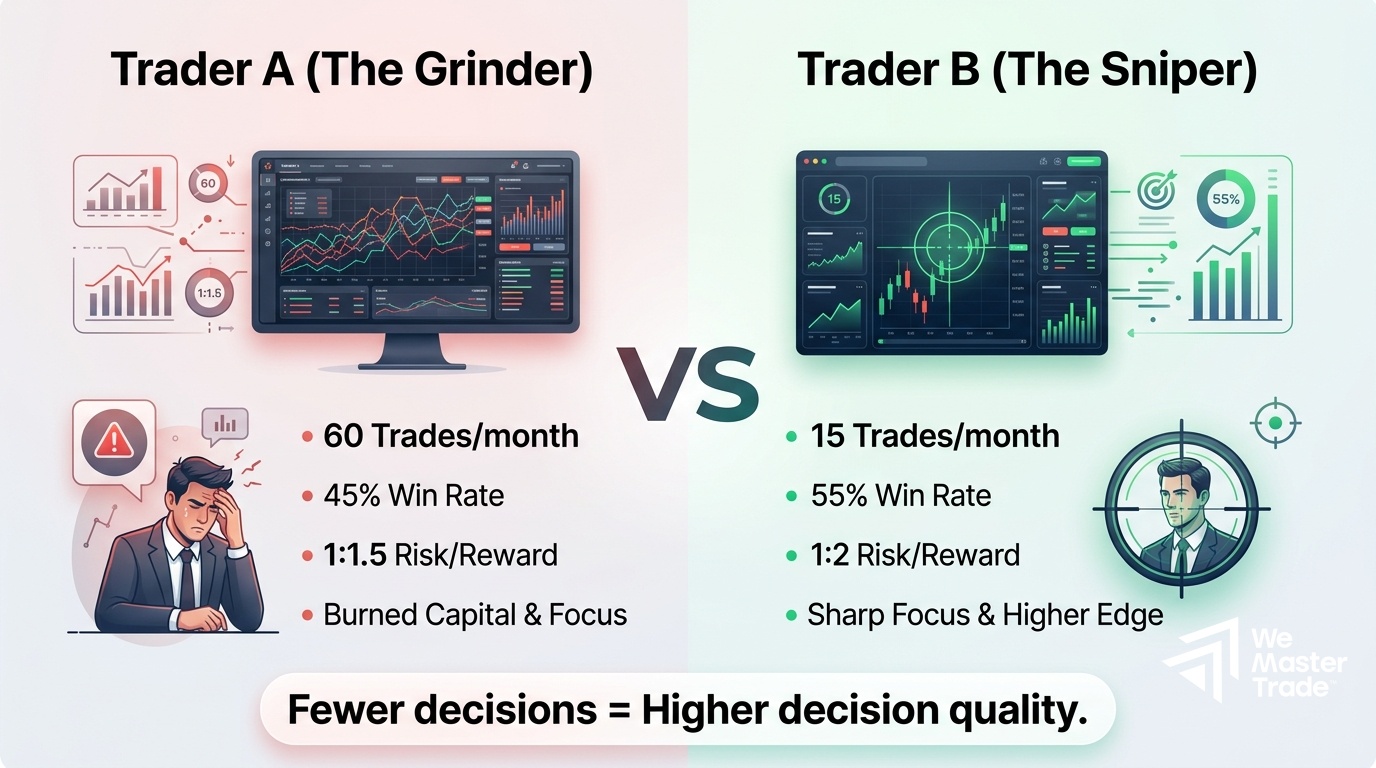
Consider two traders:
- Trader A takes 60 trades per month with a 45% win rate and 1:1.5 R:R
- Trader B takes 15 trades per month with a 55% win rate and 1:2 R:R
Trader B’s expectancy per trade is significantly higher, and because they’re taking fewer positions, their decision quality stays sharp. Trader A is grinding — burning focus and capital in equal measure.
The prop trading world validates this constantly. Accounts breached in evaluation phases are overwhelmingly the result of overtrading during drawdown, not a single catastrophic loss.
Every Trade Has a Hidden Cost
Beyond spreads and commissions, every trade you take costs you psychological capital. The more decisions you force, the worse your judgment becomes. Cognitive fatigue is real, and it hits traders who are glued to charts for six hours harder than those who check in once or twice a day.
What “Less Is More” Actually Means in Practice
This isn’t about trading infrequently for its own sake. It’s about quality over quantity — being selective enough that when you do pull the trigger, the setup genuinely justifies the risk.
A trader with a clean, well-defined trading system who takes 10 high-conviction trades a month will almost always outperform someone throwing 50 trades at the market hoping a handful stick.
Defining Your Setup Criteria
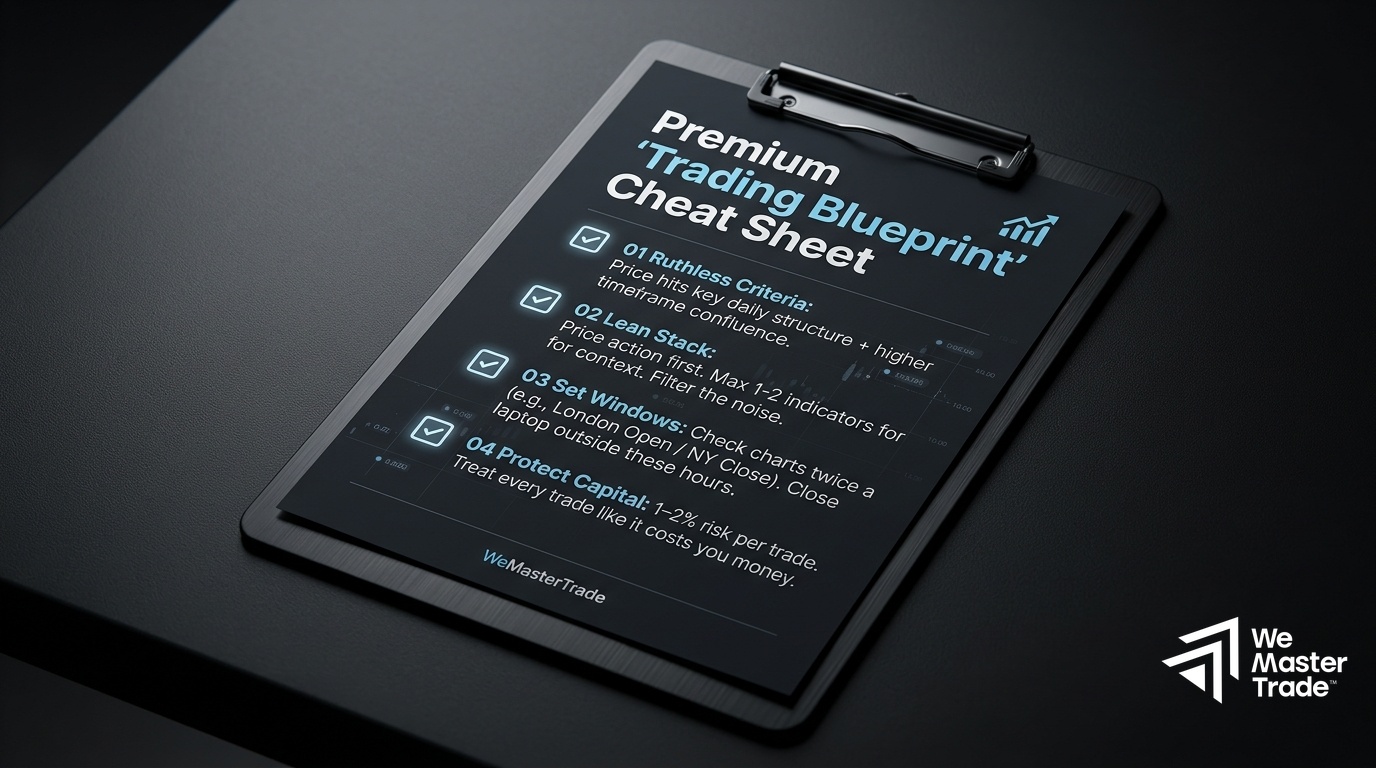
The first step is to get ruthlessly specific about what constitutes a valid setup for you. That might be:
- Price reaching a key daily structure level
- A confluence of support/resistance with a higher-timeframe trend
- A clean candlestick pattern at a predetermined zone
Whatever your criteria, write them down. If a trade doesn’t meet every condition on your checklist, it doesn’t get taken. Full stop.
This is how professional traders operate. They’re not hunting for trades — they’re waiting for the market to come to them.
Simplify Your Chart: Fewer Indicators, Clearer Signals
Walk into most retail traders’ setups and you’ll find a chart covered in overlapping indicators — MACD, RSI, Stochastic, three moving averages, Bollinger Bands. Each one was added after a losing trade in an attempt to prevent the next one.
The reality is that indicator overload creates more confusion, not less. When five tools are all giving slightly different signals, decision paralysis follows — or worse, you cherry-pick the one that confirms what you already want to do.
Build a Lean Indicator Stack
A lean setup might look like this:
- Price action as primary signal — candlestick patterns, structure, and trend direction
- One momentum indicator (RSI or MACD) to confirm entry timing
- Volume or ATR for context on market conditions
Three data points, cleanly interpreted, beat ten conflicting ones every time.
Higher timeframes help here too. The daily and 4-hour charts filter out the noise that the 1-minute and 5-minute charts amplify. When you zoom out, the signal-to-noise ratio improves dramatically — and so does your win rate.
Risk Management Is Where “Less” Does the Heavy Lifting
Traders who overtrade are often managing too many open positions simultaneously, which forces them to cut winners early to protect overall account equity. The result is a portfolio of mediocre exits and outsized losses. Traders exploring prop firm models can also read Researching the Prop Firm Market to understand why rules and risk limits matter.
The Power of Doing Less With Position Sizing
If you’re only taking 10–15 trades per month, you can afford to be precise with every single entry and exit. You can:
- Set your stop loss at a technically justified level rather than a round number
- Size each position based on the actual risk to your account (typically 1–2%)
- Hold trades to their full target without emotional interference
This level of precision is nearly impossible to maintain when you’re juggling a dozen active trades. Fewer trades, better execution.
Protecting Your Funded Account
If you’re trading a funded account or working toward a prop firm challenge, risk management isn’t optional — it’s the evaluation criterion. Drawdown limits are firm. One emotional revenge trade after a loss can wipe out a week of gains.
The traders who pass evaluations and keep funded accounts long-term are almost always the ones who trade sparingly, protect capital first, and treat each trade like it costs them money to take — because it does.
Building a Trading Routine Around Patience
Patience isn’t a personality trait you either have or don’t have. It’s a skill you develop by building systems that enforce it.
Set Specific Chart-Check Times
One of the most practical changes you can make is to stop watching charts in real time. Decide you’ll check the charts twice a day — once at the London open and once at the New York close, for example. Outside of those windows, the charts are closed.
This single habit eliminates the majority of impulsive entries. When you’re not watching tick by tick, you can’t trade tick by tick.
Use a Trading Journal to Raise Your Standards
Track every trade: the setup conditions, your reasoning, the outcome, and — critically — whether it met your predefined criteria. After 30 or 60 trades, a pattern emerges. Trades taken outside your system underperform. Trades taken inside it hold up.
That data becomes your own evidence-based argument for taking fewer, better trades. You stop needing willpower to stay disciplined — you have proof.
The Rules Traders Break by Trading Too Much
Overtrading doesn’t just cost you money. It causes you to break the rules you set for yourself, often without realizing it.
- Trading during news events you said you’d avoid — because you’re bored and the market is moving
- Adding to losing positions because you’ve already got three other trades open and the math feels manageable
- Moving stop losses wider to avoid being stopped out of a trade you entered impulsively
Every one of these mistakes is more likely when you’re trading frequently. When you take fewer trades, each one gets more scrutiny, more respect, and better execution.
Conclusion: Trade Less, Build More
The best-performing traders in prop firms and professional trading environments share one visible trait: they’re selective. They wait. They pass on setups that are “pretty good” in favor of setups that are clearly excellent. They understand that not being in a trade is itself a position — one that costs nothing and risks nothing.
If you’re struggling with consistency, the answer is rarely a better indicator or a faster strategy. It’s almost always fewer trades, tighter rules, and more patience.
At WeMasterTrade, our funded trading program rewards disciplined, consistent trading — not high-frequency activity. If you’re ready to trade like a professional, start by doing less of what isn’t working.