












Price gaps attract attention because they show urgency. A market closes at one level and opens at another, leaving a visible space on the chart. Traders often ask whether the gap will fill, continue, or reverse. The honest answer is: it depends on context.
Learning how to trade gaps is not about assuming every gap closes. It is about identifying the type of gap, the reason behind it, the market environment, and the risk if price moves against the trade.
This guide is educational, not personal financial advice. Traders should test any gap strategy in a simulated environment before using real capital. WeMasterTrade readers can continue building technical and risk skills through WeMasterTrade Academy and broader market education on the WeMasterTrade Blog.
What Is a Gap in Trading?
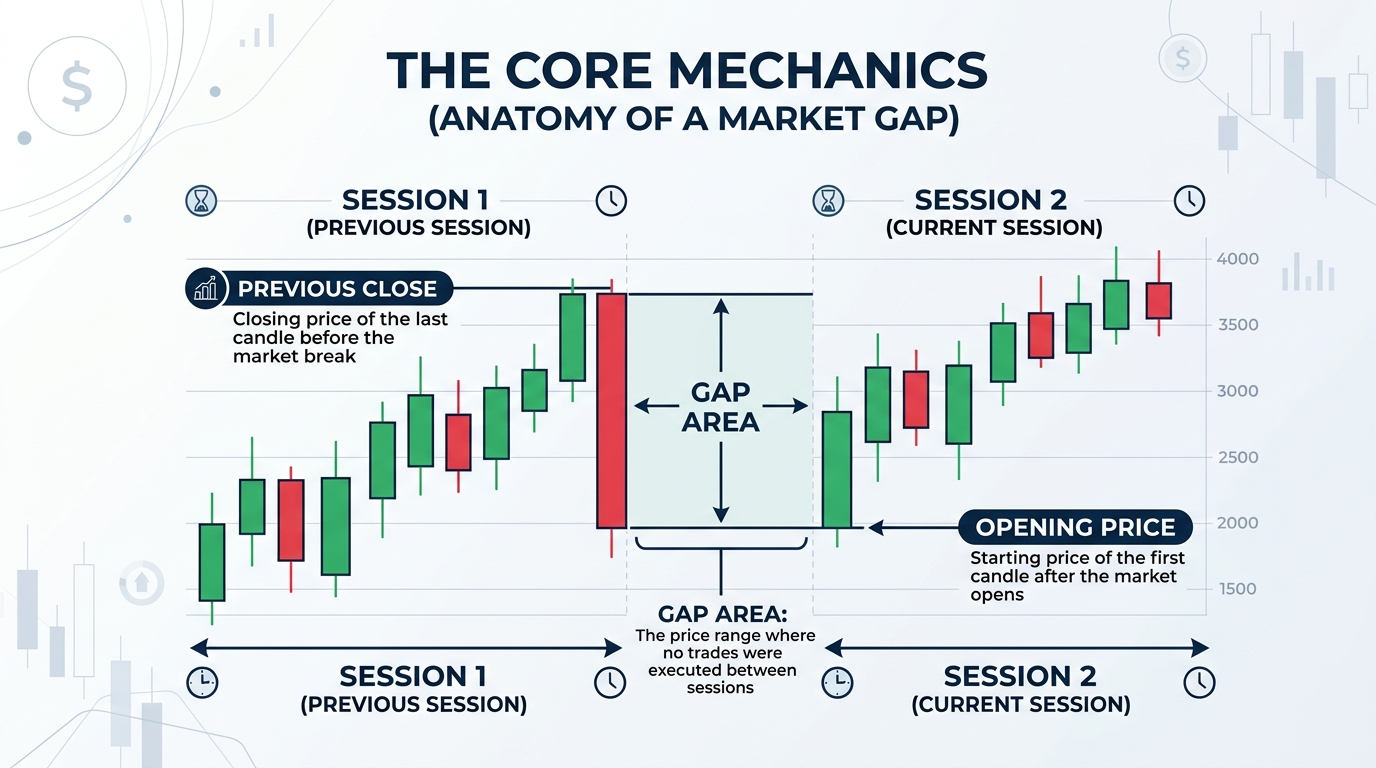
A gap is a discontinuity on a price chart where the market opens significantly above or below a previous trading range, leaving little or no trading activity between the two areas. Investopedia describes a stock gap as a discontinuity in price that can be caused by impactful news or events outside regular trading hours.
Gaps are common in stocks because companies release earnings, guidance, mergers, regulatory news, and other updates outside market hours. Gaps can also occur in indices, futures, commodities, and crypto-related products, especially around market reopenings, weekends, and major macroeconomic events.
Why Gaps Happen
Gaps happen when new information changes the balance between buyers and sellers before the next regular trading session. By the time the market opens, the old closing price may no longer reflect where participants are willing to trade.
Common causes include:
- Earnings releases and guidance updates.
- Economic data such as inflation, employment, or central bank decisions.
- Geopolitical events.
- Analyst upgrades or downgrades.
- Sector-wide news.
- Overnight futures movement.
- Low liquidity during pre-market or after-hours trading.
Gaps are important because they combine price movement with uncertainty. They can create opportunity, but they also create gap risk. Investopedia explains gap risk as the possibility that price moves sharply between sessions without allowing investors to react at intermediate prices.
The Four Common Gap Types
Many technical traders classify gaps into four categories: common, breakaway, runaway, and exhaustion gaps. These categories are useful, but they are easier to identify after the fact than in real time.
Common gaps
Common gaps often occur in sideways markets and may not have a strong news catalyst. They are more likely to fill, but traders should still wait for confirmation instead of assuming.
Breakaway gaps
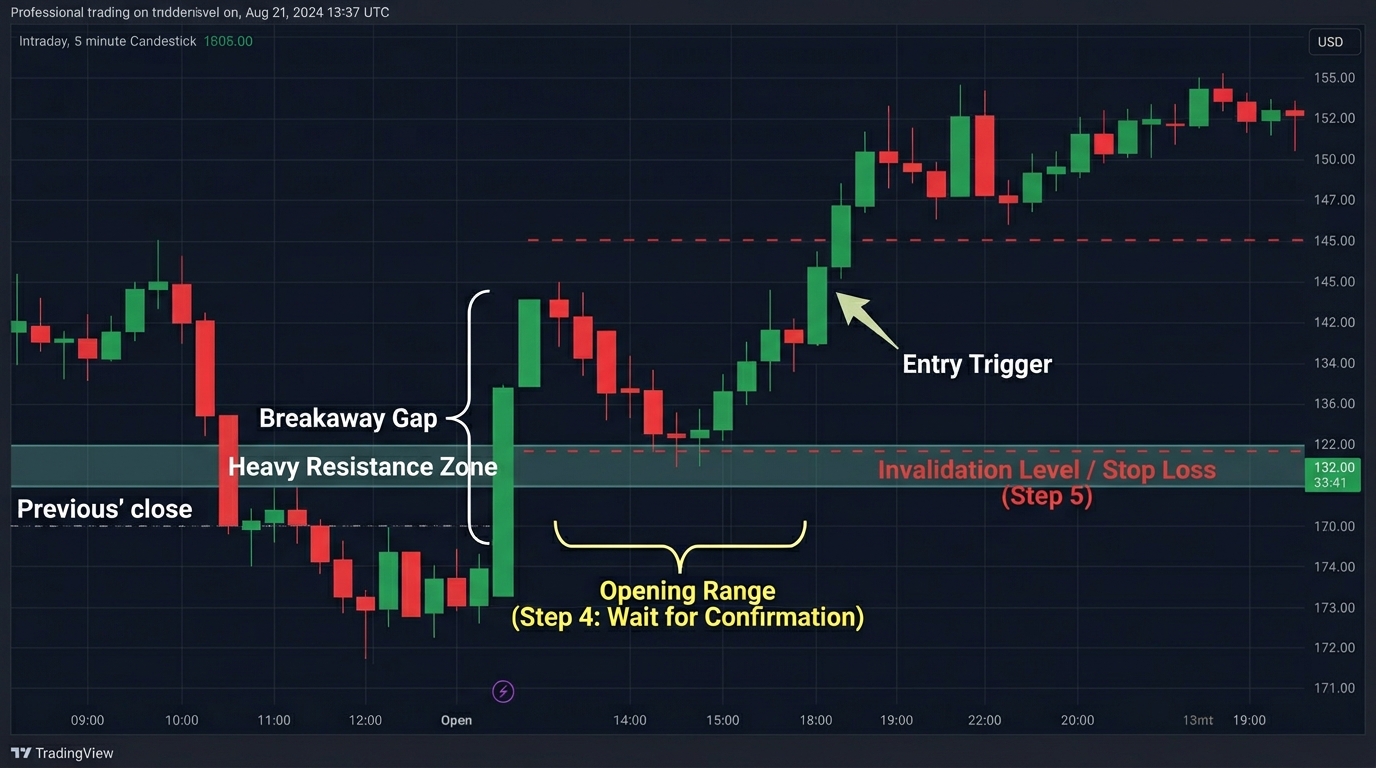
Breakaway gaps occur when price gaps out of a consolidation, range, or major support/resistance zone. They may signal the start of a new trend if supported by volume, news, and follow-through.
Runaway gaps
Runaway gaps, also called continuation gaps, appear during an existing trend. They can show urgency as traders who missed the earlier move enter aggressively.
Exhaustion gaps
Exhaustion gaps appear late in a trend and may signal that the move is becoming stretched. They can be followed by reversal or gap fill, especially if volume spikes and price fails to continue.
Gap Fill Versus Gap Continuation
The two broad gap trading ideas are gap fill and gap continuation.
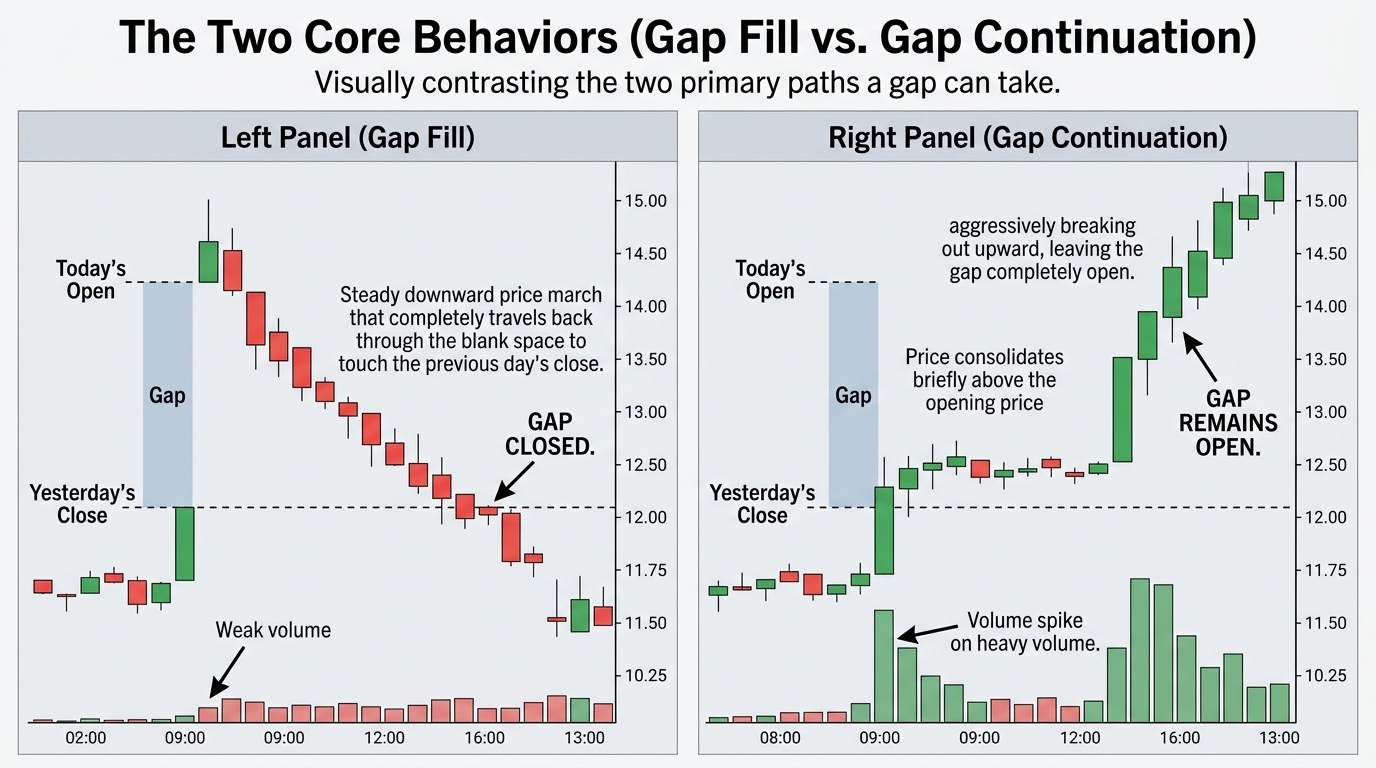
Gap fill
A gap fill trade expects price to move back toward the previous close or into the gap area. This approach may work better when:
- The gap is small or unsupported by strong news.
- The broader market is neutral.
- Price fails to hold above or below the opening range.
- Volume weakens after the open.
- The gap occurs into a major support or resistance zone.
Gap continuation
A gap continuation trade expects price to keep moving in the direction of the gap. This approach may work better when:
- The gap breaks a significant technical level.
- The catalyst is strong and market-moving.
- Volume confirms participation.
- Price holds above the opening range after a gap up, or below it after a gap down.
- The broader market supports the direction.
StockCharts describes gap trading as using price differences between a prior close and next open, with traders judging whether price may fill the gap or continue in the gap direction. That judgment should be based on evidence, not habit.
A Step-by-Step Gap Trading Framework
Step 1: Identify the catalyst
Before trading the chart, ask why the gap happened. An earnings surprise is different from a low-volume pre-market move. A central bank decision is different from a minor analyst note.
If you cannot identify the catalyst, reduce confidence. Unknown gaps can still be traded, but they deserve smaller size or stricter confirmation.
Step 2: Mark key levels
Mark:
- Previous close.
- Pre-market high and low.
- Opening price.
- Opening range high and low.
- Nearby support and resistance.
- Prior day’s high and low.
These levels help define whether price is accepting the new gap level or rejecting it.
Step 3: Classify the gap
Ask whether the gap appears common, breakaway, runaway, or exhaustion. You do not need perfect classification. You need a working hypothesis that can be confirmed or rejected.
Step 4: Wait for confirmation
The first minutes after the open can be volatile. Many traders use an opening range, such as the first 5, 15, or 30 minutes, to avoid entering during the most chaotic price discovery.
For a gap continuation setup, confirmation may be a break above the opening range high on a gap up. For a gap fill setup, confirmation may be failure to hold the opening range followed by a move back into the gap.
Step 5: Define invalidation
Every gap trade needs a level that proves the idea wrong. For continuation, invalidation may be a move back into the opening range or below a breakout level. For gap fill, invalidation may be a strong reclaim of the opening range in the gap direction.
Step 6: Plan exits before entry
Targets may include:
- Partial fill of the gap.
- Full fill to the previous close.
- Prior support or resistance.
- Measured move from the opening range.
- Trailing stop if continuation gains momentum.
Do not enter first and decide later. Gap trades can move quickly.
Risk Management for Gap Trades
Gap trading requires extra risk control because volatility and slippage can be higher than normal.
Practical safeguards include:
- Reduce position size during high-volatility opens.
- Avoid trading gaps immediately before major scheduled news unless the strategy is built for it.
- Use limit orders when appropriate, but understand that limit orders may not fill.
- Avoid assuming stop-loss orders always execute at the exact stop price during fast markets.
- Do not average down into a gap trade unless it is part of a tested plan.
- Stop trading after reaching a daily loss limit.
Funded traders should be especially careful because one volatile open can challenge daily drawdown or rule limits. Traders evaluating prop firm pathways may find Researching the Prop Firm Market and WeMasterTrade Instant Funding useful for understanding why account rules and risk boundaries matter.
Common Mistakes
Assuming every gap fills
Some gaps fill quickly. Others continue for days or weeks. Treating gap fill as automatic can be dangerous.
Ignoring the catalyst
A gap caused by a major earnings surprise is not the same as a random low-volume gap. Context matters.
Entering too early
The open can be noisy. Waiting for confirmation may reduce the number of trades but improve decision quality.
Using normal size in abnormal volatility
Gap trades can move faster than regular setups. Smaller size can help keep risk consistent.
Forgetting broader market direction
An individual stock gap may be easier to trade when the sector and index support the same direction. If the broader market is moving against the gap, the setup may be weaker.
FAQ
Do all gaps get filled?
No. Some gaps fill quickly, some fill much later, and some may not fill for a long time. Traders should avoid treating gap fills as guaranteed.
What is the safest way to trade gaps?
There is no risk-free way to trade gaps. A more disciplined approach is to wait for confirmation, reduce size, define invalidation, and paper trade the setup before using real capital.
Are gap trades better for stocks or forex?
Gaps are often more visible in stocks because regular sessions close overnight. Forex trades nearly 24 hours during the week, so gaps are more common after weekends or major events.
Should beginners trade gaps?
Beginners should study gaps and practice in simulation first. Gap trading can be volatile and may be difficult without strong risk management.
Conclusion
Learning how to trade gaps requires more than spotting empty space on a chart. Traders need to understand why the gap happened, whether price is accepting or rejecting the new level, and where the trade idea becomes invalid.
The strongest gap traders are selective. They know the difference between a gap that deserves action and a gap that only deserves observation. As with all trading strategies, market conditions may vary, and no setup guarantees profit.