












Forex order types are instructions that tell a platform when and how to enter, manage or exit a position. A market order prioritizes immediate execution. A limit order prioritizes a specified price or better. A stop order waits for price to reach a trigger and then seeks execution.
Choosing the right order does not make a trade profitable. It makes the plan more precise. The order should express where the setup becomes valid, where it becomes invalid, what price is acceptable and what execution risk remains.
This guide covers the main order types, their position relative to the current market and the mistakes that commonly cause unintended trades.
Forex order types at a glance
Assume EUR/USD is quoted near 1.1000. The table shows the usual directional logic.
| Order | Buy placement | Sell placement | Primary use | Main risk |
|---|---|---|---|---|
| Market | At current available prices | At current available prices | Enter or exit immediately | Slippage and spread |
| Limit | Below current market | Above current market | Enter on a pullback or exit at a target | Order may not fill |
| Stop entry | Above current market | Below current market | Enter after a breakout trigger | False breakout and slippage |
| Stop loss | Below market for a long | Above market for a short | Limit loss after invalidation | Trigger price is not a guaranteed fill |
| Take profit | Above market for a long | Below market for a short | Exit at a favorable target | Price may not reach or fully fill |
| Stop-limit | Trigger plus limit price | Trigger plus limit price | Control the worst accepted price after a trigger | Can remain unfilled during a fast move |
| Trailing stop | Follows price under a long | Follows price above a short | Lock in part of a favorable move | Normal volatility can trigger it early |
Availability and naming vary by platform. Some systems combine orders into one ticket, while others require separate entry, stop-loss and take-profit instructions.

Market orders
A market order asks for execution at the best available price. It prioritizes getting into or out of the market, not receiving the exact price shown when the button was pressed.
When a market order is useful
- The trader needs immediate execution.
- The market is active and the spread is acceptable.
- Waiting for a pullback would invalidate the purpose of the trade.
- An existing position must be closed because risk has changed.
Market-order execution risk
The displayed bid and ask can change before the order reaches the execution venue. If the requested quantity exceeds the amount available at the best price, the order may fill across several levels.
This creates slippage. It can be positive or negative, but fast or thin markets increase the probability that the realized fill differs from the quote.
A market order is therefore not “buy at the current chart price.” It is “buy or sell now at the prices available when the order is processed.”
Limit orders
A limit order specifies a price condition. A buy limit is normally placed below the current market because the trader wants to buy after a decline. A sell limit is normally placed above the current market because the trader wants to sell after a rise.
Buy limit example
EUR/USD trades around 1.1000, and a trader believes the 1.0960 area may provide support. A buy limit at 1.0960 waits for the ask price to reach an executable level at or below the limit.
The order may receive a full fill, a partial fill or no fill. A chart touching 1.0960 does not always prove that sufficient quantity was available for that account.
Sell limit example
GBP/USD trades around 1.2700, and the trader expects resistance near 1.2760. A sell limit at 1.2760 waits to sell at that price or better.
If price reverses before reaching the limit, the trade is missed. That is not necessarily a failure; the order protected the trader from entering at a worse price than planned.
Limits as exit orders
A take-profit instruction is commonly implemented as a limit order. A long position places the target above the market, while a short position places it below.
Limit orders control price but sacrifice certainty of execution. They are most appropriate when the acceptable price matters more than immediate participation.
Stop entry orders
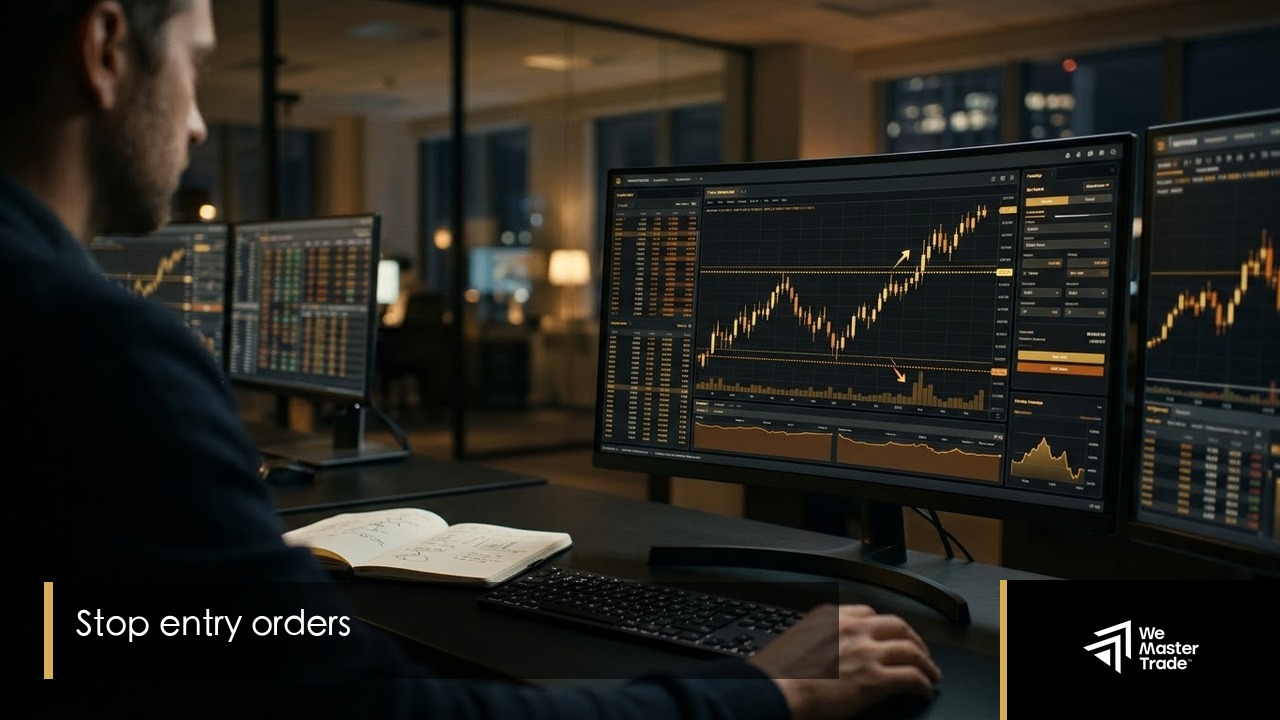
A stop entry order waits for price to reach a less favorable level before entering. It is commonly used when the trader wants evidence that price has broken beyond a threshold.
- A buy stop is placed above the current market.
- A sell stop is placed below the current market.
Buy stop example
USD/JPY trades near 150.00 and has repeatedly failed below 150.40. A trader may place a buy stop above 150.40 so the order activates only if price moves through the resistance area.
The risk is a false breakout. Price can trigger the order, fill higher because of slippage and then return below the level.
Sell stop example
AUD/USD trades near 0.6600 with support around 0.6560. A sell stop below that level enters only if price breaks lower.
Again, the stop is a trigger rather than a guaranteed execution price. During news or a gap, the first available fill may be below the requested trigger.
Stop-loss and take-profit orders
Entry orders create exposure. Protective orders define how that exposure should be reduced.
Stop-loss order
A stop loss closes a position after price reaches an invalidation level.
- A long position generally uses a sell stop below the market.
- A short position generally uses a buy stop above the market.
The stop should be placed where the trade idea is wrong, not at a random distance chosen only to create a preferred risk-reward ratio. Once that distance is known, the trader can calculate position size so the monetary risk remains within the plan.
A conventional stop-market order does not guarantee the trigger price. It becomes executable when triggered and may slip during gaps, news or thin liquidity. The guide to trading without a stop loss explains why removing the order does not remove the underlying risk.
Take-profit order
A take-profit order closes a position at a favorable level. For a long trade, it sits above the entry; for a short trade, below it.
Targets can be based on structure, volatility, measured movement or a tested strategy rule. The target should be defined before entry where possible, but it may be adjusted only under a documented process rather than emotional reaction.
Bracket orders
Some platforms allow an entry to be submitted with both a stop loss and take profit. These linked instructions are often called a bracket. When one exit fills, the other should be canceled under an OCO relationship, but traders must verify the platform’s behavior.
Trailing stops, stop-limit and linked orders
Trailing stop
A trailing stop moves in the favorable direction as price advances, while remaining fixed when price moves against the position. It can trail by points, percentage, volatility or a chart-based rule depending on the platform and strategy.
Advantages:
- Automates part of exit management.
- Can protect an open gain during a sustained trend.
- Reduces the need for constant manual adjustment.
Limitations:
- A trail that is too tight can be triggered by normal noise.
- A fixed-distance trail does not adapt to changing volatility unless designed to do so.
- Gaps and slippage still apply.
- Some trailing functions run locally and may require the platform to remain connected.
Stop-limit order
A stop-limit order has a trigger and a limit. After the trigger is reached, the order becomes a limit order rather than a market order.
This controls the worst accepted price, but it creates non-execution risk. If the market jumps beyond the limit, the order may remain open while the loss continues to grow. It should not be described as an automatically safer stop loss.
OCO and if-done orders
“One cancels the other” links two orders so that filling one cancels the other. An if-done instruction activates related orders only after the first order fills.
These tools can reduce operational mistakes, but support and behavior differ. Partial fills, connection failures and manual position changes can leave unexpected orders active. Always check the order list after an execution.
Time-in-force instructions
Platforms may offer:
- GTC: good until canceled.
- Day: active until the trading day ends.
- GTD: good until a specified date or time.
- IOC: execute immediately as much as possible and cancel the rest.
- FOK: fill the entire amount immediately or cancel it.
Retail Forex platforms do not all support every instruction. Confirm the definitions on the supported trading platforms rather than assuming a familiar label behaves identically everywhere.
How bid, ask and spread affect triggers
Forex always has two prices:
- The bid is the price at which the market can buy from the trader.
- The ask is the price at which the trader can buy from the market.
- The difference is the spread.
A long position opens at the ask and closes at the bid. A short opens at the bid and closes at the ask. Depending on platform conventions, the chart may display primarily the bid.
This can create apparent discrepancies. A short position’s stop may trigger because the ask reached the level even though a bid-only chart did not visibly touch it. A buy stop can also activate as the ask rises while the displayed bid remains lower.
Spreads can widen around news, rollover and holidays. Protective levels should account for the actual trigger side and normal spread behavior, not just a single chart line.
Worked order examples

| Scenario | Order | Reason |
|---|---|---|
| Buy EUR/USD only after a pullback from 1.1000 to 1.0960 | Buy limit | Seeks a lower entry price |
| Buy EUR/USD only after a break above 1.1040 | Buy stop | Requires upward confirmation |
| Sell GBP/USD after a rally into 1.2760 resistance | Sell limit | Seeks a higher short entry |
| Sell GBP/USD only after support breaks at 1.2640 | Sell stop | Requires downward confirmation |
| Exit a long if structure fails below support | Sell stop loss | Defines invalidation risk |
| Exit a short at a lower target | Buy limit/take profit | Closes at a favorable price |
Complete trade example
Suppose EUR/USD trades at 1.1000 and a strategy identifies resistance at 1.1040. The trader wants to enter only after a break.
- Place a buy stop at the validated trigger above resistance.
- Define the invalidation level below the breakout structure.
- Calculate size from the entry-to-stop distance.
- Attach a stop loss and target if the platform supports a bracket.
- Check scheduled news and current spread.
- Cancel the order if the setup expires before activation.
The order type expresses the strategy. It does not validate the breakout or guarantee the fill.
Common order-placement mistakes
Reversing limit and stop logic
The simplest memory rule is:
- Buy limit below; buy stop above.
- Sell limit above; sell stop below.
Ignoring the spread
Placing orders from a bid-only chart without considering the ask can lead to unexpected triggers. Always confirm which side activates the order.
Treating a stop price as guaranteed
Stops can slip during gaps and fast markets. Weekend gaps in Forex are a clear example: the next available price may be far beyond Friday’s close.
Using a stop-limit where exit certainty matters most
The limit can prevent a bad fill, but it can also prevent any exit. Traders must choose between price control and execution priority consciously.
Leaving stale pending orders active
A valid setup can expire. If the context changes but the pending order remains, it may activate days later for the wrong reason.
Changing size without recalculating risk
The same stop distance with a larger lot size creates a larger monetary loss. Entry, stop and size must be reviewed as one unit.
Failing to record realized execution
The order ticket shows intention; the account history shows reality. Track spread, fill, slippage and exit behavior as part of your trading statistics.
Pre-order checklist
Before submitting any Forex order, confirm:
- Is this an entry, protective exit or profit target?
- Should execution be immediate or conditional?
- Is the order above or below the current bid and ask?
- Which price side triggers it?
- Where is the strategy invalidated?
- What is the monetary risk after position sizing?
- Can the order slip or remain unfilled?
- Does scheduled news or rollover affect execution?
- When should the order expire or be canceled?
- Are stop and target orders linked correctly?
- Do the platform and account rules allow this trade?
Frequently asked questions
What are the four pending Forex order types?
The standard four are buy limit, sell limit, buy stop and sell stop. Limits seek a more favorable entry price; stops enter after price reaches a less favorable trigger in the intended direction.
What is the difference between a limit and stop order?
A limit order prioritizes a specified price or better but may not fill. A stop order activates after a trigger and then usually prioritizes execution, which can result in slippage.
Can a stop loss slip?
Yes. A standard stop loss normally becomes a market order when triggered. If the market gaps or depth is thin, the fill can be worse than the stop price.
Which order type is best for beginners?
There is no universally best type. Market orders are simpler but expose the trader to current spread and slippage. Pending orders require clear trigger logic and active management. Beginners should first understand the execution behavior of each type in a low-risk or simulated setting.
Does a take-profit order guarantee the target price?
It generally controls the minimum acceptable price, but a fill still depends on available liquidity and platform rules. Partial fills or no fill can occur in unusual conditions.
Choose the order that expresses the trade plan
Forex order types are tools for converting a trading idea into precise instructions. Market orders prioritize immediacy, limits prioritize price, and stops prioritize conditional activation. Protective and linked orders then define how risk should be managed after entry.
Before trading, test how the platform handles bid and ask triggers, partial fills, gaps, trailing stops and linked orders. The correct order is the one that matches the strategy’s entry logic and failure point while keeping execution risk within the account plan.

> Forex and leveraged trading involve substantial risk. No order type guarantees execution, limits losses to an exact amount or ensures a profitable outcome. This material is educational and not personal financial advice.