




Starting your trading journey feels overwhelming.
You see words like “leverage” and “bid-ask spread” everywhere. Your head spins. But understanding trading terminologies for beginners is your secret weapon. Once you know these terms, everything clicks into place. You make smarter choices. You avoid expensive mistakes. You speak the language of successful traders.
This guide breaks down 63 essential terms in a simple listicle format. No confusing jargon. No complicated explanations. Just clear definitions that stick.
Think of this as your basic trading terms list. Keep it handy. Refer back often. Your future self will thank you.
Order Types & Execution
Orders are the instructions you give to buy or sell assets, and mastering these 11 types gives you complete control over trade execution.
1. Market Order
What it is: An order that executes immediately at the best available current price.
How it works: A market order buys or sells instantly at whatever price is available right now. Speed is its strength. Price certainty is its weakness.
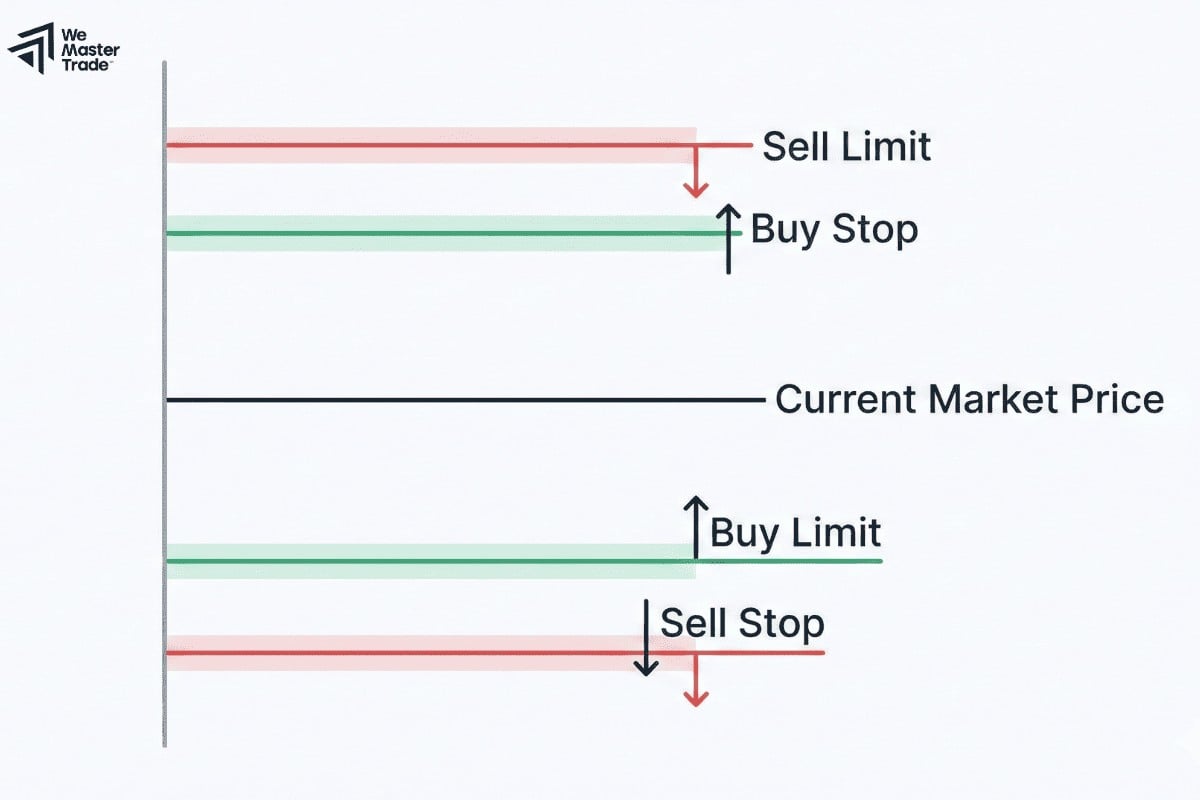
2. Limit Order
What it is: An order to buy or sell at a specified maximum or minimum price or better.
How it works: A limit order sets your maximum buying price or minimum selling price. You get price control. But your order might never execute.
Example: Say a stock trades at $50. You set a buy limit at $48. Your order only fills if the price drops to $48 or lower. If it stays at $50, you wait. Or your order expires.
3. Stop Order (Stop-Loss Order)
What it is: An order that becomes a market order once a specific trigger price is hit.
How it works: Stop orders protect you from big losses. They become market orders when the price hits your trigger point. Think of them as your trading insurance.
4. Sell Stop
What it is: A stop order placed below the current market price.
How it works: It limits losses on long positions by triggering a market sell order when the price drops to your stop level.
5. Buy Stop
What it is: A stop order placed above the current market price.
How it works: It helps you enter momentum trades or limit losses on short positions by triggering a market buy order when the price rises to your stop level.
6. Stop-Limit Order
What it is: A stop order that converts to a limit order instead of a market order.
How it works: After triggering at the stop price, it becomes a limit order. This gives more control, but execution isn’t guaranteed. If the market moves too fast past your limit price, your order won’t fill.
7. Good Till Cancelled (GTC) Order
What it is: An order that stays active until filled or manually cancelled.
How it works: Unlike day orders that expire at market close, GTC orders remain working across multiple trading sessions.
8. Day Order
What it is: An order valid only for the trading day it’s placed.
How it works: Automatically cancels if not executed by market close.
9. Fill or Kill (FOK) Order
What it is: An order requiring immediate and complete execution.
How it works: The entire order must fill instantly at your specified price or better. Otherwise, it cancels immediately.
10. All or None (AON) Order
What it is: An order requiring the entire quantity to be filled at once.
How it works: Partial fills aren’t accepted. The full order size must execute together, but timing is more flexible than FOK.
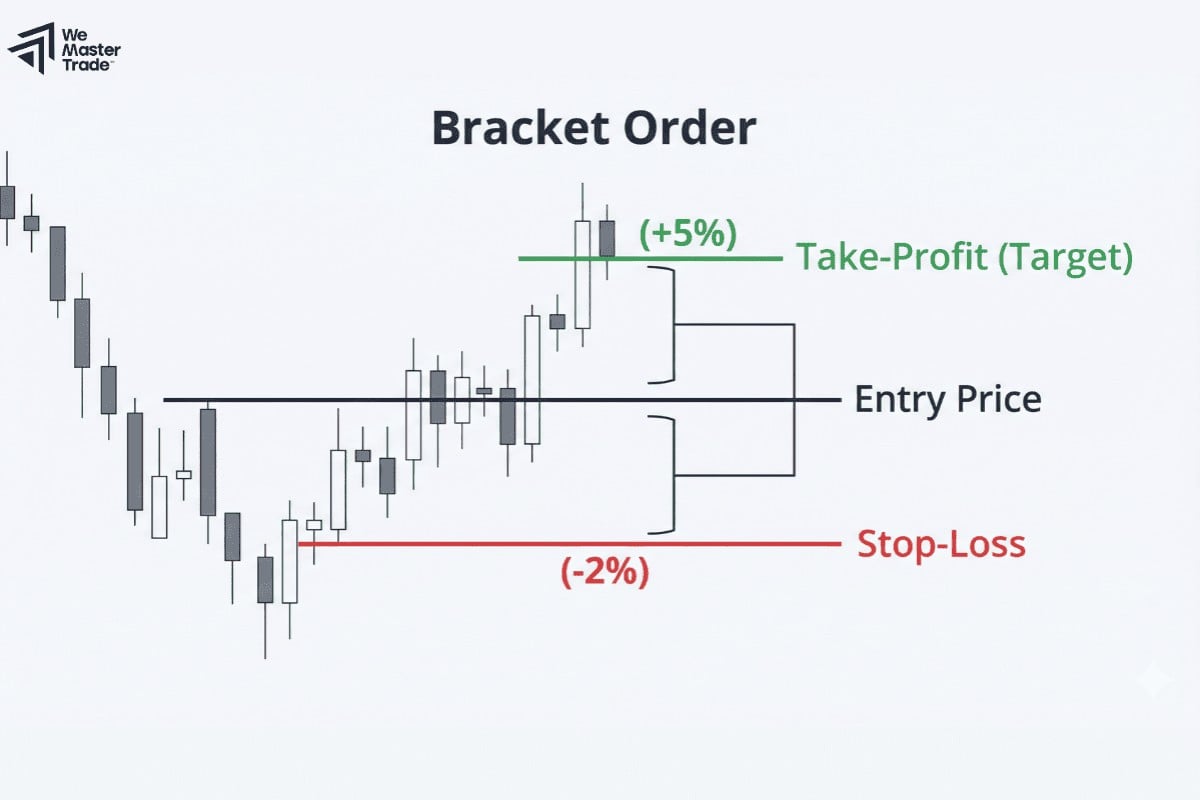
11. Bracket Order
What it is: An order that combines entry, stop-loss, and take-profit in one package.
How it works: Once your entry order fills, stop-loss and take-profit orders activate automatically. This creates a “bracket” around your position.
Risk Management Orders
Every successful trader masters these concepts. They’re not optional. They’re essential for survival.
12. Stop-Loss
What it is: An order that automatically closes your trade at a preset price to cap losses.
How it works: One bad trade can’t wreck your account. For long positions, place stops below your entry. For short positions, place them above.
13. Trailing Stop
What it is: A dynamic stop-loss that moves with favorable price action.
How it works: As the price moves in your favor, the trailing stop follows at a set distance. It locks in profits while still giving your trade room to grow.
14. Take-Profit
What it is: An order that closes your trade when you hit your target price.
How it works: It removes emotion from the equation. Greed can’t push you to hold too long. Once your target is hit, the position closes automatically.
15. Break-Even
What it is: Moving your stop-loss to your entry price to eliminate risk.
How it works: Once your trade moves favorably, move your stop to your entry point. If the market reverses, you exit without losing money.
Pricing & Liquidity
Every trade costs money. Understanding these costs helps you trade smarter and keep more profits.
16. Bid
What it is: The highest price a buyer is willing to pay for an asset.
How it works: This is what you receive when selling. Buyers “bid” on assets they want to purchase.
17. Ask
What it is: The lowest price a seller is willing to accept for an asset.
How it works: This is what you pay when buying. Sellers “ask” for their desired price.
18. Spread (Bid-Ask Spread)
What it is: The difference between the bid and ask price.
How it works: The bid-ask spread’s meaning is simple. It’s a hidden transaction cost. Every time you trade, you cross this spread.

19. Slippage
What it is: The difference between your expected execution price and actual execution price.
How it works: Markets move fast. Between clicking “buy” and execution, prices shift. That difference is slippage.
20. Commission
What it is: The fee charged by brokers for executing your trades.
Types:
- Fixed fee per trade
- Per share or per contract
- Percentage of trade value
- Tiered pricing based on volume
The “zero commission” trap: Some brokers offer “commission-free” trading but widen spreads to compensate. You still pay—just differently. Always check the total cost.
21. Fees
What it is: Additional charges beyond commissions.
Common types:
- Exchange fees
- Regulatory fees
- Overnight financing charges (swap fees)
- Account maintenance fees
- Inactivity fees
- Withdrawal fees
Why it matters: Successful traders track all costs. They know their break-even point. They ensure their edge overcomes these expenses. Small fees add up over time and can destroy profitability.
Leverage & Margin
Leverage & margin confuse many beginners. Let’s clear this up with simple explanations.
22. Leverage
What it is: The ability to control large positions with small capital by borrowing funds from your broker.
How it works: A 10:1 leverage ratio means $1,000 controls $10,000 worth of assets. The broker lends you the difference.|
23. Margin
What it is: The minimum amount of capital required by your broker to open and maintain leveraged positions.
How it works: Margin is your collateral. It’s the money you must keep in your account to support your leveraged trades.
24. Initial Margin
What it is: The upfront capital required to open a position.
How it works: Before entering a trade, your broker checks if you have enough initial margin. If you do, the trade opens. If not, the order is rejected.
25. Maintenance Margin
What it is: The minimum equity required to keep positions open.
How it works: As your positions move against you, your account equity drops. If it falls below the maintenance margin level, you trigger a margin call.
26. Margin Call
What it is: A warning that your account equity has fallen below maintenance margin requirements.
How it works: You must add funds immediately. Or close positions to bring your account back above maintenance margin. If you don’t act, your broker acts for you.
27. Liquidation
What it is: When your broker automatically closes your positions because you can’t meet margin requirements.
How it works: If you ignore a margin call or losses continue, your broker forcibly closes positions to limit further losses. You have no control over which positions close or at what price.
Position Sizing & Performance
Most beginners focus on entry and exit. Winners focus on position sizing first.
28. Position Size
What it is: The quantity of shares, contracts, or lots you trade in a single transaction.
How it works: Position size is calculated based on your risk tolerance and stop-loss distance. It determines how many units you trade.
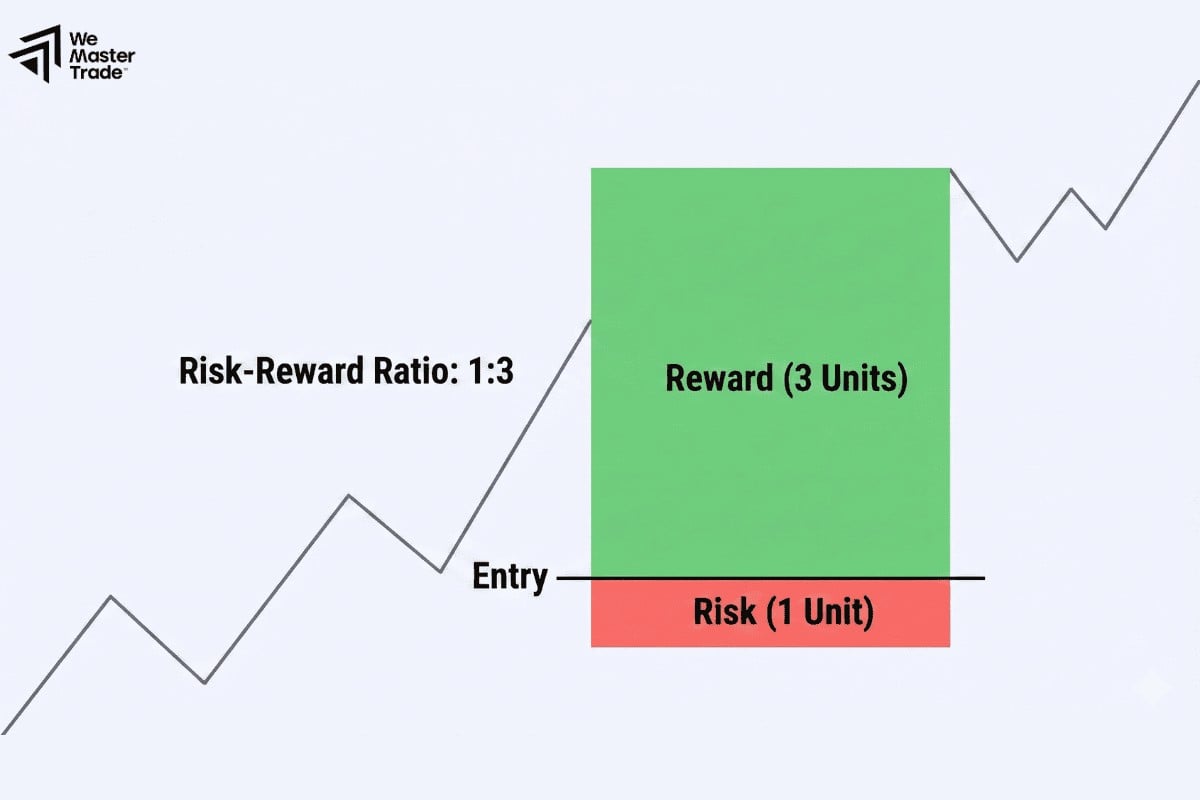
29. Risk-Reward Ratio
What it is: A comparison of potential loss (risk) to potential gain (reward) in a trade.
How it works: Your risk-reward ratio shows how much you aim to make for every dollar you risk.
Example: A 3:1 ratio means you’re risking $100 to potentially make $300.
30. R-Multiple
What it is: A measurement of how many times your initial risk you made or lost on a trade.
How it works: R-multiple normalizes trade results regardless of position size or dollar amounts.
Calculation: R-multiple = (Profit or Loss) ÷ (Initial Risk)
Examples:
- Risk $100, make $300 = 3R trade
- Risk $100, lose $50 = -0.5R trade
- Risk $100, lose $100 = -1R trade
Charts & Price Action
Charts tell stories. Learn to read them, and markets start making sense.
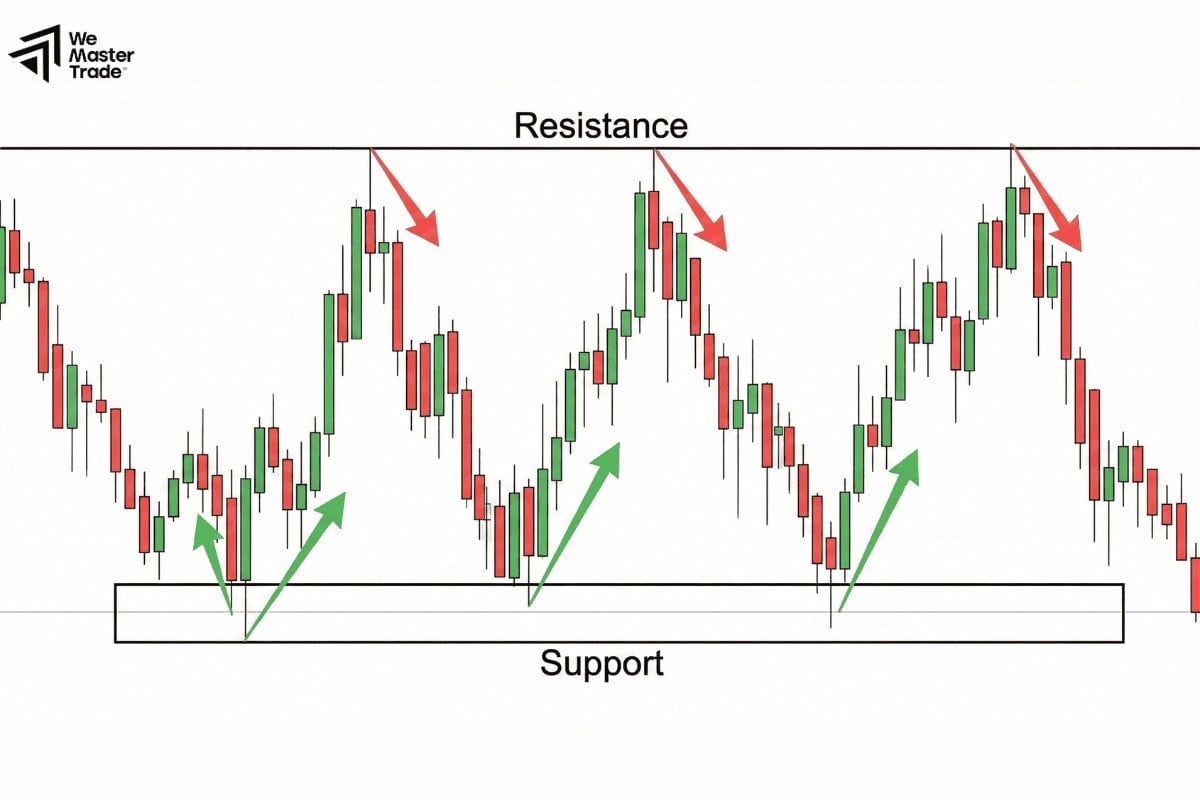
31. Support
What it is: A price level where buying interest tends to overcome selling pressure, preventing further declines.
How it works: Support is where price tends to stop falling. Buyers step in. Demand exceeds supply. Price bounces.
32. Resistance
What it is: A price level where selling interest tends to overcome buying pressure, preventing further advances.
How it works: Resistance is where price struggles to rise. Sellers dominate. Supply exceeds demand. Price retreats.
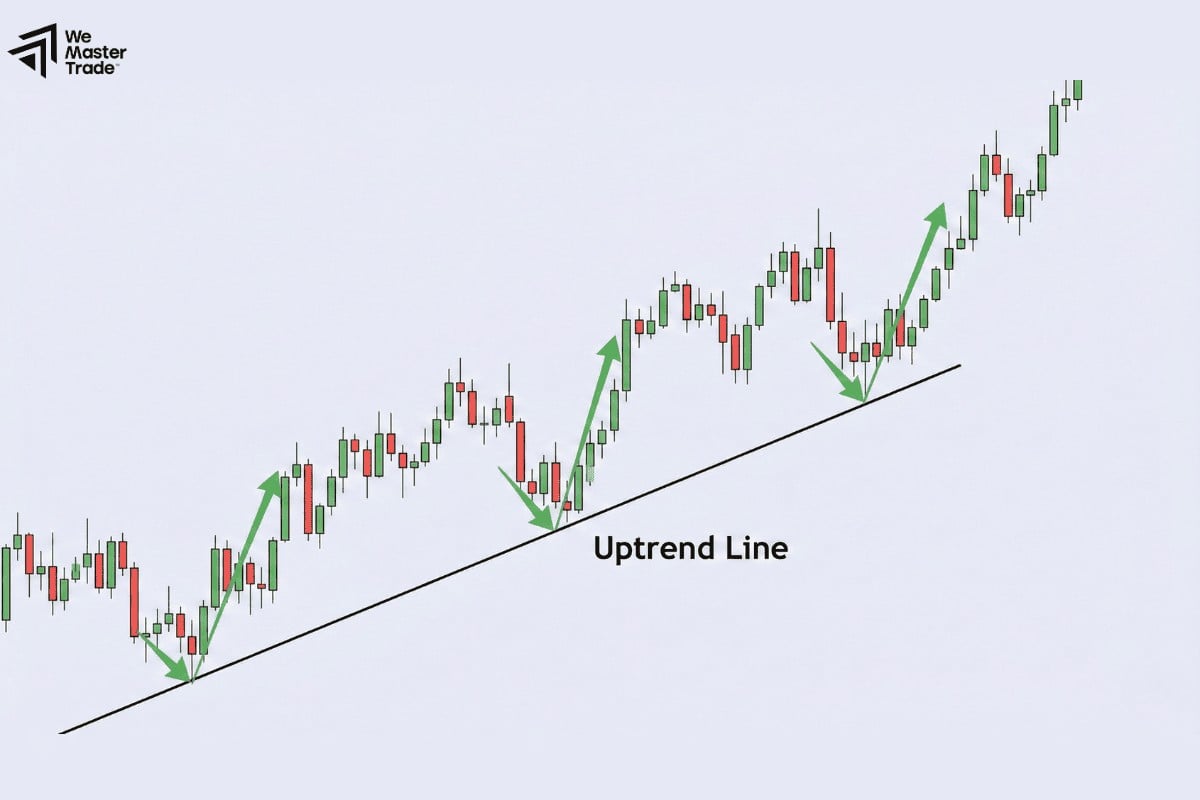
33. Trendlines
What it is: Lines drawn on charts connecting swing lows (uptrend) or swing highs (downtrend) to visualize direction.
How it works: Trendlines map market momentum and direction. They act as dynamic support or resistance.
34. Breakout
What it is: When price decisively moves beyond an established support or resistance level.
How it works: Breakouts signal potential trend changes or accelerations. They represent shifts in supply-demand balance.
35. Volume
What it is: The number of shares, contracts, or lots traded during a specific time period.
How it works: Volume measures trading activity and confirms price movements.
36. False Breakout
What it is: When price briefly moves beyond support or resistance but quickly reverses, trapping traders.
How it happens: Price breaks a level. Traders rush in. Then the price reverses sharply. Stop-losses get triggered. Smart money collects.
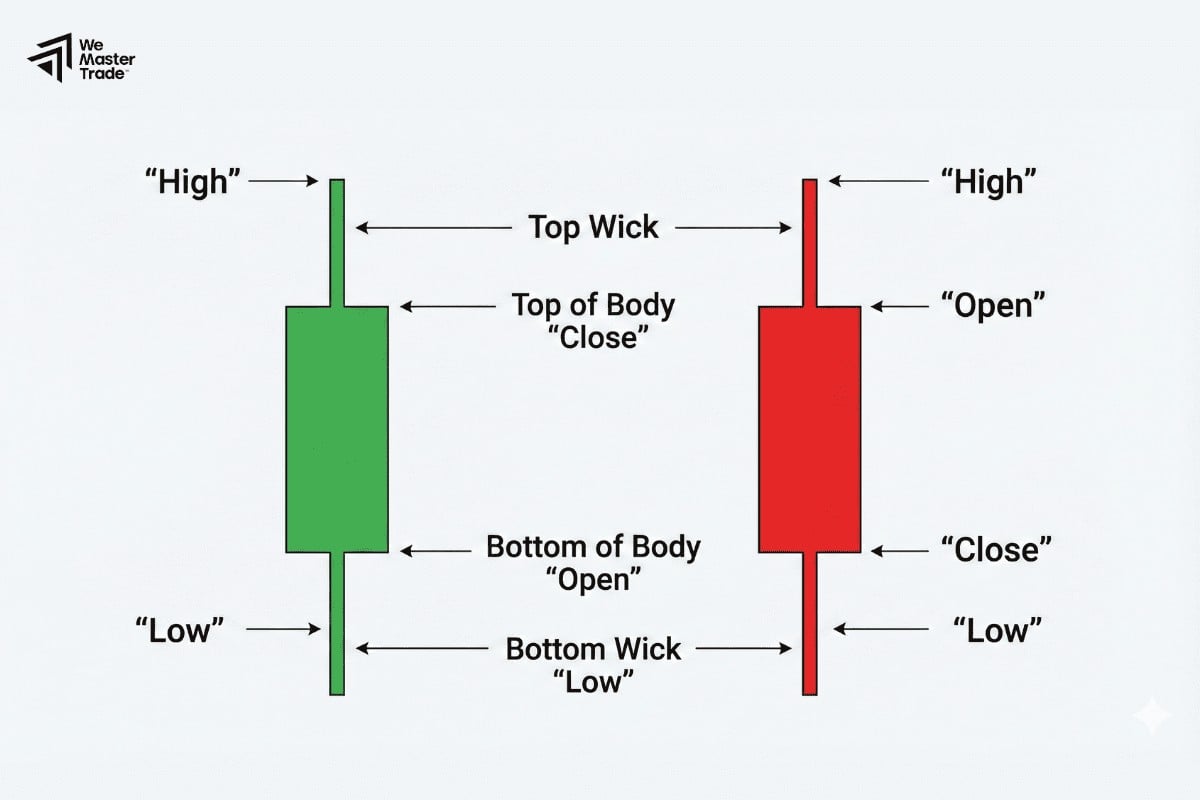
37. Candlesticks
What it is: Graphical representations of price action showing open, high, low, and close prices for a time period.
How they work: Each candle is a visual story. The body shows an open-to-close range. The wicks (shadows) show the full high-low range.
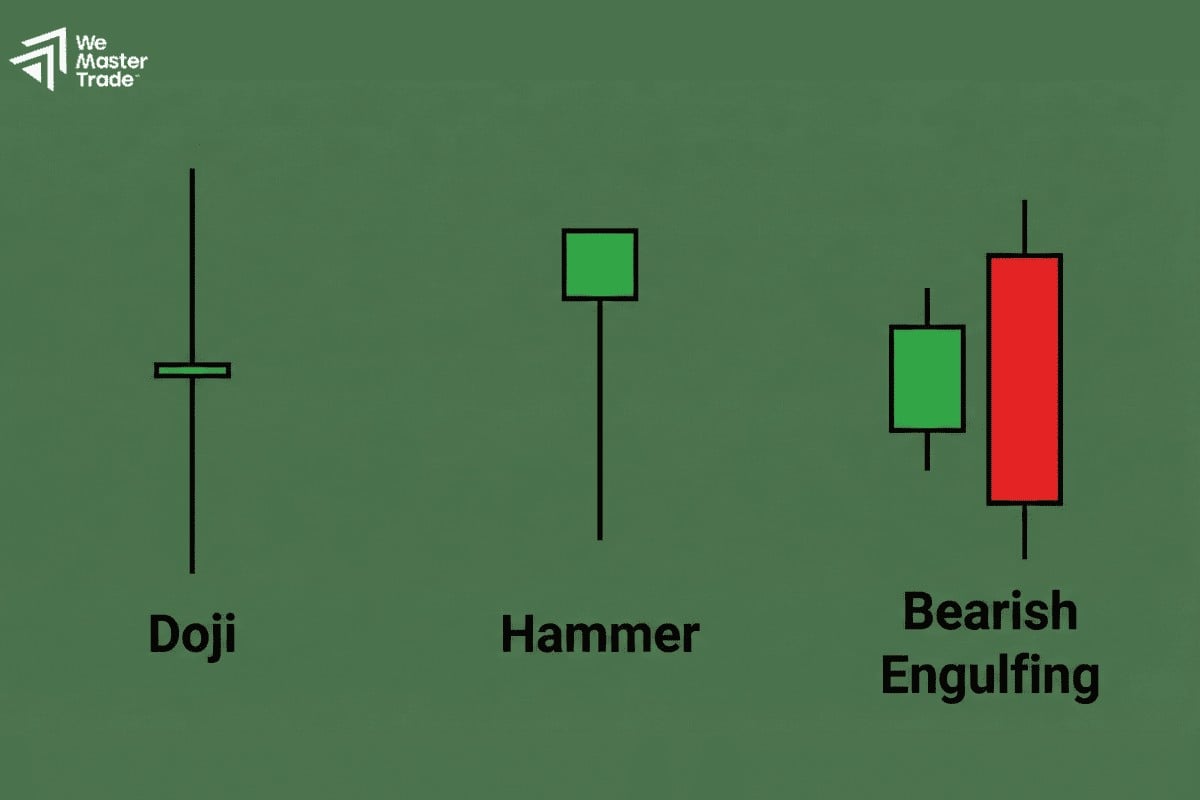
38. Doji
What it is: A candlestick pattern where open and close prices are nearly equal, creating a cross or plus shape.
What it signals: Indecision. Neither bulls nor bears control. The market is balanced.
39. Hammer
What it is: A candlestick with a small body at the top and a long lower wick (shadow), resembling a hammer.
What it signals: Potential bullish reversal. Price fell significantly, but buyers rejected lower prices and pushed it back up.
40. Engulfing Pattern
What it is: A two-candle pattern where the second candle completely engulfs the body of the first candle.
Bullish engulfing: Small red candle followed by a larger green candle that engulfs it. Signals potential upside reversal.
Bearish engulfing: Small green candle followed by a larger red candle that engulfs it. Signals potential downside reversal.
What it signals: Strong sentiment shift. The engulfing candle shows that the new direction has overwhelming power.
41. Three Black Crows
What it is: Three consecutive long bearish candles with lower closes, each opening within the previous candle’s body.
What it signals: Strong bearish continuation or reversal. Sellers are in complete control.
Where it matters most: After uptrends or at resistance levels. It’s a serious warning sign.
Trading Journal & Performance
Your trading journal is your secret weapon. It turns experiences into lessons. It transforms losses into learning opportunities.
42. Trading Journal
What it is: A detailed record of all your trades, including entries, exits, rationale, emotions, and results.
Why it’s essential: Memory is unreliable. Journals provide objective data. They reveal patterns in your trading you’d never see otherwise.
What successful traders track:
- Entry and exit prices (Term #43)
- Position size
- Stop-loss and take-profit levels
- Trade rationale (why you entered)
- Emotional state (fear, confidence, FOMO)
- Results (profit/loss)
- Lessons learned
43. Entry and Exit Prices
What they are: The exact prices at which you open and close positions.
Why they matter: These determine your profit or loss. They also reveal your execution quality.
Analysis questions:
- Are you entering too early (before confirmation)?
- Are you entering too late (after big moves)?
- Are you exiting at logical levels?
- Are you letting emotions override your plan?
44. Win Rate
What it is: The percentage of trades that are profitable.
Calculation: Win Rate = (Winning Trades ÷ Total Trades) × 100
Example: 60 wins out of 100 trades = 60% win rate.
45. Expectancy
What it is: The average amount you can expect to win or lose per trade over time.
Calculation: Expectancy = (Win Rate × Average Win) – (Loss Rate × Average Loss)
Example:
- Win rate: 50%
- Average win: $300
- Average loss: $100
- Expectancy = (0.50 × $300) – (0.50 × $100) = $150 – $50 = $100 per trade
Why it’s crucial: Positive expectancy means your system works long-term. Negative expectancy means you’re slowly going broke. This is the ultimate metric for system viability.
46. Maximum Drawdown
What it is: The largest peak-to-trough decline in your account balance during a specific period.
How it works: It measures your worst losing streak. If your account peaked at $10,000 and bottomed at $7,000 before recovering, your maximum drawdown is $3,000 or 30%.
Why it matters: This shows how much capital you need to survive rough patches. It reveals the psychological stress your strategy creates.
47. Profit Factor
What it is: The ratio of gross profits to gross losses.
Calculation: Profit Factor = Total Gross Profit ÷ Total Gross Loss
Example:
- Total wins: $10,000
- Total losses: $5,000
- Profit Factor = $10,000 ÷ $5,000 = 2.0
Interpretation:
- Above 1.0 = Profitable system
- 1.5 = Solid system
- 2.0+ = Excellent system
- Below 1.0 = Losing system
What it reveals: How much you make for every dollar you lose. Higher is better.
48. Realized P&L
What it is: Actual profit or loss from closed trades.
How it works: Money in your account. Real results you can withdraw. This is what actually affects your account balance.
49. Unrealized P&L
What it is: Paper profit or loss on open positions.
How it works: It fluctuates constantly as prices move. It’s potential profit or loss, not actual.
Advanced Concepts
Some trading terms sound impressive. These are advanced concepts used by experienced traders.
50. Order Blocks
What it is: Price zones where large institutional traders (banks, hedge funds) placed significant buy or sell orders.
How it works: These areas often act as strong support or resistance levels because they signal large volumes waiting to be filled.
51. Killzones
What it is: Specific times during the trading day with the highest market activity and liquidity.
Common killzones:
- London Open (3:00-4:00 AM EST)
- New York Open (9:30-11:00 AM EST)
- London/New York Overlap (8:00 AM-12:00 PM EST)
Why they matter: These periods have increased volatility and trading opportunities. More movement means more profit potential.
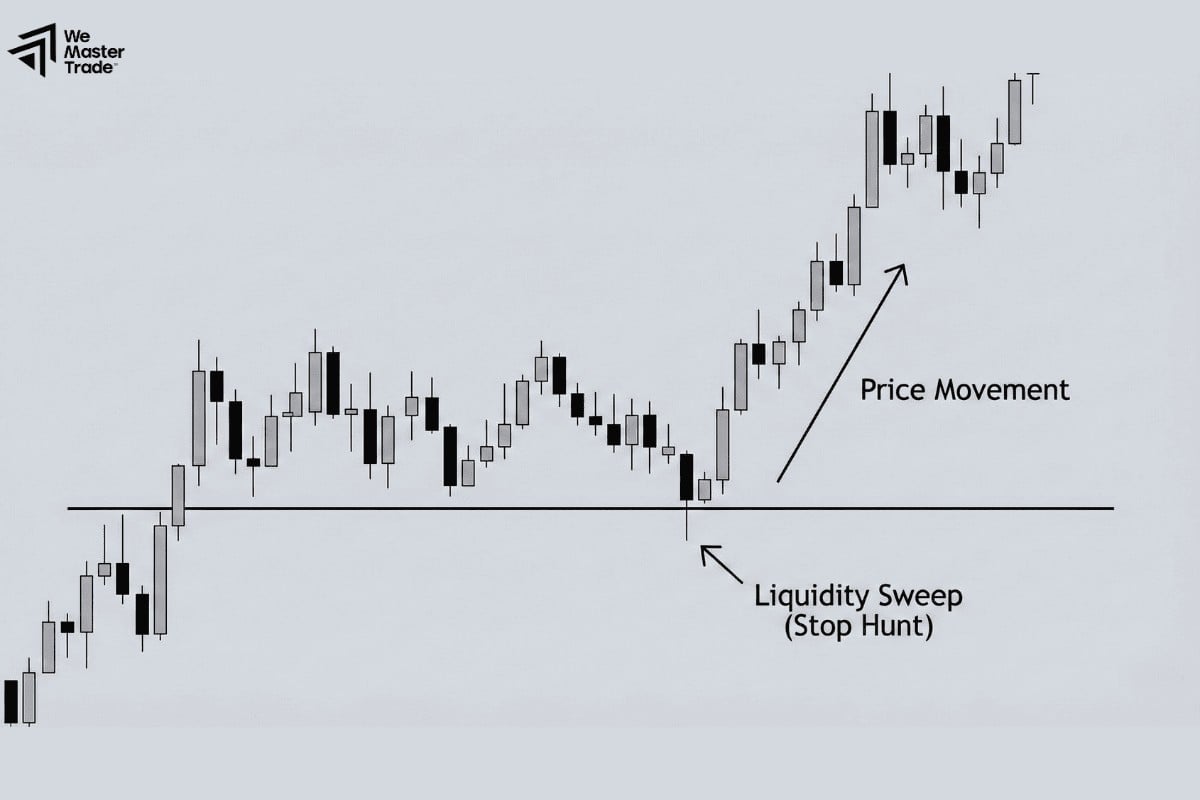
52. Liquidity Sweeps
What it is: Market moves designed to trigger stop-loss orders and grab liquidity before reversing direction.
How it happens: Price briefly breaks a key level, triggers stops, then reverses sharply. Retail traders get stopped out. Smart money gets better entry prices.
Why it occurs: Large institutional traders need liquidity to fill big orders. They can’t just buy/sell massive positions at one price. They manipulate prices to create liquidity.
Trading Instruments
Different assets offer different opportunities. Basic trading terms list applies across all markets, but each has unique characteristics.
53. Stocks
What they are: Shares representing partial ownership in a company.
Characteristics:
- Trade during market hours (9:30 AM – 4:00 PM EST)
- Affected by company earnings, news, and sector performance
- Can pay dividends
- Long-term growth potential
Best for: Long-term investors and swing traders.
54. Forex
What it is: The global market for trading currencies.
Characteristics:
- 24-hour market (Sunday evening to Friday afternoon)
- Highest liquidity of any market
- Traded in pairs (EUR/USD, GBP/JPY, etc.)
- High leverage available (often 50:1 or more)
55. Options
What they are: Contracts giving the right (not obligation) to buy or sell assets at specified prices by certain dates.
Characteristics:
- Leverage without margin calls
- Limited risk (premium paid)
- Time decay factor
- Complex pricing (Greeks)
56. Futures
What they are: Contracts obligating you to buy or sell assets at future dates and prices.
Characteristics:
- High leverage
- Margin requirements
- Standardized contracts
- Expiration dates
57. Cryptocurrencies
What they are: Digital assets using blockchain technology.
Characteristics:
- 24/7 trading
- Extreme volatility
- Decentralized (mostly)
- Regulatory uncertainty
Best for: Risk-tolerant traders comfortable with high volatility.
Additional Essential Terms
These final terms complete your foundation.
58. Liquidity
How easily assets can be bought or sold without affecting the price. High liquidity means tighter spreads and faster execution.
59. Short (Short Selling)
What it is: Selling an asset you don’t own (borrowed from a broker) to profit from price declines.
How it works:
- Borrow shares from your broker
- Sell them at the current price
- Buy them back later at (hopefully) a lower price
- Return borrowed shares to the broker
- Keep the profit
Example: Short at $100, buy back at $80, profit $20 per share.
60. Long (Going Long)
What it is: Buying an asset expecting its price to rise.
How it works: Buy low, sell high. This is a traditional investing and trading direction.
Example: Buy at $50, sell at $70, profit $20 per share.
Common Confusions Cleared Up
Understanding these trading acronyms prevents costly mistakes:
Margin vs Leverage: Margin is required collateral. Leverage is buying power amplification.
Spread vs Commission: Spread is the embedded bid-ask difference. Commission is an explicit broker fee.
Stop vs Stop-Limit: Stop guarantees execution at the market price. Stop-limit guarantees price but not execution.
Market vs Limit Order: Market executes immediately. Limit executes only at the specified price or better.
Short vs Long: Short profits from falling prices. Long profits from rising prices.
Realized vs Unrealized P&L: Realized is from closed trades. Unrealized is from open positions.
Position Size vs Lot Size: Position size is the total units traded. Lot size is standard contract amounts.
Breakout vs False Breakout: Breakout has follow-through. False breakout reverses quickly, trapping traders.
Support vs Resistance: Support is a price floor with buying interest. Resistance is a price ceiling with selling pressure.
Risk-Reward vs R-Multiple: Risk-reward estimates before trading. R-multiple measures after trade completion.
Your Next Steps in Trading Mastery
You now understand 63 core trading terminologies for beginners. You know about the bid-ask spread, leverage & margin, and market vs limit order decisions. You’ve learned essential terms from this basic trading terms list that professionals use daily.
But knowledge alone won’t make you profitable. Application will. Practice will. Experience will.
Start small. Trade with money you can afford to lose. Keep detailed journals. Review trades obsessively. Learn from every mistake. Track your win rate, expectancy, and profit factor religiously.
Remember these critical principles:
- Never risk more than 1-2% per trade
- Every trade needs a stop-loss. No exceptions
- Quality setups beat quantity. Patience pays
- Discipline trumps emotion every single time
- Continuous learning separates winners from losers
The path from beginner to consistent trader is long. It’s challenging. It’s expensive. But armed with this terminology guide and proper education, you’re positioned for success. You speak the language now. You understand the mechanics. You know the risks.
Trading requires preparation, discipline, and persistence. Master the language. Master the fundamentals. Master yourself. The markets are waiting. Make every trade count.

