












Quantitative analysis reveals that approximately 82% of algorithmic trading models that demonstrate outstanding profitability during historical simulations fail to maintain those performance metrics when deployed in live markets. This persistent performance degradation represents a critical vulnerability for systematic funds and individual traders alike. The breakdown rarely stems from shifting structural dynamics alone, but rather from systemic execution and statistical oversight during initial development.
This comprehensive analytical brief outlines the primary backtesting mistakes that inadvertently corrupt strategy validation, from statistical overfitting to mechanical platform misconfigurations. By identifying these foundational errors, quantitative traders can implement institutional-grade validation frameworks, refine their risk management parameters, and ensure that historical performance aligns with real-world capital deployment.
Introduction: The Illusion of Backtest Profitability
Historical simulation serves as the bedrock of systematic strategy validation, yet it frequently produces a dangerous psychological trap. A pristine, upward-sloping equity curve trading graphic provides an illusion of market predictability that rarely survives exposure to actual order books. Academic research from the Journal of Financial Economics indicates that backtested investment strategies routinely overstate subsequent out-of-sample annualized returns by an average factor of three. This distortion occurs because a historical dataset is static, whereas live financial markets are dynamic systems driven by competitive order routing, fragmented liquidity, and evolving participant behavior.
When developers begin testing trading strategies on a professional trading platform, they often focus exclusively on maximizing the terminal net profit or inflating the apparent Sharpe ratio. This single-minded focus creates an optimization bias trading environment where noise is treated as a tradeable signal. A valid backtest is not meant to uncover a flawless historical sequence; its true function is to stress-test an underlying economic hypothesis against diverse historical market regimes to determine if an edge truly exists. Without understanding the mathematical limits of historical data quality, a trader is merely mapping a custom model to the past rather than preparing a robust framework for future uncertainty.

Mistake 1: Overfitting and Curve-Fitting Data
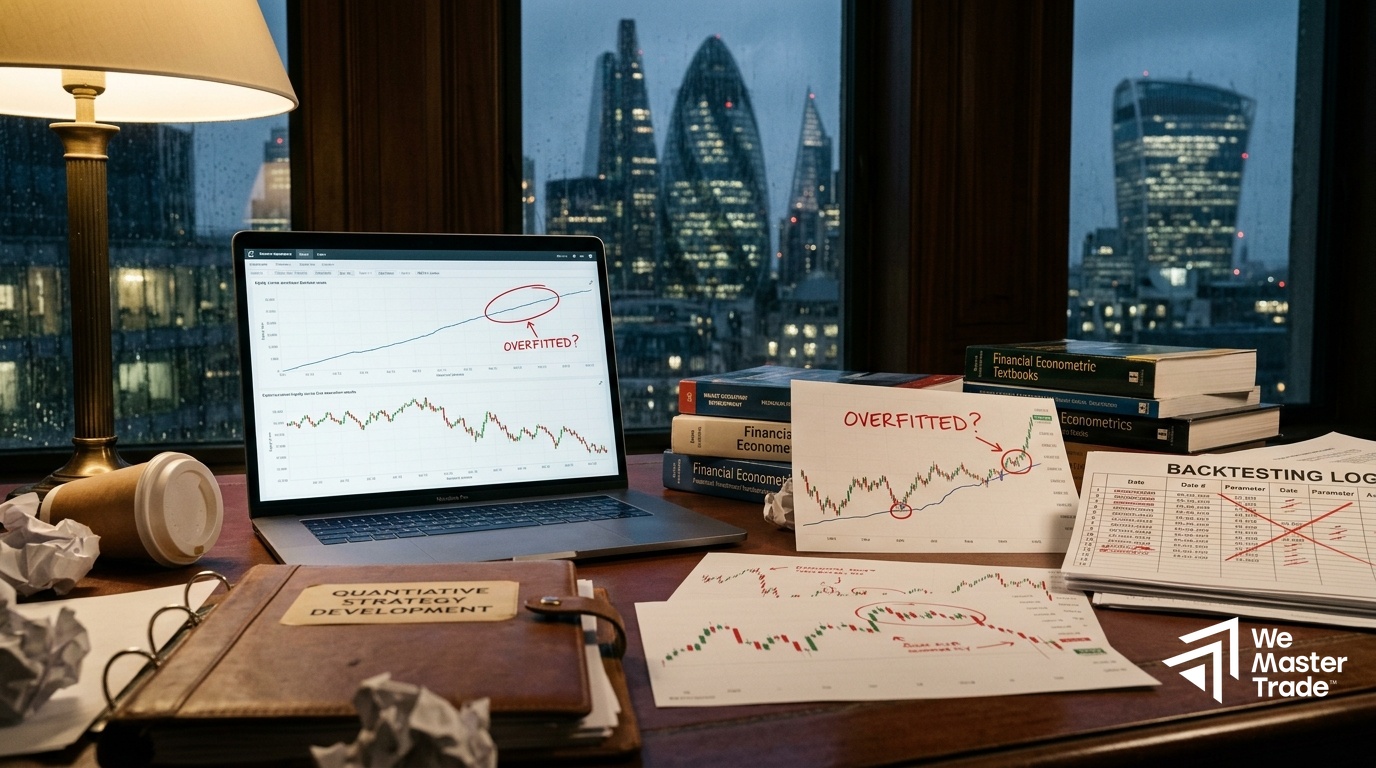
Perhaps the most widespread of all quantitative trading errors is the phenomenon of trading strategy overfitting. This occurs when an algorithmic model is modified with an excessive number of parameters or rules to perfectly match the historical price fluctuations of a specific asset. For example, applying dozens of technical indicators with highly specific look-back windows to a single five-year patch of historical data will inevitably yield exceptional paper profits. However, this process alters the model so that it tracks historical noise rather than persistent structural anomalies.
This mistake is deeply intertwined with data snooping bias, where a researcher tests thousands of parameter permutations until one randomly satisfies the performance criteria purely by statistical coincidence. When curve fitting trading systems, the resulting model becomes incredibly fragile. To prevent these optimization bias trading traps, systematic market participants often seek guidance from a structured trading academy to master rigorous mathematical validation techniques. Without separating actual statistical significance from random market distributions, an over-optimized strategy will completely disintegrate the moment it encounters unseen out of sample testing data.
Mistake 2: Mismanaging Platform Execution Settings
A significant portion of algorithmic trading pitfalls occurs not from faulty mathematics, but from a fundamental misunderstanding of backtesting software flaws. Default simulation engines frequently utilize idealized execution logic, assuming that all simulated transactions are filled immediately at the exact bar close or midpoint price without delay. This structural simplification completely ignores the physical infrastructure realities of modern electronic markets, such as order routing latency, matching engine queues, and broker processing times.
When a model relies on clean historical price arrays without accounting for execution latency, the resulting data is structurally flawed. For instance, high-frequency or short-term mean-reversion strategies are highly sensitive to minor timing variations. To correct these platform-level distortions, traders should consult a comprehensive backtest on MT5 guide to properly configure tick-by-tick data models, custom millisecond execution delays, and exact spread settings. Failing to isolate and fix these software assumptions means that testing trading strategies yields fictional equity curves that cannot be executed in a competitive live environment.
Mistake 3: Failing to Account for Real Slippage and Transaction Costs
Failing to calculate the true cost of market participation is one of the most destructive backtesting mistakes an analyst can make. In a backtest environment, liquidity is assumed to be infinite, allowing large block orders to execute without moving the market price. In real-world asset trading, entering a large position requires crossing the bid-ask spread and eating through available depth of book, resulting in execution slippage. Empirical tracking shows that omitting transaction costs backtesting rules can completely reverse the performance profile of an automated strategy.
Consider a short-term momentum strategy that averages a gross profit of 1.8 pips per trade over 5,000 simulated executions. If the combined impact of clearing fees, broker commissions, and dynamic slippage averages 2.2 pips per round turn, a seemingly spectacular historical simulation transforms into an absolute capital drain in live execution. Developing an accurate slippage model trading framework is paramount for achieving a realistic slippage estimation across different liquidity periods. While accessing specialized broker offerings or monitoring active trading promotions can marginalize fixed transaction costs, the underlying code must penalize every trade to reflect real, variable market frictions.
Mistake 4: Incorporating Future Information and Look-Ahead Bias
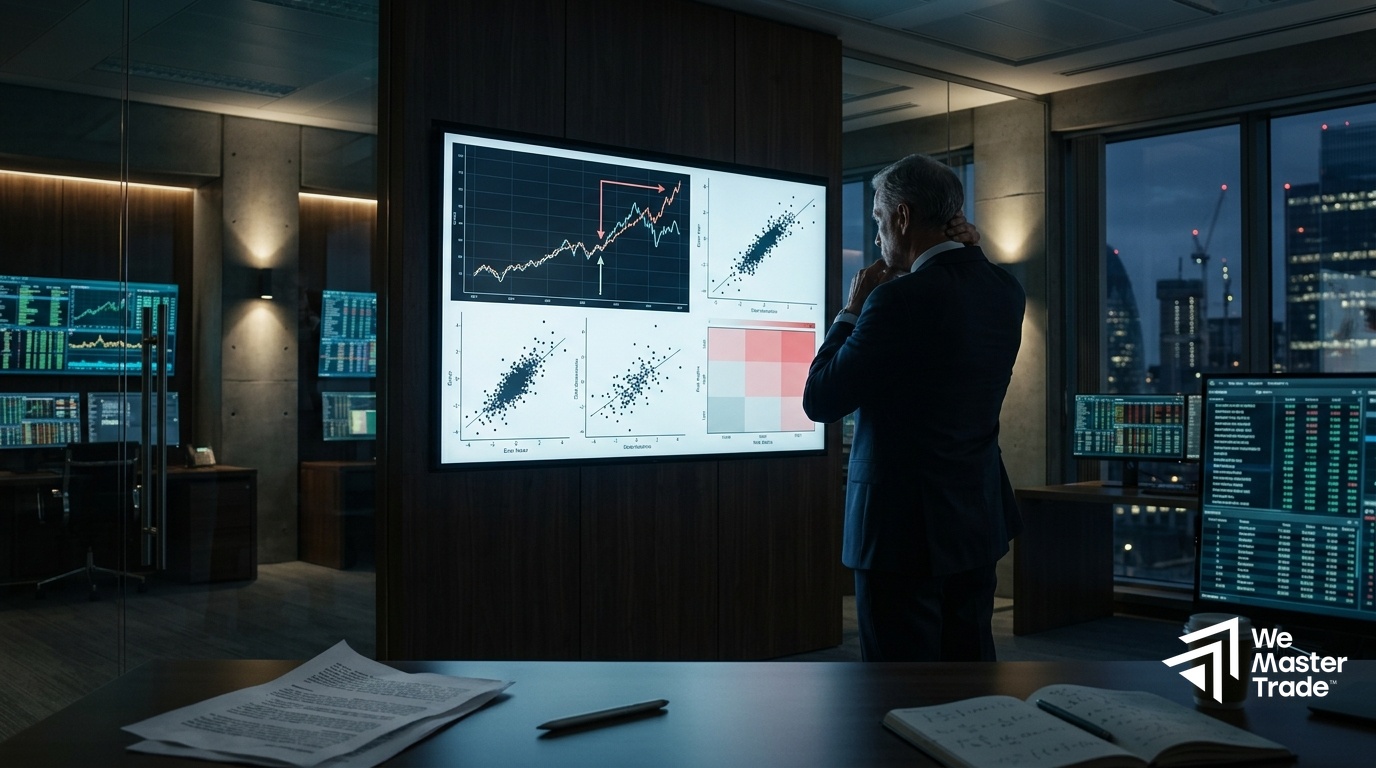
Look-ahead bias represents a catastrophic logical error where future data is inadvertently passed into the historical decision-making loop. This bias can occur through subtle coding errors within custom scripts, such as referencing the high, low, or closing price of a session before that session has realistically concluded. For example, if an algorithm evaluates a daily candle’s total range at 09:30 AM to determine an entry signal, it utilizes data that would not exist in a real-time trading scenario.
In quantitative development, common python backtesting mistakes often involve indexing errors within data manipulation libraries like Python Pandas. A single misplaced index modifier—such as calling data from $t+1$ instead of $t$—creates a model that effectively predicts the immediate future with perfect accuracy. The resulting equity curve trading visual will display unparalleled, non-correlated returns with an impossibly high Sharpe ratio and zero drawdown. Identifying these historical simulation pitfalls requires rigorous code audits, step-by-step logic tracing, and independent verification to ensure the system operating model remains strictly bound to causal reality.
Mistake 5: Ignoring Survivorship Bias and Changing Market Regimes
Selecting historical data without accounting for asset survivorship constitutes a massive data-selection error. If an equities strategy is backtested using only the current listings of an index, it ignores all the constituent companies that went bankrupt, merged, or were delisted during that historical timeframe. Research from the CFA Institute confirms that survivorship bias backtesting errors inflate historical stock strategy returns by an average of 1.5% to 3.5% per annum.
Furthermore, automated trading risks intensify when a strategy assumes that market dynamics are stationary data processes. Financial markets experience frequent market regime shifts, transitioning from low-volatility trending states to highly fractured, high-volatility mean-reverting environments. A strategy optimized exclusively during an extended equity bull market will suffer a catastrophic maximum drawdown calculation shock when confronted with a sudden liquidity crisis or monetary policy reversal. Strategies must be exposed to non-stationary environments to prove their true structural durability.

Advanced Frameworks for Strategy Validation
To neutralize these five fatal errors, professional quantitative researchers implement structured validation pipelines that separate signal from noise. The baseline defense against trading strategy overfitting is the implementation of rigorous out of sample testing. By dividing historical datasets into separate phases, the model can be designed on in-sample data and validated on completely untouched out-of-sample data.
To scale this approach dynamically, analysts utilize walk forward optimization. This technique applies a moving window across historical time series, repeatedly optimizing parameters over a specific training block and evaluating them on the immediate next block. This methodology directly simulates the actual lifecycle of live parameter updates.
Additionally, executing a monte carlo simulation trading sequence allows analysts to randomly shuffle the sequence of historical trade returns or inject synthetic volatility into the pricing feed. This statistical stress test determines whether a strategy’s maximum drawdown calculation is a stable metric or a product of lucky historical sequencing.
Comparison of Key Strategy Validation Techniques
| Validation Methodology | Core Objective | Primary Bias Mitigated | Data Requirements |
| Out-of-Sample Testing | Verifies model generalizability on unseen data | Trading strategy overfitting | High (Requires distinct data split) |
| Walk-Forward Optimization | Simulates rolling parameter re-optimization over time | Market regime shift vulnerability | Very High (Requires long time series) |
| Monte Carlo Simulations | Stress-tests return sequences via statistical shuffling | Optimization bias / Lucky sequencing | Moderate (Uses generated trade files) |
Key Questions About Backtesting Mistakes Answered
Q: What is curve-fitting in backtesting and why does it cause live trading failures?
A: Curve-fitting occurs when a trading model is overly optimized to match the specific quirks and noise of historical data. While it produces exceptional backtest metrics, the strategy fails in live markets because it cannot generalize to unseen, real-time data distributions.
Q: How do you accurately factor in transaction costs and slippage during historical testing?
A: To avoid unrealistic performance expectations, you must explicitly code variable slippage models, exchange fees, asset borrow costs, and liquidity constraints into your backtesting engine, rather than relying on clean, midpoint execution assumptions.
Q: What is the difference between look-ahead bias and data-snooping bias?
A: Look-ahead bias incorporates future data or information into a historical decision-making point that would not have been available in real time. Data-snooping bias occurs when a researcher tests hundreds of parameter combinations until one happens to work purely by statistical coincidence.
The WeMasterTrade Advantage: Aligning Simulation and Live Execution
Developing robust trading systems requires moving past simulated environments into live market executions where execution speed and real liquidity matter. WeMasterTrade addresses the persistent gaps between historical simulation and live trading environments by offering its innovative Angel Funding model. Instead of forcing retail quantitative traders to spend months completing complex evaluation phases that often incentivize over-optimized strategies, the platform provides instant funded trading accounts. This structural design allows traders to test the real-world validity of their strategies with actual market liquidity immediately.
The core operational differentiator of WeMasterTrade lies in its internal risk architecture. A dedicated, institutional-grade Risk Management team actively monitors all platform activity, identifying high-probability live trades executed by funded partners. The desk then mirrors these positions in institutional liquidity pools, scaling them at up to a 1:4 copy ratio alongside the trader’s original position. Because WeMasterTrade’s primary monetization model directly co-depends on the success of its users, the firm offers a highly competitive profit split of up to 90% in the trader’s favor. This structure ensures a genuine, aligned partnership where institutional risk oversight complements individual strategy execution. Skilled market participants who want immediate capital access without restrictive multi-month evaluation periods will find WeMasterTrade’s professional ecosystem worth examining.