










Most traders start with candlestick charts. Candles are popular because they show open, high, low, and close data in a compact visual format. But candlesticks are not the only way to read a market. Alternative chart types can help traders reduce noise, highlight trends, or focus on price movement instead of time.
The key is not to search for a magic chart. A chart type is a lens. It can clarify certain information while hiding other information. Good traders choose the lens that fits the question they are trying to answer.
Why Traders Use Alternative Chart Types
Standard candlesticks are time-based. A five-minute candle closes every five minutes, whether price moved significantly or barely moved at all. This can be useful, but it can also create visual noise during choppy sessions.
Alternative chart types change how price data is organized. Some smooth price movement. Some ignore time. Some only print a new bar when price moves a certain amount. This can help traders focus on trend, volatility, or structure.
Common reasons to explore alternative charts include:
- Reducing noise in volatile markets.
- Identifying trend direction more clearly.
- Avoiding overreaction to minor candles.
- Studying price movement independent of time.
- Testing whether a strategy performs better with cleaner signals.
However, traders should be careful. A cleaner chart is not automatically a better chart. If a chart removes noise, it may also delay signals or hide important intrabar information.
Heikin-Ashi Charts
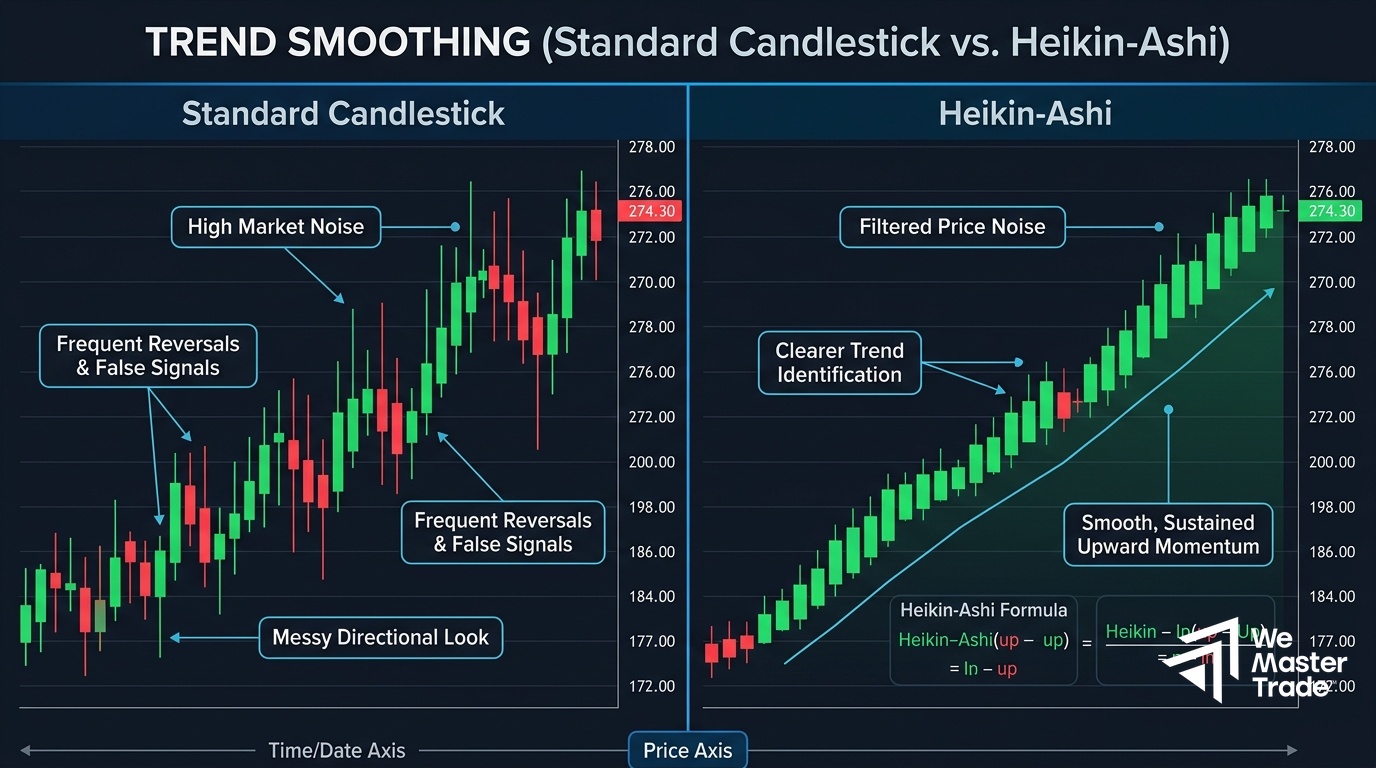
Heikin-Ashi charts look similar to candlesticks but use modified calculations. StockCharts explains that Heikin-Ashi can be used to identify trending periods, potential reversal points, and classic chart patterns, but they are not read like standard candlestick reversal patterns.
The appeal of Heikin-Ashi is smoothness. Consecutive candles of the same color can make trends easier to see. Small pullbacks may appear less distracting than on traditional candles.
Potential uses
- Trend-following analysis.
- Staying with a move while the average pace remains strong.
- Filtering minor countertrend candles.
- Visual review of trend strength after a trade.
Limitations
Heikin-Ashi prices are averaged. That means the candle open and close may not match the actual traded open and close. For this reason, traders should be careful when using Heikin-Ashi alone for precise entries, stop placement, or order execution.
A practical approach is to use Heikin-Ashi for context and standard candlesticks for execution.
Renko Charts
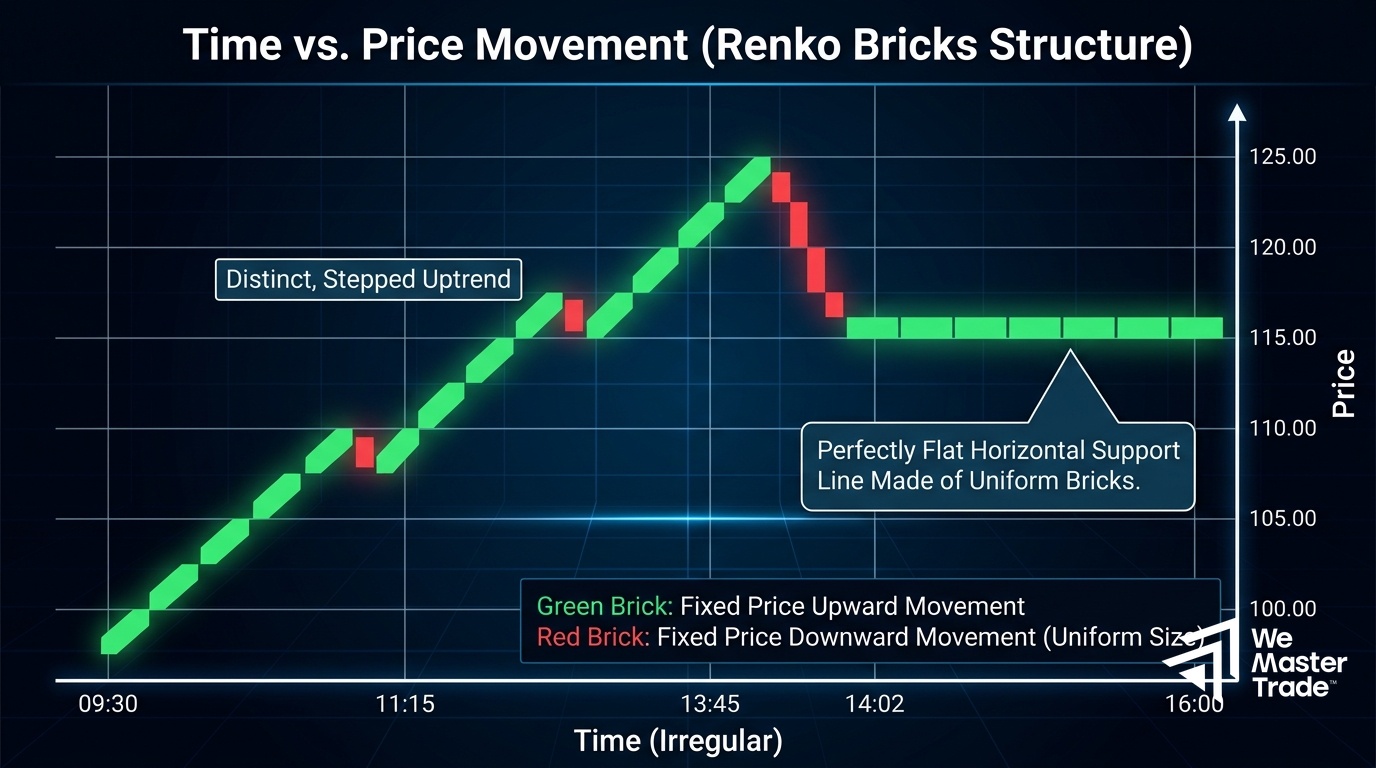
Renko charts are built from price movement rather than time. A new brick appears when price moves by a defined amount. If the brick size is 20 points, the chart will not print a new brick until price moves enough to meet that threshold.
Renko charts can make trends and support/resistance areas appear cleaner because small fluctuations are filtered out.
Potential uses
- Trend identification.
- Breakout and pullback structure.
- Reducing time-based noise.
- Reviewing whether a move had sustained directional pressure.
Limitations
Renko charts can delay information. Since a brick only forms after price moves a certain amount, entries may occur later than on time-based charts. Brick size selection also matters. A brick size that is too small may be noisy; too large may hide useful detail.
Renko can be useful for analysis, but traders should backtest and paper trade it before using it in live conditions.
Range Bar Charts
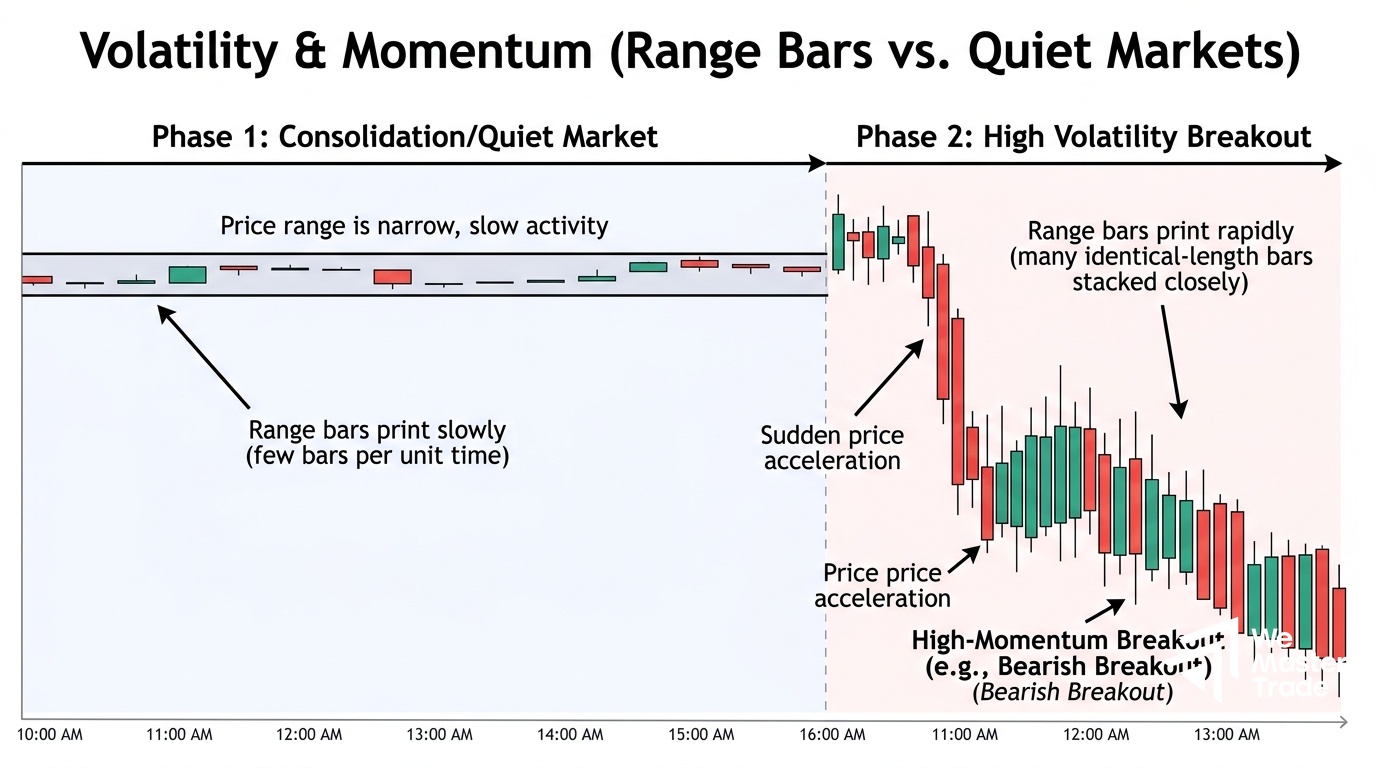
Range bars also focus on price movement. Each bar has a fixed high-to-low range. A new bar forms only when price moves beyond the chosen range.
Range bars can be helpful when a trader wants every bar to represent comparable price movement. This can make volatility and momentum easier to interpret.
Potential uses
- Short-term trading where price movement matters more than clock time.
- Markets with uneven activity during the session.
- Studying breakouts, pullbacks, and consolidation.
Limitations
Because range bars are not time-based, a quiet period may produce very few bars while a volatile period may produce many. This can distort a trader’s sense of session rhythm if they are used to time-based candles.
Tick Charts
Tick charts create a new bar after a set number of transactions or ticks. For example, a 500-tick chart prints a new bar after 500 transactions.
Tick charts are often used by active traders who want a market-activity-based view. During busy periods, tick charts print more bars. During quiet periods, they slow down.
Potential uses
- Reading intraday activity.
- Comparing active and quiet sessions.
- Studying futures or highly liquid markets.
Limitations
Tick data can vary by provider. Forex and CFD traders should be especially careful because tick volume may not represent centralized exchange volume. Tick charts may also be less useful for longer-term traders.
Point and Figure Charts
Point and figure charts are one of the oldest alternative charting methods. They focus on price movement using columns of Xs and Os, traditionally ignoring time and volume.
The goal is to highlight meaningful directional moves and reduce minor fluctuations. Some traders use point and figure charts to study support, resistance, breakouts, and price objectives.
Potential uses
- Long-term technical structure.
- Clear support and resistance zones.
- Breakout analysis.
Limitations
Point and figure charts can feel unfamiliar for traders trained on candlesticks. They also require careful selection of box size and reversal amount.
How to Choose the Right Chart Type
The right chart type depends on your strategy and decision process.
Use the chart that answers your question
If the question is, “What happened during this five-minute period?” candlesticks may be best. If the question is, “Is the trend still intact?” Heikin-Ashi or Renko may help. If the question is, “How is price moving independent of time?” range bars may be useful.
Keep execution precise
Alternative charts can help with context, but execution often requires precise price levels. Many traders use a standard chart alongside the alternative chart to confirm actual prices.
Avoid chart-hopping
Changing chart types after every losing trade can create confusion. Choose one alternative chart to test, define rules, and gather enough data before judging it.
Practice before live use
Before using any alternative chart in a real or funded environment, paper trade it. Use the same risk rules and review process you would use live. If you are exploring funded trading structures, the WeMasterTrade Instant Funding page and Researching the Prop Firm Market can help frame the importance of rules and consistency.
FAQ
Are alternative chart types better than candlesticks?
Not always. They are different tools. Some clarify trends, while others may hide timing or actual price details.
Which alternative chart type is best for beginners?
Heikin-Ashi is often easier to understand because it looks similar to candlesticks. Still, beginners should learn standard candlesticks first.
Can I trade using only Renko charts?
Some traders do, but it is safer to test thoroughly and understand delayed signals, brick size selection, and actual price execution.
Do alternative charts guarantee better signals?
No. They may improve visual clarity, but no chart type guarantees profitable trades.
Conclusion
Alternative chart types can help traders see markets from a different angle. Heikin-Ashi may smooth trends, Renko may filter noise, range bars may normalize price movement, tick charts may reflect market activity, and point and figure charts may simplify structure.
The best approach is deliberate testing. Choose one chart type, define what it should improve, paper trade it, and compare the results with your existing process. A chart should make decisions clearer, not simply make the screen look different.