
















Introduction
Interest in the best futures prop firms has been steadily growing among Singapore traders. Accessing larger capital without risking significant personal funds now feels attainable and practical. For many, it’s a viable path to scaling up, operating within clear rules, and progressing in a structured environment.
The traders exploring this option are diverse. Some trade full-time, while others are finance students seeking real-world experience. Many are professionals managing positions alongside demanding careers. They share a preference for defined parameters, measurable performance, and accountability, rather than a desire for quick profits.
However, firms vary significantly. The best futures prop firms are rarely distinguished solely by high payout percentages. More important are the structure of risk limits, the design of evaluations, and the consistent application of rules across changing market conditions. Some firms genuinely support disciplined development, while others rely on models that are structured around repeated evaluations that can undermine long-term sustainability.
This distinction is crucial. Choosing the right firm can lead to steady progress with funded capital, while choosing poorly can turn prop trading into a frustrating cycle of resets.
Key Takeaways:
- Singapore offers a supportive environment for traders seeking structured access to larger capital, backed by strong infrastructure and active market participation.
- The best futures prop firms stand out for transparent risk rules, realistic performance targets, and consistent enforcement, rather than for headline-grabbing marketing claims.
- Evaluation models shape trader behaviour, influencing discipline, risk exposure, and long-term sustainability under funded conditions.
- True profitability depends not only on payout splits but also on trading costs, rule design, and operational clarity.
- Careful firm selection plays a decisive role in determining whether prop trading becomes a structured pathway for capital access or a repeated reset cycle.

Why Prop Trading Is Booming in Singapore
Proprietary trading, often called prop trading, refers to trading financial markets using a firm’s capital rather than your own, typically under defined risk rules and performance targets.
Prop trading has gathered real momentum in Singapore as traders look for ways to scale responsibly rather than stretch their own capital. Access to larger funding under defined risk limits offers a structured alternative to increasing personal exposure.
Several factors make this shift feel logical rather than speculative. Market hours align well with major global sessions, financial infrastructure is reliable, and access to professional trading platforms is straightforward. Just as importantly, there is a strong cultural emphasis on discipline and measurable performance. In that environment, funded trading is not viewed as a gamble. It is seen as a structured step forward for serious market participants.
A Trading Culture Built on Serious Participation
Singapore’s financial landscape treats trading as a credible, skill-based pursuit. Conversations about markets are common, strategy refinement is expected, and performance is measured rather than guessed. Reviewing metrics, adjusting risk, and analysing outcomes form part of the routine.
That mindset makes the move from personal accounts to futures proprietary trading firms feel like a natural progression. It is not a dramatic shift. It is an extension of an already structured approach to markets.
Access to global exchanges through advanced trading platforms in Singapore allows traders to practise disciplined execution before stepping into a formal evaluation. The widespread familiarity with the trading challenge format has also strengthened a culture built around rules, targets, and accountability.
Within this environment, proprietary trading risk rules tend to be interpreted as professional safeguards rather than restrictions. Daily drawdowns and consistency requirements are seen as part of operating at scale.
For traders evaluating the best futures prop firms, this cultural foundation provides an advantage. Prop trading does not sit on the fringes of Singapore’s financial ecosystem. It aligns closely with how many traders already operate.
Structural Conditions That Support Active Traders
Singapore provides futures traders with tangible advantages as a strong operational base for active participation in global markets.
Its favourable timezone overlaps with both major Asian and European trading sessions. This allows traders to engage liquid markets during reasonable hours, promoting clearer thinking when managing intraday volatility, a critical factor when operating funded accounts. Stable routines often translate into steadier execution.
The absence of capital gains tax is frequently cited as an advantage. However, the tax treatment of trading profits depends on individual circumstances. Singapore does not impose capital gains tax, but if trading activity is deemed to constitute a business, income tax may apply. Funded account payouts may also be classified as income depending on the structure. Traders should clarify their specific position with a qualified tax professional. When structured appropriately, retained profits can still enhance compounding efficiency and financial resilience over time.
Beyond tax and timezone considerations, Singapore’s infrastructure plays a decisive role. Its reliable banking system, robust connectivity, and access to established web trading platforms reduce operational friction. Order execution is efficient, withdrawals are processed smoothly, and technical disruptions are comparatively uncommon.
For traders evaluating the best futures prop firms, these structural strengths are meaningful. Prop trading in Singapore does not feel like a speculative leap. It builds on an established financial ecosystem designed for disciplined, globally connected market participation.
Opportunity Requires Discernment
The growing interest in prop trading has spurred a rapid increase in the number of firms, many of which appear similar at first glance. In practice, however, substantial differences exist.
Promotional materials often emphasise high payout splits and quick access to funding. A closer look, however, sometimes reveals less appealing realities, such as restrictive trailing drawdowns, unclear news-trading policies, or payout structures that quietly reward trading volume over disciplined execution.
Therefore, careful prop firm evaluation is critical. The difference between sustainable funding and repeated disqualification often lies in the fine print. Small structural details within evaluation rules can materially influence how trades are managed under pressure.
The best futures prop firms tend to share consistent traits: coherent, rather than contradictory, risk parameters; clearly documented and consistently applied rules; and targets designed to encourage controlled execution, not forced aggression.
Discernment is essential, protecting both capital and confidence.
The Best Futures Prop Firms Used by Singapore Traders
Singapore traders work with a mix of global and regionally connected providers, each structured around different funding models, drawdown mechanics and payout frameworks. While many firms may appear similar at first glance, their evaluation logic and risk design can vary meaningfully in practice.
When assessing the best futures prop firms, alignment is more important than branding. The right structure should complement your trading style, risk tolerance and time horizon, rather than forcing adjustments simply to fit rigid rules. Understanding how these firms operate under real conditions helps traders make decisions based on compatibility, rather than marketing.
A Market of Distinct Prop Firm Models
Singapore traders operate across a broad spectrum of prop firm structures. Each model reflects a different philosophy around evaluation, capital allocation, and risk control.
Among the best futures prop firms, challenge-based providers such as FTMO use clearly defined multi-phase evaluations to filter for consistency. Futures-focused programmes like Topstep design their rules around the natural volatility of futures contracts. Lower-leverage models such as The 5%ers emphasise gradual scaling and capital preservation.
There are also firms structured more like traditional desks. Propex places weight on mentorship and internal progression rather than public challenges. Quant-oriented environments such as Genk Capital tend to attract systematic and arbitrage-driven traders.
Hybrid structures are increasingly visible. WeMasterTrade blends instant funding options with phased evaluations, supported by static drawdown parameters designed to reduce structural friction.
In practice, suitability depends far less on brand familiarity and far more on structural fit. The model must align with how a trader actually manages risk and executes strategy.
Comparison of the Best Futures Prop Firm in Singapore
| Firm | Funding Model | Drawdown / Max Loss | Profit Target | Payout Split | Key Notes |
| FTMO | Two-step challenge | 5% daily / 10% max | 10% | Up to 90% | Strict risk enforcement |
| The 5%ers | Instant & evaluation | 4–6% daily / 10% max | 6–10% | 50–90% | Favours lower-risk traders |
| Topstep | One-step challenge | Around 4% daily / 10% max | Around 6% | Up to 90% | Futures-specific structure |
| Propex | Career-track prop firm | Internal risk controls | Performance-based | Negotiable | Mentorship-driven |
| Genk Capital | In-house prop trading | Internal models | Performance-based | Proprietary | Quant and arbitrage focus |
| WeMasterTrade | Instant & multi-phase challenge | 4–5% daily / 10% static | Around 6–10% | 50–90% | Flexible rules, news and weekend trading allowed |
This diversity demonstrates why a careful evaluation of the best futures prop firms requires more than surface comparisons.
How These Firms Differ in Practice
On paper, many of the best futures prop firms appear comparable. The real distinctions emerge only once trading begins and risk rules are tested under live conditions.
- WeMasterTrade combines challenge-based access with flexible rule design, aiming to reduce friction between established strategies and evaluation mechanics. Its structure appeals to traders who want clarity without unnecessary constraints.
- FTMO tends to suit traders who perform well within rigid, clearly documented thresholds. Its phased evaluation model rewards strict rule adherence and consistency.
- The 5%ers is often favoured by traders who prioritise lower leverage and gradual scaling rather than aggressive growth. Patience aligns well with its framework.
- Topstep is designed around futures contract volatility, making it intuitive for traders navigating structured futures trading evaluations.
- Propex reflects a more traditional desk model, placing emphasis on mentorship and internal development instead of public challenges.
- Genk Capital typically attracts systematic and arbitrage-driven traders operating within internal quantitative models.
The differences are not obvious in promotional material. They become apparent when managing positions through drawdown phases, where structure shapes behaviour and composure.
What Singapore Traders Should Look for in a Prop Firm
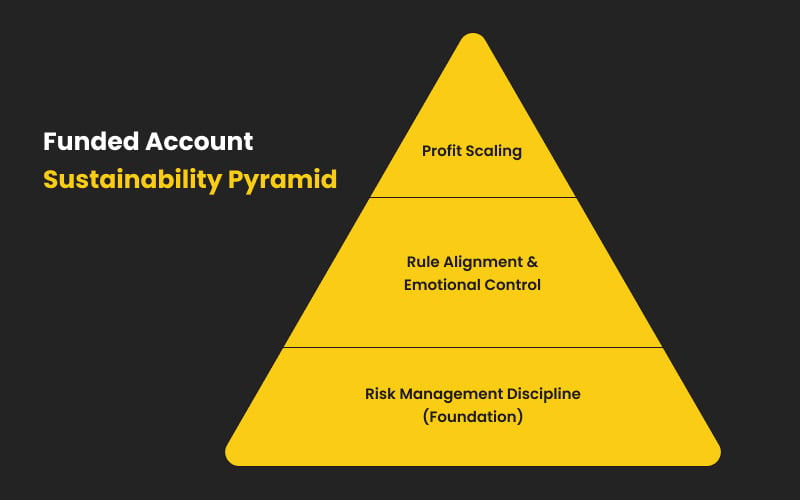
Choosing among the best futures prop firms requires more than comparing headline figures. Structural alignment, operational clarity, and behavioural impact matter far more over time.
The True Cost of Trading
A generous profit split does not automatically translate into strong net returns. Execution quality, commissions, spreads, and platform conditions all influence actual profitability.
When a firm’s revenue relies heavily on repeated trading payout cycles rather than sustainable trader progression, incentives can become misaligned. Trader-focused proprietary trading firms increasingly design models where long-term performance, not transaction volume, drives mutual success. That distinction becomes critical when evaluating the best futures prop firms.
Rules That Align With Trading Style
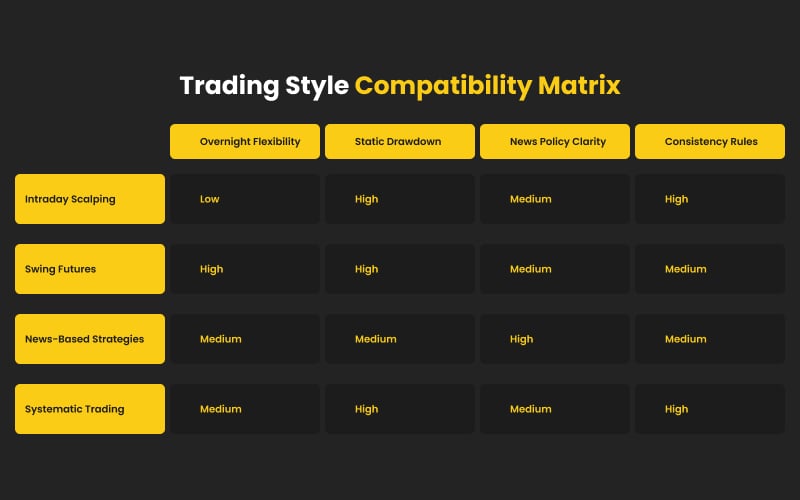
No two traders operate identically. Swing traders require the flexibility to hold positions overnight. News-driven strategies depend on clearly defined event policies applied consistently. Futures traders perform more naturally when drawdown limits reflect genuine contract volatility rather than artificial constraints.
Static drawdown structures often reduce psychological strain compared to complex trailing systems. Firms that accommodate multiple trading styles within a single framework reduce the need to distort proven strategies. Among the best futures prop firms, rule coherence often matters more than rule strictness.
Realistic Targets and Risk Parameters
Profit targets and drawdown limits must function as a balanced pair. Tight risk caps combined with ambitious targets frequently push traders towards unnecessary aggression.
Evaluation models that reward patience and selective execution tend to mirror sustainable live trading conditions more closely. The best futures prop firms design targets that encourage discipline rather than urgency.
Practical Support and Payout Access
Operational efficiency influences trader confidence. Reliable payout schedules, region-compatible payment methods, and responsive support teams reduce unnecessary friction.
As virtual trading transitions into funded conditions, administrative clarity allows traders to focus on execution rather than logistics. Within the best futures prop firms, smooth payout processes and transparent communication reinforce trust.
Track Record and Community Credibility
Longevity across different market cycles reveals structural durability. Short-lived firms rarely demonstrate how their models perform during volatility shifts or liquidity changes.
Transparent trader outcomes carry greater weight than marketing claims. Firms that invest in communication, education, and trader development signal longer term commitment. Among the best futures prop firms, credibility is built over time, not through promotional volume.
Questions You Might Have
1. Which prop firms suit futures traders best?
Futures-focused programmes tend to suit contract traders more naturally because their risk models are designed around margin requirements, tick values, and intraday volatility. This alignment reduces the need to artificially shrink position sizes just to remain compliant. When assessing the best futures prop firms, traders should prioritise structures that mirror real futures behaviour rather than forcing strategy adjustments to satisfy rule mechanics.
2. Is a higher payout split always better?
A higher payout percentage can look compelling, but it does not automatically translate into better net performance. Execution costs, commissions, slippage, and restrictive trading rules often have a larger cumulative impact. A firm offering slightly lower splits but cleaner execution conditions and fewer constraints may ultimately provide more stable long-term returns.
3. Do instant funding models outperform challenge-based ones?
Neither model is inherently superior. Instant funding reduces the psychological pressure of passing an evaluation, which can help traders operate more naturally. Challenge-based models, however, can reinforce discipline and structured risk control. Among the best futures prop firms, results tend to improve when the funding pathway complements a trader’s existing approach rather than forcing behavioural changes.
4. How important is drawdown structure?
Drawdown mechanics shape both behaviour and emotional resilience. Static models provide clear boundaries, making it easier to plan risk per trade. Trailing drawdowns can tighten progressively, increasing pressure even during profitable phases. Understanding how drawdown evolves is essential, as it directly influences position sizing, recovery strategy, and overall composure.
5. Does local relevance matter for Singapore traders?
Local relevance often improves day-to-day practicality. Timezone alignment supports consistent routines and better decision-making. Reliable payout access, region-compatible payment methods, and responsive support reduce administrative friction. These operational details may seem minor, but over time, they contribute meaningfully to focus, stability, and sustained performance.
Conclusion
Singapore provides a strong foundation for active traders, supported by reliable infrastructure and efficient access to global markets. Yet long-term success in prop trading is shaped less by location and more by structural fit.
The best futures prop firms distinguish themselves through clarity of rules, balanced risk parameters, and genuine support for trader progression. Within the broader landscape of futures proprietary trading firms, transparency and coherence increasingly separate sustainable models from those driven primarily by challenge turnover.
WeMasterTrade operates as a proprietary trading firm built around alignment between practical trading strategies and clearly defined evaluation frameworks. Its funding models aim to reduce unnecessary rule friction while maintaining structured proprietary trading risk rules that reinforce disciplined execution.
For traders considering their next step, the key question is alignment. When strategy and structure move in the same direction, funded trading can become a scalable progression rather than a cycle of resets.
Contact us to learn more about our funding models and how they operate in real trading conditions.

