












Inside bars are easy to recognise on a chart, yet many traders never gain a consistent edge from them. The advantage does not come from spotting the candle itself. It comes from understanding where it forms and what the market is preparing to do next.
An inside bar appears when one candle is completely contained within the previous candle, often called the mother bar. In practical terms, price pauses inside a smaller range after a move. This contraction often precedes expansion, which is why traders frequently study the pattern while learning forex trading.
Instead of chasing movement, the inside bar trading strategy prepares you for it.
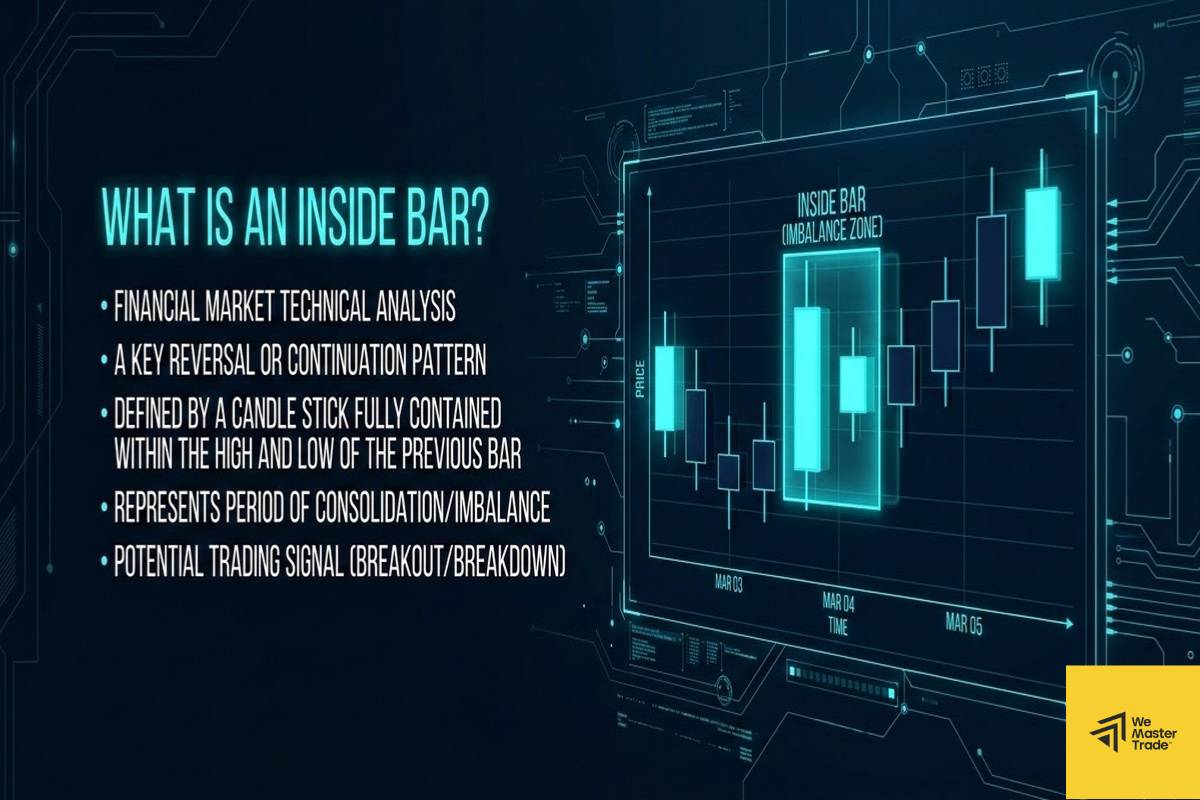
What Is an Inside Bar?
An inside bar follows a simple rule:
the candle’s high is lower than the mother bar’s high, and its low is higher than the mother bar’s low.
Price compresses into a tighter range and temporarily balances buyers and sellers.
Traders sometimes confuse the pattern with others. A doji reflects indecision but not necessarily compression, while an engulfing candle shows expansion, which is the opposite behaviour. The inside bar represents a pause in activity.
By itself, the candle is neutral. Context gives it meaning. It can appear in both uptrends and downtrends, but the surrounding structure determines whether it is useful.
Why the Inside Bar Works
The logic behind inside bar trading is behavioural rather than technical.
After a strong move, early participants take profits while new traders hesitate to enter at extended prices. Volatility drops and the market pauses. During this pause, orders accumulate and stop losses gather above and below the small range.
Eventually price attempts to leave that range. That moment becomes the inside bar candle breakout.
Breakouts succeed when price has room to travel and fail when price runs directly into opposing liquidity. Many traders struggle because they trade the candle pattern rather than the location. This behaviour is similar to how price revisits imbalances explained in the fair value gap trading strategy.
High-Probability Contexts
The pattern works best when it appears for a reason.
Best Locations
- after a strong momentum candle
- at clear support or resistance
- after a liquidity sweep or stop run
- near the beginning of active trading sessions
These sweeps often occur during phases of market positioning described in the accumulation manipulation distribution model.
These situations suggest the market is pausing before continuing, not stalling.
Situations to Avoid
- sideways markets with overlapping candles
- extremely quiet trading hours
- periods just before major economic news
If the chart looks messy, skip the setup. Many effective bar trading tricks are simply filters that keep you out of poor conditions.
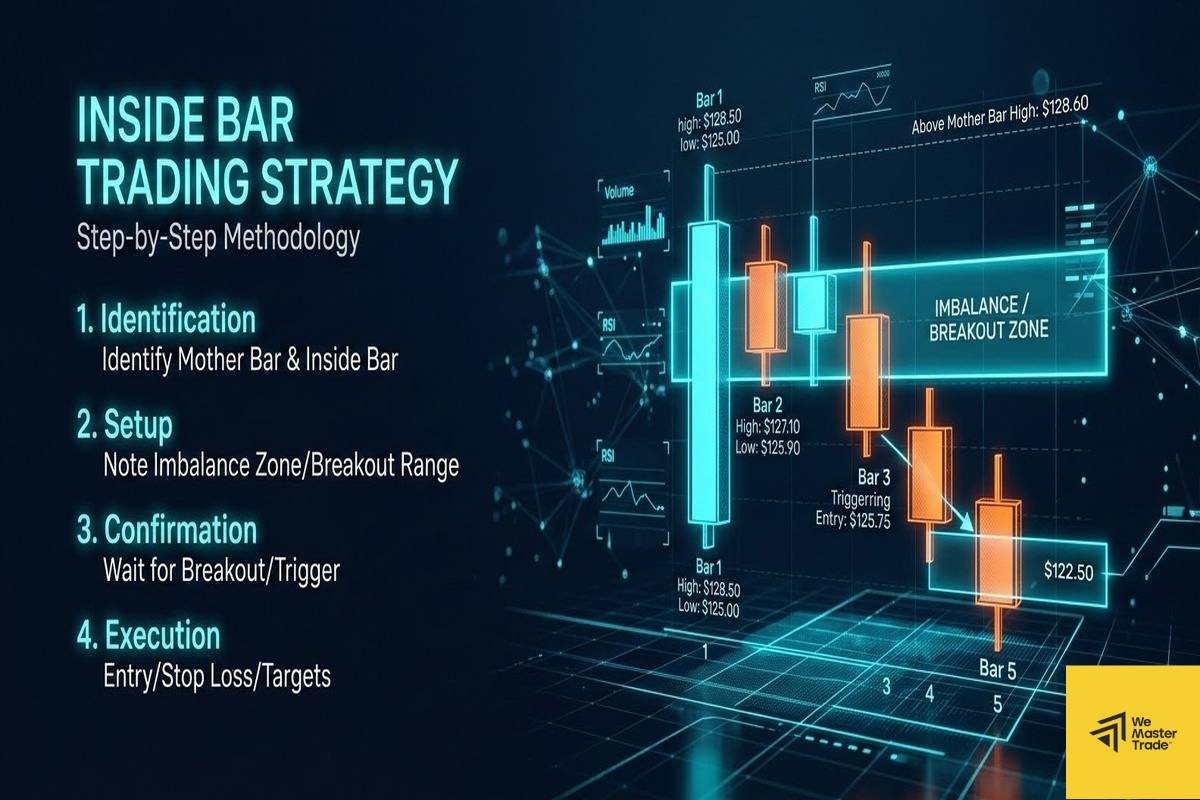
Step-by-Step Inside Bar Trading Strategy
Step 1: Determine Direction
Start with a higher timeframe and identify structure. In an uptrend you should see higher highs and higher lows. In a downtrend you should see lower highs and lower lows.
The inside bar should align with that bias.
Step 2: Mark the Mother Bar
Mark the high and low of the mother bar. This range becomes your decision zone and shows where the market paused.
Step 3: Choose an Entry Method
Breakout entry
Place a buy stop above the inside bar high or a sell stop below the inside bar low.
Retest entry
Allow the breakout to occur first, then enter on a pullback toward the inside bar level or the midpoint of the mother bar. This approach often produces calmer entries and smaller risk.
Step 4: Stop Loss Placement
A conservative stop sits beyond the opposite side of the mother bar.
An aggressive stop sits beyond the inside bar, but only when the setup has strong supporting factors.
The stop should represent the point where the trade idea is invalid.
Step 5: Targets
Use logical objectives instead of guessing:
- prior swing highs or lows
- equal highs or equal lows
- clear liquidity areas
Fixed ratios such as 2:1 or 3:1 can help, but structure-based targets usually align better with real market behaviour.
After the first objective is reached, trailing behind new higher lows or lower highs helps protect profits. Many traders first practise this discipline in trading challenges designed to build consistency before applying it independently.
False Breakout Filter Checklist
Many losses come from entering too quickly. Before trading a breakout, confirm at least two of the following:
- trend alignment
- proximity to a key level
- a candle body closing outside the range
- visible volatility expansion
Also include a timing rule. If price does not continue within a few candles, step aside. Real moves rarely hesitate.
Example Setups
Continuation
Price surges higher, stalls, and creates an inside bar. Breakout is in direction of prior movement and price continues to new highs.
Setup for Reversal
Price blasts through a resistance level then quickly falls back below it. Inside bar forms on rejection and the breakdown comes back toward previous lows.
Setup Quality Guide
| Grade | Characteristics |
| A | Strong trend, clear level, clean breakout |
| B | Trend present but weaker location |
| C | Sideways conditions or overlapping candles |
Trading fewer high-quality setups is often more effective than trading many mediocre ones.
Frequently Asked Questions
What timeframe works best?
Higher timeframes usually produce fewer false breakouts, while lower timeframes provide more opportunities but require stronger filtering.
Where should the stop loss go?
The safest placement is beyond the mother bar. A stop beyond the inside bar is tighter but easier to trigger.
How do I filter setups?
Focus on trend direction, location, and volatility rather than candle shape alone.
Breakout or retest entry?
Breakouts provide speed, while retests provide confirmation and control.
How many inside bars are too many?
Multiple inside bars often signal low volatility and reduced reliability.
Do they work in ranges?
They can, but trending environments generally produce cleaner results.
How do news events affect them?
Major announcements increase unpredictability and can invalidate breakouts.
Final Thoughts
The inside bar strategy looks simple, but it rewards patience. The candle itself is not the opportunity. The movement that follows is.
When applied correctly, the inside bar trading strategy helps traders prepare for expansion after contraction instead of chasing price after it moves. Like any method, it is a framework rather than a guarantee. Experienced traders who follow clear rules sometimes move toward instant funding programs based on trading performance once their execution becomes consistent.
This material is educational. Trading involves risk and outcomes vary between individuals.